Thursday, December 4, 2008

Conjunction (Alpine) Junction

01 December 2008 - Celestial Triangle

I grew up with Schoolhouse Rock as background music to my weekends, making me incapable of hearing the word "conjunction" without automatically adding "junction." So it was fitting that I witnessed the recent conjunction of the crescent moon, Venus, and Jupiter at a pull off in the town of Alpine Junction, NY.

Conjunction over Varney HillThe celestial triangle over Varney Hill in the fading light.
Click the image for a larger view.

To orient you, that's the moon on the left (though you probably figured that out), Venus is the brighter and lower of the two "starry" objects, Jupiter is fainter and higher in the sky.

Crescent moon, Venus, and Jupiter in conjunction
This is the write up from spaceweather.com (thanks, Aunt Janet!)

Space Weather News for Monday, Dec. 1, 2008
http://spaceweather.com

When the sun goes down tonight, step outside and look south. Beaming through the twilight is one of the prettiest things you'll ever see--a tight three-way conjunction of Venus, Jupiter and the crescent Moon. The event is visible from all parts of the world, even from light-polluted cities. People in New York and Hong Kong will see it just as clearly as astronomers watching from remote mountaintops. Only cloudy weather or a midnight sun (sorry Antarctica!) can spoil the show.

The great conjunction offers something extra to Europeans. For more than an hour on Monday evening, the crescent Moon will actually eclipse Venus. Astronomers call such an event a "lunar occultation." Venus emerging from the dark edge of the Moon is a remarkably beautiful sight. Sky watchers across Europe will be able to see this happen.


SkyWatchFriday Logo


-

Wednesday, December 3, 2008

White-winged Crossbill Irruption

A write-up of our Thanksgiving Trip is coming, but first I have to mention what happened upon our return. We arrived in the Southern Tier Friday night, under the cover of darkness, fairly well exhausted and fairly well under the weather. Colds, coughs, sniffles, the usual late fall maladies all around. Because of that, and our bodies were still operating under the Pacific Time Zone, Saturday wound up a fairly low key day.

In catching up on emails I discovered the majority of bird posts piling up in my inbox revolved around a specific winter finch: the White-winged Crossbill. This is a favorite . . . no, I'll go out on the limb and say it's the favorite winter finch of birders and naturalists everywhere. That's because of their odd-but-effective bill structure, adapted for prying open cones to extract the seeds, and their nomadic lifestyle which keeps birders guessing if they'll be absent, uncommon, or (rarely) common across the northern U.S. in most years.

WWCR Distribution - Nov 2007 - Feb 2008An eBird map of reported WW Crossbill sightings from last
winter (November 2007 through February 2008). Reports
were relatively few and spread across disparate locations.

When their preferred cone crops, hemlock, spruce, and larch, fail in one area they irrupt elsewhere, gracing the newly-found conifers along with birder's lists, delighting nature watchers, at least for a season. Then it's back to their seemingly erratic wandering (see the Kaufman's excellent post for more about their habits).

According to the local bird lists it seemed every conifer with cones (and it's a good year for many species, particularly several spruces) had crossbills. Sightings were rarely of one or a pair, almost always it was dozens or even hundreds, in one case thousands: Rochester birder Dave Tetlow recorded over 1,700 while conducting the sea watch count for two and a half ours at Hamlin Beach State Park, Monroe Co., NY. Obviously, it's shaping up to be an amazing year for WW Crossbills in the northeast and parts of the upper midwest.
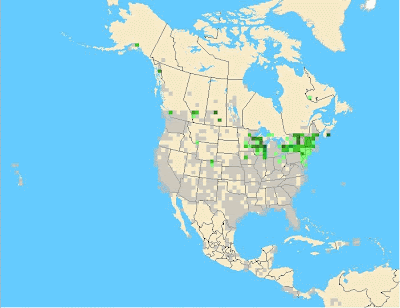
WWCR Distribution - Nov 2008WW Crossbill sightings reported to eBird in November,
2008. Lots of birds, and frequently encountered.

Saturday morning, while filling the feeders, I was reflecting on this, mentally mapping all of the possible conifers I encounter in our area and on my drive to Ithaca. I admit I'm a crossbill junkie, I could watch them for hours as they worry a cone, prying open and excavating the seed with their specialized bill. Had I paid attention I would have noticed the litter of cone debris covering the snow in our yard, something I've never noticed in our yard but I would notice later that afternoon. Turns out our spruces were the ones I should be eying!

White-winged CrossbillsClick on the images for larger versions and better viewing.
Note the crossed bill tips and the colors: males are red, females are
yellowish and streaky. Both sport white patches in the wings.

While FeederWatching a bit later I saw a small flock of finch-like birds land on a spruce. Crossbills! I relinquished the binoculars so Donna and Reina could watch, figuring the birds would stick for a while. No luck. Donna had excellent views, Reina had trouble with the bins but did finally get an eyeful, then the birds flew.

White-winged CrossbillsCrossbills continued to stream into the yard, swelling
the numbers from a dozen to nearly a hundred birds.

Later that afternoon they returned. I bolted outside, no jacket and only Crocs on my bare feet but with the necessary optics. I followed a group moving from tree to tree, picking through the cones with amazing grace and speed. They were joined by more crossbills, a few Pine Siskins mixed in, and still more crossbills arrived. All told I had about ten unadulterated minutes with them before they moved on. Quickly counting the flock as it headed west I estimated 90 - 100 birds. The siskins didn't feel the same urgency, they stuck around the yard awhile longer.

Pine SiskinsTwo of the half-dozen siskins that joined the crossbill flock.

There are still plenty of cones on our trees, and the conifers on my commute are heavy as well. I'm driving slower than usual now, hoping for another encounter.

White-winged CrossbillA male crossbill works a spruce cone.

Read the eBird article to learn more about this irruption along with strategies to find them. And if you do, be sure to contribute your sightings!

-

Tuesday, December 2, 2008

Have You Checked Your Hard Drive?

You may remember the famously spooky line, "Have you checked the children?" from "When A Stranger Calls," the 1979 thriller that scared the bejeebies out of millions of folks, especially me - and I only saw the preview (I was in 5th grade). A couple of days ago I had a similarly scary experience.

After returning from an amazing week in the Pacific Northwest I copied the four-plus gigabytes of photos we took to our external drive, then opened Picasa to look at them on the larger monitor. Not only were they not found, four months worth of photos were gone. If a CSI staffer was examining the drive they'd conclude the camera was broken, or the photographer had disappeared, on or about July 27th, 2008, the date of the last photo. Oddly, all photos prior to the 27th are fine, as was the entire iTunes library.

Gone were the photos of our saw-whet owl visitor, the Ring-necked Pheasants, the out-of-range/date Little Blue Heron, the lifer Curlew Sandpier, the rare-in-the-Basin Hudsonian Godwits, the ultra-rare Magnificant Frigatebird . . . but at least those (and others) are immortalized here on recent posts on The Feather and the Flower. Gone are hundreds of other pics: family outings, family at home, landscapes, macro shots of insects and plants, images for work, and who knows what I'm forgetting.

Obviously it could be a lot worse. I know too many folks that have lost their entire photo collection - years of images, gone - or all of their personal financial files. Too many that have lost data for their research projects, too many that have lost their Master's thesis or doctoral dissertations. I've never known anyone who lost The Great American Novel, but I'm sure that's happened, too.

Happily, I was able to recover all the photos. I'm in one of those, "Aww, lawdy, lawdy! I've been given a second chance!" modes, I'm sure I'll be one of those annoying types back from the brink. I'll be completely anal about backing up more often. Weekly, like I originally planned before I got lethargic about it. I'll be proselytizing the virtues to everyone I meet, at least for the next few weeks.

So, how about you? Have you checked your hard drive?

Regular posting to begin again tomorrow.

-

Sunday, November 30, 2008

Where I Was

Mt. Rainier
Mt. Rainier, as seen from the Seattle - Bremerton ferry.

Jan M got it, based on the birds (and weather!) she figured we were in the Pacific Northwest of the United States. We were in Gig Harbor for the bulk of the trip; more coming soon!
Posted by Picasa

-

Wednesday, November 26, 2008

Where I'm At

I'm not at home in the Southern Tier of New York, but maybe you can guess where I'm spending Turkey Day tomorrow. This doesn't factor into the location, but I'm unable to upload photos so it'll be a text only challenge.

The birding trips have been fairly local, just neighborhood birding with the occasional local park. On my walks I commonly see Red-breasted Nuthatches, Golden-crowned and Ruby-crowned Kinglets (in good numbers!), Black-capped and Chestnut-backed Chickadees, Brown Creepers, American Robins and Varied Thrushes. When I say "commonly seen" I really mean "frequently hear" since getting binoculars on them in the trees and in the weather has been tough.

When I find a patch of open water to scope I frequently spot Horned, Red-necked, and Western Grebes, Common and Pacific Loons (I have my eye out for Yellow-billed), and gulls. Weird gulls, not quite Western, not quite Glaucous-winged. I sometimes find a Pigion Guillimot and/or Marbled Murrelet, and Bald Eagles aren't as forthcoming as I suspected.

Any guesses? Leave them in the comments, and let me know how you arrived at your conclusion!

-

Thursday, November 20, 2008

Little Blue Persists

20 November - Snow, Clouds, Sun, and a Little Blue

Today was actually a pretty good day, even if it was a work day. I don't mean to imply that I was slightly depressed. No, I actually like the winter weather, it keeps the bird feeder visitors interesting. The "Little Blue" is a Little Blue Heron, Egretta caerulea, a surprise visitor that has been hanging around Sapsucker Woods Sanctuary since November 7th (I wrote about this bird and its unexpected status in an earlier post). Since its arrival the weather has turned decidedly more wintry.

Little Blue Heron in the snow, center stage in the
little open water left on Sapsucker Woods Pond.

Many of us have been checking to see if the Little Blue is around each day, wondering when the weather will finally drive it to warmer temperatures farther south.

The sky cleared later in the day. Though not
seen directly, the sun made its presence known,
casting a cool light across Sapsucker Woods.


The Little Blue spent the late afternoon
perched on a snowy log
after a successful day
hunting in the shrinking patch of open water.


As I was photographing the bird from inside the Cornell Lab of Ornithology the clouds allowed a burst of sun light before sundown. With views like this, is it any wonder we spend so much time watching out of the staff lounge, birds or no birds?

Read more about Little Blue Herons at the All About Birds website.


SkyWatchFriday Logo


-

Wednesday, November 19, 2008

Antarctica, Penguins, and a Blog

Do you love exotic locations? Penguins? Reading nature-oriented blogs?

If so there's a new (at least to me) blog that is worth adding to your reader, "Antarctica: Life Among the Penguins."

It's written by Noah Stryker who is spending this season at Camp Crozier, Antarctica with a few research scientists and thousands of Adelie Penguins. Noah, an associate editor of Birding (from the American Birding Association) and columnist from WildBird Magazine, is an excellent writer and photographer. Couple that with his curiosity, attention to detail, and passion for birds and you've got a recipe for an outstanding vicarious experience.

Enjoy!

-
Locations of visitors to this page