A write-up of our Thanksgiving Trip is coming, but first I have to mention what happened upon our return. We arrived in the Southern Tier Friday night, under the cover of darkness, fairly well exhausted and fairly well under the weather. Colds, coughs, sniffles, the usual late fall maladies all around. Because of that, and our bodies were still operating under the Pacific Time Zone, Saturday wound up a fairly low key day.
In catching up on emails I discovered the majority of bird posts piling up in my inbox revolved around a specific winter finch: the
White-winged Crossbill. This is a favorite . . . no, I'll go out on the limb and say it's
the favorite winter finch of birders and naturalists everywhere. That's because of their odd-but-effective bill structure, adapted for prying open cones to extract the seeds, and their nomadic lifestyle which keeps birders guessing if they'll be absent, uncommon, or (rarely) common across the northern U.S. in most years.
 An eBird map of reported WW Crossbill sightings from last
winter (November 2007 through February 2008). Reports
were relatively few and spread across disparate locations.
When their preferred cone crops, hemlock, spruce, and larch, fail in one area they irrupt elsewhere, gracing the newly-found conifers along with birder's lists, delighting nature watchers, at least for a season. Then it's back to their seemingly erratic wandering (see
the Kaufman's excellent post for more about their habits).
According to the local bird lists it seemed every conifer with cones (and it's a good year for many species, particularly several spruces) had crossbills. Sightings were rarely of one or a pair, almost always it was dozens or even hundreds, in one case thousands: Rochester birder Dave Tetlow recorded over 1,700 while conducting the sea watch count for two and a half ours at Hamlin Beach State Park, Monroe Co., NY. Obviously, it's shaping up to be an amazing year for WW Crossbills in the northeast and parts of the upper midwest.
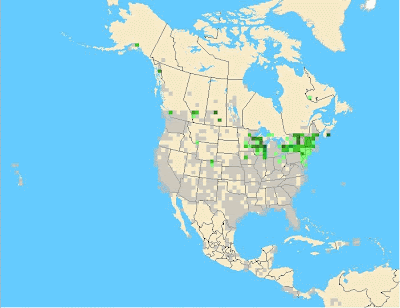 WW Crossbill sightings reported to eBird in November,
2008. Lots of birds, and frequently encountered.
Saturday morning, while filling the feeders, I was reflecting on this, mentally mapping all of the possible conifers I encounter in our area and on my drive to Ithaca. I admit I'm a crossbill junkie, I could watch them for hours as they worry a cone, prying open and excavating the seed with their specialized bill. Had I paid attention I would have noticed the litter of cone debris covering the snow in our yard, something I've never noticed in our yard but I would notice later that afternoon. Turns out our spruces were the ones I should be eying!
 Click on the images for larger versions and better viewing.
Note the crossed bill tips and the colors: males are red, females are
yellowish and streaky. Both sport white patches in the wings.
While
FeederWatching a bit later I saw a small flock of finch-like birds land on a spruce. Crossbills! I relinquished the binoculars so Donna and Reina could watch, figuring the birds would stick for a while. No luck. Donna had excellent views, Reina had trouble with the bins but did finally get an eyeful, then the birds flew.
 Crossbills continued to stream into the yard, swelling
the numbers from a dozen to nearly a hundred birds.
Later that afternoon they returned. I bolted outside, no jacket and only Crocs on my bare feet but with the necessary optics. I followed a group moving from tree to tree, picking through the cones with amazing grace and speed. They were joined by more crossbills, a few
Pine Siskins mixed in, and still more crossbills arrived. All told I had about ten unadulterated minutes with them before they moved on. Quickly counting the flock as it headed west I estimated 90 - 100 birds. The siskins didn't feel the same urgency, they stuck around the yard awhile longer.
 Two of the half-dozen siskins that joined the crossbill flock.
There are still plenty of cones on our trees, and the conifers on my commute are heavy as well. I'm driving slower than usual now, hoping for another encounter.
 A male crossbill works a spruce cone.
Read
the eBird article to learn more about this irruption along with strategies to find them. And if you do, be sure to contribute your sightings!
-
 The celestial triangle over Varney Hill in the fading light.