Showing posts with label Bird_Chase. Show all posts

Sunday, May 9, 2010

Biggest Week in American Birding [Alternatives]

It's almost here, the biggest week in American birding! Migrant songbirds have been flooding into the region, birders will be descending into the state to find them, and I will be spending a week searching out the most reliable places to locate dozens of different species. It's going to be awesome!

Yes, this afternoon I'll be heading east on I-86 to . . . what's that? Ohio is west of New York? Right, I'm not that geographically challenged.

Anyway, I'll be heading east . . . what? No, I don't mean west, that'd take me out on to Pennsyltucky. I'm heading to northern New Jersey.

Oh, I know there's a festival where everyone-who-is-anyone will be migrant watching, but I'll be at the original biggest week, that granddaddy of competitive birding: that week-long run up to the World Series of Birding in New Jersey.

I won't be blogging, possibly I'll throw a tweet out now and again, or maybe a facebook update. I will be out at all hours noting any newly-arrived songbirds, pinpointing territories of breeders, staking out any lingering winter birds, searching for raptor nests, listening for what may be lurking in various wetlands, chasing a vagrant or two . . . a little bit of everything.

I've done this before, but this year already feels like a whole new ball game. The "Big Day" is late (mid-May!) and spring came early this year (not astronomically, but ornithologically). Usually we're scrambling to find the newly-arrived warblers, hoping the Canada Warbler is back on its territory before Saturday, hoping the Tennessee, Bay-breasted, and Blackpoll Warblers (the harbingers of "the end of spring migration") will have reached this far north. This year, they're already there! Leaves are out, Blue-headed Vireos have already quieted down, replaced by their ubiquitous Red-eyed brethren.

It's not all fun-and-games, sleep-deprivation, and supplementing our year lists. You can read how we use the competition to fund conservation work (and meet the team, hear additional stories, and more) at the Lab's web site.

Finally, you can follow my tweets (no promises, I may need those precious seconds for quick cat-like naps), as well as those from the Sapsuckers through the week and especially on the Big Day, which runs on Saturday, 15 May this year.

Wish us luck!

-

Wednesday, June 3, 2009

The WSB Scouting Chronicles, Day One

Someone recently lamented birding competitions like the World Series of Birding can be so impersonal: you hear about "the team," then you hear a final number, and if you search, a species list. What you don't hear are the details of the human experience, how those species were added, and how others were missed. Those stories are arguably the most interesting part of a Big Day. Though I can't offer all the details on what happened on the Big Day I can highlight some tales from the scouting trail.

06 May 2009, Milford, PA
I pulled into Milford right at 6:00 PM. After fitting a full work week into two-and-a-half days I could now shift my focus to helping the Sapsuckers scout the northern New Jersey counties for the Big Day competition, which kicked off in a mere 54 hours.

First problem: where was everyone?

The others arrived in Jersey between the Sunday and Tuesday before the Big Day. Priorities change minute by minute so the plan was for me to call the other northern scouts when I left Ithaca to find out the latest. As I headed south on I-81 former Sapsucker captain Ken Rosenberg (Director of Conservation Science), debuting in an advisory role, relayed the birds he was listening to in the Delaware Water Gap as we talked.

"When you arrive - Cerulean - at the motel, why don't you - Worm-eating - give a call - Blackburnian - and we'll figure - another Cerulean - out where to send you." Giddiness kicked in, I pressed the accelerator a bit harder. For someone who birds sporadically and briefly, immersing myself into solid birding for two days of spring migration was going to be heaven.

When I arrived at the Milford Motel the clerk had no idea who I was, and more importantly had no reservation for me. I started to wonder if I should be in Milford, NJ instead of Milford, PA, though the NJ one is a bit far south for where I'd be scouting. Eventually it all worked out, I was in the right place, now I just needed for someone to get back into cell phone range. Rather than wait in a lonely motel room I crossed the Delaware River into New Jersey to re-visit my old stomping grounds. I'd scouted Sussex county extensively between 2000 - 2004, and I was anxious to see what changed.

Not much, it turned out. Really, everything looked familiar. The soundscape was subdued, the evening chorus quiet compared to what the morning would bring. This evening held a Hermit Thrush's song here, a Blue-headed Vireo's there, but mostly quiet. I finally got word to meet the crew at the Sussex Queen Diner at 8:00 PM for the daily debriefing and to receive scouting assignments. Almost an afterthought, we could grab a bite, too.

Because of the way roads are laid out in this area it's a slow, winding meandering to get anywhere in Sussex county. I stopped at a small marsh in High Point State Park to listen for anything interesting. I verified a Yellow Warbler singing its secondary song, one that mimics a Chestnut-sided Warbler, while cars blew past the turn off. When one turned in I guessed it would be another WSB-affiliated birder. Birders from all teams are crawling all over the northern counties, concentrating on a target areas. Much like a fall out of songbirds in a patch of good habitat, you can get congregations of birders at these hotspots.

I was right. The car stopped, and there was Ken. Not just any WSB-affiliated birder, but the one I was looking for. We caught up for a few moments, then headed off independently for a couple last minute checks before meeting at the diner. Ken sent me to a small wetland to find out if any marsh birds were calling, he followed up on a report of needed birds at a different marsh. His site was a bust, I couldn't find my site at all. Using the New York DeLorme to get around northern NJ might not be a good idea.

Thirty minutes later I walked into the diner. Current Sapsuckers Marshall Iliff (eBird Project Leader) and Tim Lenz (eBird programmer) were poring over their NJ atlases, Ken highlighting historic territories of some much-needed species. Lewis Grove (fellow scout, flight-call researcher), was relaying his experiences from the day to Sapsucker Andrew Farnsworth (project leader on flight-call research and terrestrial acoustic monitoring). All looked somewhat frazzled, and it was only Wednesday.

Cloud-covered moon over New JerseyClouds rolled in covering a near, but not quite, full moon.
Unfortunately, they brought rain. A lot of rain.


Over dinner the Sapsuckers explained the strategy they were planning for this year and where some key birds were staked out. Around 9:30 I headed out for my evening assignment: visit three sites known to have Northern Saw-whet Owls, listening for any spontaneous calling. Saw-whets are certainly present in NJ in May, but whether they'll call during the time allotted for a stop is always questionable.

Given I just had to stand quietly and listen it was a relatively easy evening. The hard part was standing in a steady downpour, at times torrential, listening from the narrow shoulder of the road. Traffic was minimal, but each time a car approached my mind wandered to every horror story and urban legend I ever heard. I recalled a disproportionate number of them that take place on rainy nights on isolated roads.

The rain let up a bit at my second stop, where I parked and hiked in to the site. It was startlingly black, no town lights, street lights, headlights; no moon or stars. Half a mile later I didn't hear any owls, probably because no owls called, possibly due to a loss of hearing when I crossed a wetland full of Spring Peepers. The third stop was equally unproductive for owls, but helped me reorient myself to some sites I'd be visiting again in daylight hours for different birds.

When I returned to Milford (PA) it was nearly midnight. I reviewed my plan for the next morning, which would start by listening for Ruffed Grouse at 5:30, a perfectly reasonable time of the morning. Previous years started much earlier. The extra sleep would be welcome.

-

Tuesday, May 12, 2009

I Came, I Saw, I Scouted: Wrapping up the World Series

The World Series of Birding (WSB) is more than a birding competition. Well, at its basest level it is merely a contest to see which team can observe the most bird species in a single day within the state of New Jersey.

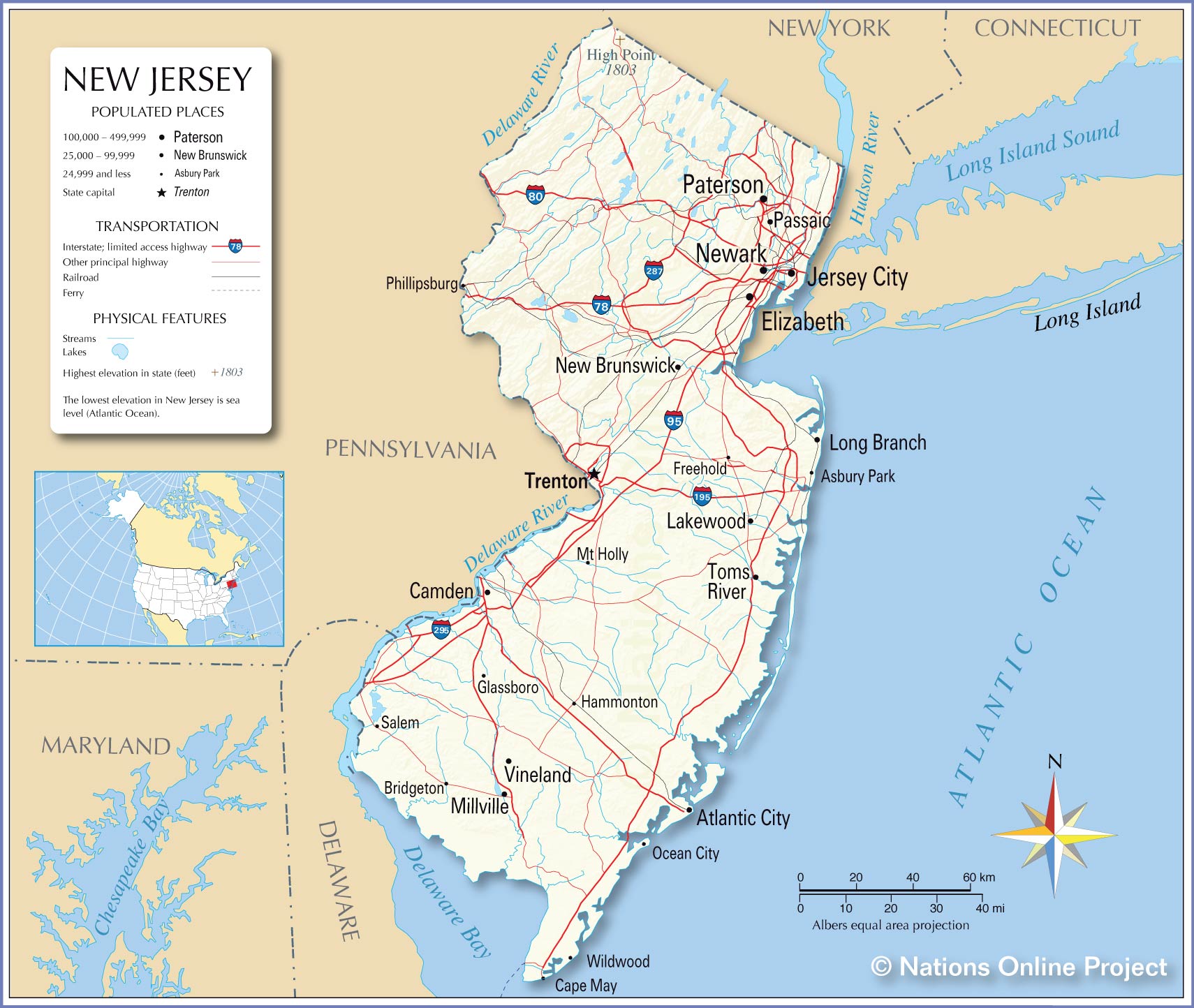
New Jersey, map courtesy of Nations Online ProjectIt's a small state, but I wouldn't want to paint it. Birding it is fine.
Map courtesy of Nations Online Project.

Dig deeper and it's a pretty daunting undertaking requiring stamina, knowledge, and more than a little strategery. Developing a strategy that allows you to find 220-plus species is mind bending, a task that employs all the little grey cells you possess. Managing your time diligently requires discipline envied by the most pious of Buddhist monks (if Buddhist monks were given to envy). The extended sleep deprivation and malnutrition would make David Blaine weep. And the skills to identify all of those birds, some by sounds less than a half-second long or by a profile on the edge of visibility, takes the eidetic memory of a Good Will Hunting. And in spite of, or because of, those factors, it really is fun.

I guess -- I didn't actually compete. When you work at the Cornell Lab of Ornithology, a place with dozens of world-class birders, you can bet only the best of the best are invited to join the Sapsuckers. But I can tell you this: it's flattering to be asked to give up a few days of computer work to travel to the wilds of Jersey to help the team scout.

Dawn in High Point State ParkI'm not being facetious when I say "the wilds." Northwestern New Jersey
contradicts the strip-mall-covered and urbanized stereotypes from movies.


Scouting is an essential part of the competition. It turns out you can't just show up and expect to make a 200 species-plus run through the state. I mean, you can have that expectation, but it's a bit naive. You'd be fooling yourself. There is a lot of preparation involved in tracking every bird in the state and determining how to visit them all, or at least one of each species. It means studying New Jersey, committing to memory the variety of habitats throughout the state, then coupling that knowledge with a thorough understanding of which birds use those habitats. Then, couple that with the phenology of bird movements -- when are those birds are actually in Jersey? When do the snowbirds head north, when do the neotrops return? Oh, and remember, you only have a single 24-hour period, so you need to know the best time of day to find them.

Black-throated Blue Warbler, maleMany Black-throated Blue Warblers pass through the state, but some breed.
You have to know where if you want to be sure to add them to your list.

That's why you scout. The mission, which I chose to accept: descend on New Jersey and stake out as many birds as you can.

So, what do you stake out? Ideally, everything. Some birds you simply shouldn't worry about. American Robin, drive by any lawn and there you go! American Crow? C'mon. They're everywhere. Northern Cardinal? Please, missing these guys is impossible, right?

Blue-headed Vireo nestFinding a Blue-headed Vireo nest may be the difference between
adding this species for the day or missing it altogether.


But there's a lesson many teams have learned over the years: take nothing for granted. What if it's pouring rain and no bird is calling? How do you efficiently find birds that were singing loudly a day or two before, but are hunkered down and silent? You don't have time to traipse through the woods looking for them, hoping to cross paths. You need to know precisely where to look. And even if it is amiable weather, you need to know what time to be at each location. Birds aren't signing all day; when does each species start? When do they quiet down? What locations are active early, which ones come alive late? It pays to know when the birds are most active, singing and calling without restraint.

Canada WarblerCanada Warblers often return to New Jersey shortly before the Big Day.
Visiting their territories lets you know exactly when they return.


I had some specific tasks, I had some general assignments. The weather was a mixed bag. I listened for saw-whet owls in the pouring rain, I watched migrant warblers in a sunny park. I spent hours by myself, not coming in contact with another person. I fought traffic on the Jersey Turnpike and sought much-needed birds in the middle of Newark. I had some successes and some complete failures. All of that information, merged with reports from other scouts, was fed to the Sapsuckers who incorporated it into their Big Day strategy.

More on the day-to-day activities of a scout to come, but how did it all work out for the Sapsuckers? The "tweet" came in on Sunday morning at 12:07 AM (you know I was still up, anxiously awaiting the results): their final tally was 221 species. I'd have to wait until late Sunday morning to hear how that stacked up against the other teams. Pretty well, it turned out, but not well enough to win.

More to come . . . .

-

Monday, March 16, 2009

An Ivory Coast: Watching the Ivory Gull

When I last posted our hero was patrolling Plymouth Harbor on a balmy day in January. Although I was also scouring the harbor that day, the hero is the Ivory Gull. And in one of those rare chase-moments it was the first bird my binoculars rested on, almost immediately after getting out of the car.

As I worked out a couple of muscle cramps and cracked my back a few times, all the while on the phone with Marshall Iliff, I watched a small group of gulls flying south towards a breakwater about 300 meters from where I stood. A single bird trailed a few meters behind, as if trying to keep up. The wing beats were a bit quicker, the flight more buoyant, almost tern-like. It was smaller than the others, paler than the others. This bird almost glowed, no gray or black to absorb the sunlight. A brief check with the bins and I told Marshall I had the bird.

They landed on the railing of what appeared to be a bridge on the breakwater, not fifty feet from a coalescence of binoculars, tripods, scopes, and cameras. I thought of the listserve posts where the bird the bird flew near the observers, flew over the observers, even landing behind the observers to perch on a snowbank a few yards from their feet. It's reported that Ivory Gulls can be quite tame and often approached by people. If that's true, that our presence wasn't stressing the bird, I was excited for an up-close-and-personal time with this rare visitor.

Gull Row, Herring and Ring-billed GullsWhat's missing from this row of gulls? The target bird.

I walked out towards the breakwater, crossed the parking lot where I should have parked, and set up my scope. I trained it on the breakwater bridge and scanned for the distinctly unmarked bird. Slowly panned along the row of gulls, right to left, waiting for the one to jump out. Didn't see it. Re-scan, slower, left to right. Still nothing.

I went back and forth across the gulls twice more with the scope, then scanned with binoculars. It wasn't there, not hidden behind a Herring Gull, not oddly-lit so it mimicked a local resident gull with a gray back and dark wing tips. It simply wasn't there. I cheated, sneaking a peek at the other birders. Surely they'd all be gazing uniformly in one direction, the gull sitting at the intersection of their various optics.

First-cycle Herring GullFirst-cycle Herring Gull. There are other birds to
watch on a chase, after all.


This is a good moment to point out bird chases are not only about the bird. A secondary purpose is to socialize, meeting local birders and those from the region, even some from across the country, catching up with those you haven't seen in ages. Birders from New York, Pennsylvania, Maine, New Jersey, Virginia, Maryland, and elsewhere were meeting and greeting. I heard everything from, "Nice to be able to put a face with your name" to "It's been a while, since the Wood Sandpiper in Delaware, right?"

What I didn't hear were directions on where the bird happened to be at that particular moment. I started to wonder if the ten-second flight was going to be the extent of my Ivory Gull sighting, one of those "better than nothing, but c'mon" sightings.

Plymouth Harbor, street viewLooking out over Plymouth Harbor.
Somewhere out there is the Ivory Gull.


I asked a woman who seemed to be in charge of the event -- she was the loudest, orchestrating who should put what scope where - if she'd seen the gull fly.

"It's up on the railing, have a look, it's simply glorious!" She turned to look, noticed it was missing. "Agnes, where's the bird? Have you seen it, Mildred? Where's it off to?" It was reminiscent of Monty Python sketches like this one; wrong accent, right pitch. I turned my attention to the handful of gulls lazily circling the harbor. Ring-billeds, Great Black-backs, Herring, none of the white-winged gulls, none Ivory.

How about on the water? I'd read Ivory Gulls tend not to swim as much as other gulls, but they certainly can. I scanned the water surface, flat as glass on this sunny morning. More non-target gulls, along with Common Eider, Red-breasted Merganser, Bufflehead, American Coot, and Common Loon. I paused on each small piece of floating ice, they mimicked a white bird swimming on the water. None were the gull. One of those pieces, however, had the gull sitting on it. About 100 meters from where I stood the bird was loafing on what must have vaguely seemed like home.
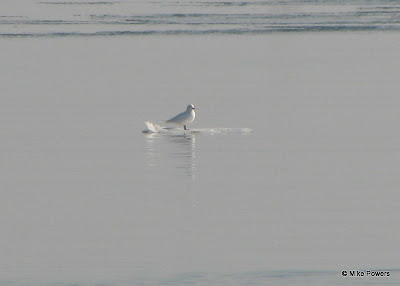
Ivory Gull floating on iceThe Ivory Gull, blending in: white on white.

I called out that I refound it, several birders re-aligned their scopes and went back to more Monty Python. "Ooooh, look at it now! So cultured, beautiful plumage. Have you tried the clam chowder at the East Bay Grille? Brilliant!"

For some, this is where it could become boring. The bird perched on the ice for the next hour and forty-five minutes, barely moving. No flying in to tear at a chicken carcass, no interacting with other gulls, no raucous vocalizing. No aerial acrobatics, none of the buoyant flying I noted when I arrived.

Yawning Ivory GullUh-oh, is that a yawn? The action might really slow down now!

But there are plenty of other aspects to focus on. I was soon joined by a birder from Maryland. He and his girlfriend left home the night before, arrived in Gloucester before daylight, and spent several hours not finding that bird (after daylight), then bailed and headed to Plymouth. Slightly out of breath, "Please tell me this one is around!"

"Right here in the scope." On par with watching a new species, taking in all of its uniqueness, is helping another "chaser" get on the bird. He took it in, satisfied he at least saw it, then went to get his scope, camera, and bins. Oh, and to wake his girlfriend.

I had plenty of time to take in the plumage, which was immaculate. Completely unblemished, snow white.
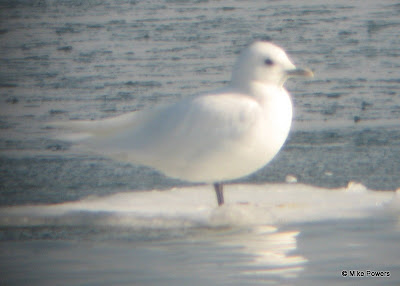
Ivory Gull perching on iceAn impromptu digiscope, which came out much better than I expected.
The legs are black, the bill dark (actually greenish) with yellow tip.

Pure, one word that comes to mind, as the driven snow. Immature birds are flecked with dark markings across the face and wings and show a dark tip to the tail feathers. All I saw was dark legs, dark, yellow-tipped bill, a dark eye, and white. The Gloucester bird showed a few dark smudges on the flanks, indicating it was a separate bird. When the two birds were reported at the same time in two different locations, that definitively showed there were two adult birds on the Massachusetts coast at the same time, something I'm not sure has ever happened. In fact, the last adult in Massachusetts was in the 1800's (the 1976 bird was an immature, three birds in the 1940's were also immatures). Adults are not completely unknown, an adult was found on the Hudson River as recent as two years ago, but they appear to be less common than vagrant immature birds.

What were two adults doing so far away from their normal wintering range? And what are the odds they'd wind up 45 miles away from each other? I have no idea, and I'm not sure anyone else does. We simply don't know a whole lot about them. The Birds of North America Online states, "knowledge of the life history of Ivory Gulls has been slow to accrue and there have been no truly long-term studies of its demography." Is it possible they come south more than we think but go unrecorded? After all, birders can't be everywhere. But it seems if this was a regular event the odds of an experienced observer encountering one (or more) would favor more documentation.

Ivory Gull resting on iceSettling in for a nap, giving the two dozen observers lots of
time to contemplate all aspects of this amazing species.


It does seem something is going on this year. In the east, most vagrant records come from the northeastern states, some from the mid-Atlantic, possibly a record from North Carolina. But in numbers? Nick, the Shorebirder, had already posted about an incursion of Ivory Gulls in Newfoundland and Labrador. More recently Jochen at Belltower Birding highlighted some interesting European sightings of Arctic gulls. An Ivory Gull in southern France? A Ross's Gull in central Spain? Jochen translates this to North American terms,

The magnitude of this incident is comparable to an Ivory Gull being found on the coasts of Georgia while an Alabama inland lake hosts a Ross's at the same time.

What's going on in the Arctic to prompt these movements? Something must be underlying these vagrant wanderings, how best to unravel this mystery?

My mind wandered back to more mundane questions. Your mind has to wander in these cases: you'd have to play the two hours I had with the gull in fast motion to make it physically interesting. The rough breakdown of Ivory Gull activity was nearly 90 minutes of near-motionless resting on the chunk of ice, another 15 minutes lethargically stretching and uninspired preening, ten minutes floating next to the ice chunk. Physically the bird was relatively passive, but that didn't slow the myriad of questions running through my head.

It then lifted off the water, circled twice to gain a little altitude, then headed farther south into the harbor. It ultimately settled near a growing colony of gulls on the water, far enough away that it became impossible to tell which gull was which. After watching what essentially amounted to specks in the distance for another few minutes, hoping for a return flight, I understood it was time to break away for my lunch meeting. The bird had left me, and it was time to leave Plymouth.

More Ivory Gull information available at:
All About Birds
BNA Online (subscription needed)

One (of many) news pieces about this gull:
Mature Arctic Ivory Gull Seen in Massachusetts (Patriot Ledger)

-

Wednesday, March 11, 2009

An Ivory Coast

File under "Better late than never." I found this in my drafts, finally time to publish it.
-Mike

The big January news among birders in the Northeastern U.S. was ivory, especially on the coast. Snow everywhere, white caps offshore, and not one, but two Ivory Gulls hanging out on coastal Massachusetts.

That is, to put it mildly, huge. The Birds of North America Online's species account asserts that "only rarely does it occur as a winter vagrant south of the Bering Sea and Maritime Provinces."

Ivory Gull distribution, courtesy BNA OnlineExpected distribution of Ivory Gull. Note that New England is
almost off the southern end of the map - clearly, not an
expected observation. Image courtesy of BNAOnline.

"Rare" and "vagrant." Two words that evoke a range of emotions in a birder. Awe washes over you at the prospect of seeing a bird a limited number of people have seen. Excitement at the prospect of seeing something you may never get a chance to see again in your lifetime. Depression when you realize you will likely not get a chance to even try for it.

Why depression? Consider this: the last Ivory Gull to grace the shores of Massachusetts was in 1976. Most observations are one-day wonders, most Ivory Gulls that undertake such southerly dispersions are immature birds, and most sightings are of single birds. And here were two adult birds, within an 90 minutes of each other (by car, they were within 45 miles of each other as the gull flies). An unheard of scenario in the lower 48.

So that was the progression of emotion that washed over me when I heard about the sighting, on a Monday. A few Cornell birders made the trip the days before, the weekend of the 17-18th January. I was looking at a long five days until the weekend, the next opportunity I'd have to even plan for a chase. And for a bird that is typically a one-day wonder, well, five days is five days too late - do the math, you'll see. Even if it stuck around, unfortunately for me, a weekend trip was not possible. I'd have to wait until an Ivory Gull graced the shores of one of New York's Finger Lakes, preferably nearby Cayuga or Seneca Lake.

eBird map of North America, 1990 - 2009Map generated from eBird data, 1990 - 2009. Note the vast majority
of reported sightings concentrate on the northern coast of Canada.

Enter providence: I discovered I had a "flexible Friday," meaning no pressing meetings or deadlines. I could take a personal day, making up work during the weekend. Done deal.

The Gloucester bird was iffy, reinforcing my decision on chasing the Plymouth bird. Plymouth looked to be a slightly shorter trip and (more importantly) that bird appeared to be more reliable, in no small part due to the chicken carcasses birders were leaving for it. Seriously.

Whatever the reason, positive reports came in from Plymouth late on Thursday. 4:30 Friday morning I was heading east, double fisting coffee and a bagel, finally coasting into Plymouth, MA by 10:30.

eBird map of Massachusetts, Winter 2009eBird reports showing the locations of the two Ivory Gulls in
Massachusetts, winter 2009. The Plymouth bird (southern cluster of
yellow pins) stuck around longer than the northern Gloucester bird.

Then the worry started. I knew exactly where to go, partially due to the Massachusetts birding listserve and partially to eBird's Google maps of bird sightings. But I didn't know where to park, as usual I had no change for parking meters . . . . Turns out my irrational fears continue to be unfounded. Many parking lots, some permit only but I found a spot for visitors.

I called Marshall Iliff, the one-third of the current eBird team who conveniently lives in Boston, as I started unloading the scope and camera from the back seat. As we made lunch plans I scanned the harbor, my bins settling on a white bird following a small group of gulls. I stopped in mid sentence, realizing this white bird was all white, like one of those white pigeons that stand out in ubiquitous flocks of Rock Pigeons in any urban or rural areas. In fact, I saw one of these albino/leucistic birds on my drive through Plymouth, not realizing how close it would resemble the bird I crossed state lines to see.

I don't know which expletive I chose, but I do remember announcing, "I just saw it." Another wash of emotion: it's still around, I saw where it landed, now I can saunter over and enjoy leisurely but chillingly delicious looks at this rare vagrant.

More follows . . .

-

Friday, January 30, 2009

There's Owls in Them Thar Fields!

Snowy Owls are fairly widespread this season, including nearly two dozen different locations in NY. There's even one in Tennessee, south of it's "usual" winter range. From the BNA Online,

Snowies are a nomadic species and often unpredictable migrant, its movements are thought to relate to the variable abundance of its main prey species, lemmings. As a winter migrant, it is more regular and abundant in the northern Great Plains than it is to the east, west and south of there.
Snowy Owl Distribution - All About Birds
General range map of the Snowy Owl. Map courtesy All About Birds.
Orange - breeding range, Blue - winter range.

Earlier in the winter there was a pair reliably reported on the south shore of Lake Ontario, a trip I was planning to take with Reina to see her first Snowies (and visit the grandparents while we were in the area, but we had our priorities). More recently there was a single bird frequently sitting right off the shoulder of State Route 20A, ninety minutes from our place. That bird turned out to be the "lifer" Reina, Donna, and friends stumbled across while driving to Toronto a couple of weeks ago.

A current eBird map for this winter shows they are fairly widespread with fairly frequent reports coming in from across New York; listserve posts indicate the same. One post (which has been followed by a dozen more) caught my attention: a Snowy Owl was reported in a field between Seneca and Cayuga Lakes, less than an hour from us.

eBird reports of Snowy Owl, December 2008 - January 2009eBird reports of Snowy Owls across New England.
Red - sightings from December, 2008; yellow - sightings from January 2009.


Considering I drive between those two lakes every day to and from work, that reported owl is practically on my commute. I'm stretching it a bit, I had to head north quite a ways to be in the right area, but leaving a early one morning ensured I didn't lose too much of the work day. Listserve directions indicated an intersection of two roads which I found fairly easily, but not immediately -- ever notice that rural roads may have multiple names, not always coinciding with names listed on maps or driving directions?

Upon arrival I employed my usual search strategy, looking for anyone that looks like they're watching birds. If that fails I try and remember descriptions or landmarks that folks wrote in their posts.

The roads were covered in blown snow but clear of traffic. The fields, large and expansive, were covered in drifts and dotted by large rolls of hay. No wonder this bird was here, it certainly felt like the windswept hummocks in the Arctic barrens it calls home in the breeding season. Many previous visitors had reported Short-eared Owls perched alongside of the hay, my eyes were peeled for them as well.

I drove slowly along the road, heading west. Each conspicuous lump of snow was merely a conspicuous lump of snow, shadowy and unmoving. Red-tailed Hawks, perched in far-away woodlots, monitored the open areas as a Pileated Woodpecker bobbed across a large expanse of the treeless fields. An American Kestrel gripped a wire, eyes focused on a drainage ditch along the road. A few Wild Turkeys perched along side and on top of the hay bales.

Recrossing my prime meridian for the morning I continued east from the intersection, cursing how well camouflaged this predominantly white, large owl could be. Later I would appreciate it, but at the moment it was frustrating. I stopped to look at another lump of snow, suspiciously rounded when compared to the other, sharper-edged drifts. This looked too smooth to be like the rest of the landscape, maybe like Telly Savalas standing among ice-covered stalagmites. (Not sure who Telly Savalas is? Substitute one of the following: Moby, John Malkovich, Michael Stipe, Patrick Stewart, Winston Churchill, or Sinéad O'Connor). Sure enough, not 100 meters east of the intersection, not 50 meters south from the road, was the owl perching on a drift, face turned towards the sun.

Snowy OwlSometimes you just have to take in how good the sun feels.
Does this position remind anyone else of this image from Birdy
(1984 movie with Matthew Modine and Nicolas Cage)?

I slowly coasted on to the shoulder and turned off the engine. Then back on so I could put the window down, then off again. I stayed in the car for two reasons. There was no reason to get out, I had a stellar view from the driver's seat, but mostly I was a bit wary of disturbing the bird as it was so close to the road. Wildlife rehabilitators often report many Snowy Owls brought to them during irruption years are starving, I figure the bird should keep focused on finding food and preserving its energy.

Snowy OwlEyes closed, catching a quick nap? Or was the snow-blindness too much?

I spent about twenty minutes with the owl. I sat in my car blind, my eyes almost always on the bird, either through binoculars or a camera lens. The only audible traffic was the clomping footsteps from a horse-drawn carriage. The bird barely peeked at me, primarily facing the eastern sun, as though ensuring an even tan. I'm not sure I ever saw the owl's eyes. The couple of times he looked over the eyes were slits, a Clint Eastwood impression from the owl world. I'm not sure how the owl felt about me, but he sure made my day.

Snowy Owl"Do you feel lucky, punk? Well, do ya?"
Why, yes. Yes, I do. (And did you just call me "punk"?)


BNA Online excerpts about the Snowy Owl:
  • The Snowy Owl is largely diurnal and hunts in all weather during winter and the continuous light of arctic summer. Although these birds often hunt by day, John J. Audubon included them in the only nocturnal scene that he painted.
  • Snowy owls were formerly placed in genus Nyctea based on plumage, osteological (skull) characters, and DNA. Based on new genetic evidence they are now considered closely related to the Bubo owls, such as the Eurasian Eagle Owl of Europe and Asia and the Great Horned Owl of the Americas.
  • Pairs may actually form on the wintering grounds in the northern Great Plains before departing for breeding areas farther north. In one study, the start of courtship was noted as early as midwinter in southern Alberta, but whether pairs actually bond there and arrive together on the breeding ground is debatable.
  • Snowy Owls do not swim as a rule, although they can swim at least short distances. One large but flightless young was observed to leap into the water of a lake, and by using both wings made it across the deep waters to the opposite shore “some 50 feet away,” where it escaped pursuit.
Read more about Snowy Owls:

-

Tuesday, October 14, 2008

A Perfect Chase

Listing, or tracking the first time you see a new bird, is a series of plateaus connected by rapid bursts of adding "lifers." At first everything is new, you're adding new birds to your life list daily, and sometimes by the score. Then the flow of new birds slows to a trickle until migration ushers in those that pass through, those that winter, or those that breed in your area and you've got another burst of new birds to add.

Then it trickles again, with periodic spikes as you visit new habitats. Then your trips range farther from home, into new bioregions, but these spikes are fewer and spaced farther apart. (This is when you start playing other listing games: year lists, county lists, yard lists, bathroom window lists . . . ).

And then there's the chase. It's not a rapid burst of dozens of birds, but a single, very-specific addition. A rare bird shows up within a reasonable distance, bringing the chance to add a new bird to your life list. And your year list, and your state list, but that's all gravy - it's the lifer you want.

Shorebirds Rock! There are three species here,
can you pick out the Curlew Sandpiper?

And, I freely admit, I got bit recently. Badly. I have been jonesing for a new bird, though I can't complain. It was just 10 months ago, in January, I added Slaty-backed Gull to my list. But it was also 10 months ago I dipped on a Ross's Gull (along with hundreds of other "chasers").

Two weeks ago a chase-worthy bird settled down within my chase-appropriate radius: a Curlew Sandpiper at Fort Erie, Ontario, near Niagara Falls. I figured I had no chance. Gone are my days of dropping everything and bolting (witness my frigatebird non-encounter). Well, maybe not gone, hopefully just on hiatus. Regardless, this bird would likely move on before I could make the trip.

Juvenile Curlew Sandpiper, probably male based on the bill:
it's not as long and slender as a female would show.

For two weeks I read about this bird as it stuck around, reliably found at the same location, and for two weeks I didn't have a window to make the trip. Until this morning. I happened to be relatively nearby, closer than the Finger Lakes, anyway, so I tacked on a side trip.

It really was the perfect chase. Weather, border guards, gas prices, satellite radio; everything cooperated, including the bird. It wasn't sitting on the side of the road waiting, there wasn't a line of scopes already boring into the bird, which is good. I like the search and the satisfaction that comes with finding and identifying it unaided.

When I arrived I was the only birder in the area. Because the bird wasn't in plain view I set out to find it (armed with reports from other successful sightings, which isn't really cheating). Pretty soon another couple arrived, but they were on a severe time limitation. They were headed back to their car as I continued down the beach. When I passed the point I found a trio of non-Killdeer shorebirds. A quick check: Dunlin-like birds, that's good.

The sandpiper has been associating with two Dunlin, the two front
birds. They show a more "messy" breast with some coloring extending
onto the belly. The Curlew Sandpiper is much cleaner underneath.

A more thorough check: two were definitely Dunlin, the other . . . was not. That's very good. Overall structure not quite Dunlin-ish, bill more slender, clean upper breast, crisp face pattern with distinct and bright eyebrow; that's excellent.

This one (or "that one"?) stood a bit taller, not as slouched
as the Dunlin. Maybe it is more presidential?

I called for the couple, who came running back. I studied, they shot pictures, looked through the scope, and had to leave. That left me all alone with the birds, plenty of time to really take in the sandpiper, comparing it to the Dunlin. And time enough to gingerly sidle closer to try a few photos of my own.


Incredibly cooperative bird, slowly moving back and forth
as it foraged among the rocks. It only flew three times
but was easily relocated after each movement.

Another couple came, I was able to get them on the bird, too. That's also part of the perfect chase: sharing what you find.

Enlarge this image and you can (kind of) see the "anchor pattern"
on some of the scapular and wing coverts. Dunlin don't show this.

The birds were a bit skittish, but they always returned to the rocky beach. We were able to watch the birds in flight, spying the clean, white rump separating it from the Dunlin, and then watch them again as they foraged, preened, or just stayed still.

The first part of the search was under clouds and steady winds.
After finding the bird the weather cleared. And angels sang.

The last time they flew I watched through binoculars where they settled but didn't follow. That's the last part of the perfect chase: they leave you. I hate walking away from a bird.

-

Friday, March 7, 2008

Flashback Friday: The Time for a Loon

As far as I know, my flashbacks are not products of Post Traumatic Stress Syndrome or past abuse of drugs. Because they're not Hunter S. Thompson-weird, I pretty much enjoy them, especially when I can figure out what clash of current events triggered it. This week our weather was instrumental. The last few days have been slushy, sleety, icy . . . pick any precipitation type, mash it with temperatures hovering around freezing, and we've got it. It is no wonder that reading Greg's post at Conservation Conversations about a recent trip to the Branson, MO area threw me back to my own winter experience there. I am surprised and mildly disturbed at my near-complete lack of note taking about the trip, so I'm really going straight from memory and a few recent Internet searches.

Dateline: 15 February, 1995, Table Rock Lake, Missouri
I will always remember that my phone number in Fayetteville ended in -8563, an easy-to-remember pattern on the key pad. Start at the middle-bottom, up a row, jog to the right, then up a row. Unfortunately, it just so happened that in our area you could dial 555 (or something) - "T-I-M-E" to check the time, our phone number spelled "T-J-M-E," and a lot of people are really bad dialers. Or spellers, I'm not sure which.

Lemons, lemonade. We got a lot of phone calls at all hours, but we (mostly) cheerfully gave people the time and had entertaining conversations with complete strangers. Most everyone was friendly after they got over the surprise that we weren't recordings.

File that information for a moment, on to the weather. Please correct me if I'm misremembering, but February always seemed to be the transitional weather month in the southern Ozarks. We had warm evenings where we'd sit in an old field and listen to American Woodcocks display, we had cold snaps with ice. Sometimes snow, but mostly ice. Like the fabled box of chocolates, you never knew what you were going to get.

In spite of the covering of ice, a Dark-eyed Junco still enjoys a
brush pile. This photo comes from our recent ice storm, which
was reminiscent of ice storms that hit us in Arkansas.


One particular morning in mid-February we didn't have class, a layer of ice covered our town, and a couple friends and I were debating if (well, more like where) we should go birding. What should our focus be, waterfowl? Sparrows? Raptors? Then came the phone call, a woman who was glad to find out the correct time, but who also provided a piece to our puzzle. When she mentioned she was calling from Eureka Springs Rob interrupted to ask about the road conditions, which she reported were fine. Something was clearly going on in Rob's mind.

After hanging up Rob dangled the idea about chasing the Yellow-billed Loon that was being seen on Table Rock Lake, a destination that required passing through (or at least near) Eureka Springs. If the weather was better a couple hours away, Rob proposed, we should go there. Perfectly logical, we agreed, and a Yellow-billed Loon? A species that shouldn't be anywhere near Arkansas? Shouldn't we go for that regardless of weather?

Another image of our recent ice storm, which
took down an already-dying White Birch.


Known as a White-billed Diver to our British friends, these high-arctic breeders should be nowhere close to southwestern Missouri. From what was "known," they should barely be reaching coastal Washington. What was this bird doing halfway across the country? It hadn't read the field guides.

And here's the kicker. This wasn't a recent sighting, the bird had been around for weeks. In fact, it had likely been around for years, returning each winter. Chris Lundberg discovered a Yellow-billed Loon on Valentine's Day 1990, which stayed until May. Chris refound it that December, possibly (probably?) the same bird returning to its wintering ground. Chris found the same species, possibly (probably?) the same individual, again in December 1991. I'm not sure if anyone was looking, it seems to be unreported or unobserved in 1992 and 1993. But in December 1994 Chris found the bird again, and it was still reported in mid-February of 1995.

Actually, starting in the 1980's, more and more Yellow-billeds have been photographed in locations well inland from their expected winter range, such as Idaho, Colorado, Texas, Arizona, New Mexico, Illinois, Minnesota, Arkansas . . . . This leads to a fundamental question: is the species actually expanding its wintering range, or are we simply getting better at identifying loons in basic (wintering) plumage? From the BNA Online account,

Many of these (inland) records were from manmade reservoirs that represent new potential habitat for this species. The recent discovery of these birds, however, probably stems from new information on field identification of basic-plumaged loons that has only recently become widely available.

This is where my note taking failed me. I have no notes written for this trip, just a single bird entry into my now-ancient version of Thayer's Birding Software. I remember the drive to Table Rock Lake being slow and dismally slushy, lots of downed branches and wires as we left Fayetteville. The weather didn't get better, but the conditions got less icy as we crossed the border into Missouri. Rob's detailed directions to the boat ramp in Table Rock Lake State Park guided us to the most reliable spot to watch for the bird.

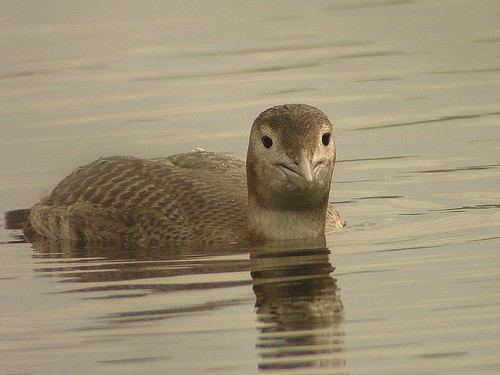
Yellow-billed Loon (juvenile). Note how the lower mandible is not
straight from head-to-tip, but abruptly bends towards the upper
mandible. This gonydeal angle is not found on Common Loons.
Photo from the California coast, 2006, by Len Blumin.


We were prepared to stand here and watch for however long it took for the loon to appear, even though we were ill-prepared to stand in the wet, cold drizzle, the kind of damp that penetrates your bones. The reports suggested this bird favored the cove between the boat ramp and a stretch of land jutting out into the lake south of the marina. Given enough time, we were told, it will return. Just be patient.

There wasn't anything on the lake that I remember, other than water droplets. I certainly didn't list any other birds (not a coot? Not a Bufflehead? Not even a Mallard?). But I also remember the drizzle barely had time to coat the scope's lenses when a bird popped up almost in front of us. Unbelievably, we were only a few dozen feet from the Yellow-billed Loon, a species that the annotated checklist kept by the Missouri Bird Records Committee lists as Winter Resident, Accidental (1-4 records, a vagrant).

Like many species, the winter plumage (definitive basic for the ornithologically accurate) isn't as flashy as the breeding plumage (definitive alternate), but what a distinctive bird. The bill was massive, oddly-shaped (compared to a Common Loon), unmistakable. I have vague memories of Rob, a much more experienced and more detail-oriented birder than I was, talking us through diagnostic features. I don't remember any of them, though, just that the bill was huge! As someone described this species, it's like it has a banana stuck on its face.

A beautiful head-on view, look how wide the bill is! Also note a
diagnostic feature: the culmen (top of the upper mandible) is
yellow, not black like a Common Loon. Photo by Len Blumin.

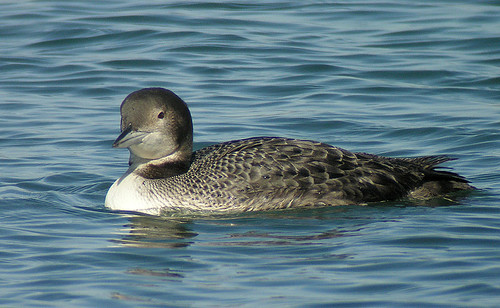
A winter-plumaged Common Loon for comparison, note the dark
culmen and the not-so-bent lower mandible. Photo by Len Blumin.


We had plenty of time to take in the bird, study it, watch it dive for extended periods only to appear hundreds of yards away. It was one of those birds that didn't leave you, eventually we had to make the decision to leave. We were soaked, we were cold, but we were fulfilled. On the way back we did two things I distinctly remember. First, a stop at the fish hatchery under the dam where we watched gulls. I don't know what gulls, but Rob annotated the various plumages as we watched, leaving me to feel as though I was starting to get a handle on gull identification. Second, a long stop at an Atlanta Bread Co., or was it St. Louis Bread Co.? Or San Francisco? Do those even exist anymore? Regardless, it was among the best, hottest soup-in-a-bread-bowl a cold, wet birder could find.

Friday, February 29, 2008

Flashback Friday: Where Are the Birds?

A central tenet of birding is you never know what you're going to find, whether you have a target in mind or not. If you have a target you might successfully find it, such as this Great Gray Owl experience. If you miss your target you might still hit upon something completely unexpected, such as my experience missing an Eurasian Wigeon. And if you aren't searching for something specific, if you're just out birding for the sake of birding, something unexpected may appear with each raising of the binocular. That scenario was driven home one afternoon on a birding trip to southern California in a way I wasn't prepared for.

Dateline: 28 March 1996, Torrey Pines State Reserve, California
As luck would have it, spring break 1996 at the University of Arkansas roughly coincided with the Cooper Ornithological Society's meeting in San Diego, California. Donna and I checked our calendars and realized we could spend a week camping through the desert southwest, ending up visiting friends in Tucson, Arizona. From there, Donna would head back to Fayetteville and I'd parade onward to SoCal for a bit more birding and then attend the 66th annual COS meeting. Of course, the binoculars would rarely leave my neck for the entire trip.

As it turned out, a (non-birding) friend from school was in San Diego attending a molecular biology conference. Through him I met a birder from Scotland who had never been to the States. A match made in birder heaven: Ian desperately wanted to go birding but had no car; I had a car, a copy of "Birdfinding in Southern California," and was psyched for some birding company.

A colony of Black Skimmers was almost the best
sighting of the day. Photograph taken by Googie Man.


We went out birding the next morning, making a long day looking for California Gnatcatchers,
Light-footed Clapper Rails, Wandering Tattlers, Black Skimmers, Wrentits, and whatever other North American west coast specialties Ian was interested in. After a morning of scoping, pishing, and otherwise raising the Border Patrol's curiosity between San Diego and the Mexican border we headed north of La Jolla, targeting Torrey Pines State Reserve as our next stop. This location came highly recommended, though exactly why escapes me now. Probably less for the birds and more to experience the rare Torrey Pine trees and the unique chaparral habitat, described as a remnant of wilderness amidst constant development.

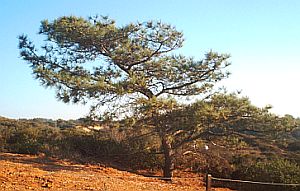
A Torrey Pine in its native habitat, rare to see in
the wild. Photograph taken by Rsduhamel.

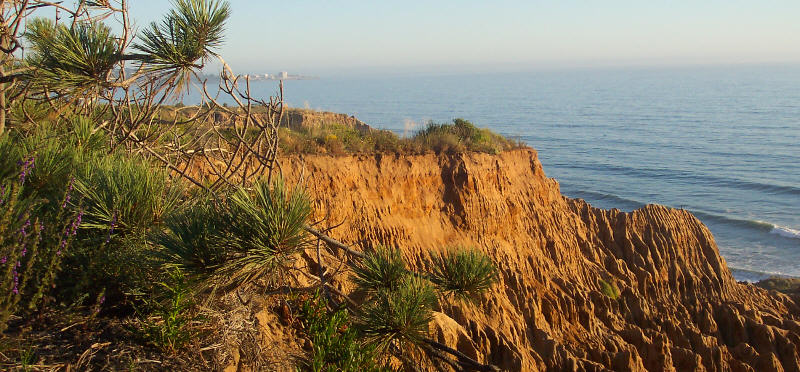
Unfortunately, our directions were a bit sketchy. We eventually found a sign for the reserve but were too cheap to pay for parking, so we wound our way north looking for a suitable, and free, parking area. We did eventually find an area filled with folks flying kites and model airplanes, or just hanging out in the afternoon sunshine. Most importantly, it had a place to park and places to easily watch the Pacific from the cliff we were perched on. We unloaded our scopes and field guides and found a spot to scope out the ocean and the beach below, our minds filled with images of shorebirds, gulls, terns, and perhaps a pelagic species or two.

A Wandering Tattler, one of the shorebirds I
was hoping for. Photograph taken by Tom Tarrant

I don't remember if we identified or even saw anything, but at one point I heard Ian's lilted, "Hullo, what's this?" which I learned was his way of saying he's got something interesting. I glanced over to see where he was looking, beach or ocean, but it turned out neither. Instead, he's got his binoculars pointed a couple of hundred yards away from where we stood on the cliff, but not focused on a bird, but on a guy in a baseball hat and beige birding vest looking through a scope: a birder in the know! We decided we should stand near him rather than on our own, much like a migrant passerine joining a resident chickadee flock.

The view from Torrey Pines State Reserve. It looks like a great spot to
take in the ocean and, hopefully, a few ocean birds. Taken by Xiao Li.


On our way over we noticed a couple other birders, all peering through scopes . . . jack pot! This must be a hot spot, tide must be low, must be some good shorebirds since they're all peering down on the beach rather than out at the ocean. Turns out there were more than a dozen folks with scopes, all focused on a stretch of sand below.

Ian and I set up our scopes, casually looking over to see if we could catch someone's eye to engage in some typical birder dialouge. What are you finding? What "good" birds might we keep an eye out for? Where else we should go this afternoon, is there a good spot for . . .

"HUL-LO, what's THIS!" I jumped to my scope, watching Ian to figure out where he's looking. My hands are somewhat fumbling, it's gotta be an amazing find, judging by the excitement and surprise in his voice. When I finally get my scope focused and start searching the sandy beach I find no birds, only breasts. And other private parts that will make the blog censors blush.

Yep, the "birders" we hastened to join were actually peeping toms spying on the nude beach below. Had we watched more carefully before joining them we would have noticed a few taking some rather amazing liberties in such a public place, treating their bodies "like an amusement park" is how a famous Seinfeld episode described it.

Now a quandary. Do we stay and pretend not to see the nude bodies but keep on birding? Or pack up and run, dissociating ourselves from this crowd? We don't know this place, was it possible there would be a raid any moment? Would we be spending the next few days in a California jail?

We ended up packing up and leaving, but at a casual pace and talking a bit too loudly about Calidris sandpipers, shearwaters and storm-petrels. I'm sure the peepers were looking at us like we were nuts. I would be remiss if I didn't point out that at least this was California, the nude sunbathers (and swimmers, beachcombers, joggers, and volleyballers) were in excellent shape and attractive in that girl-in-a-Beach-Boys-song way.

That is my birds-and-nudity story, the only one I have (to date). I'm sure many, many birders have something similar, I (and others, I bet) would love to hear them, if you're willing to share. One recounting can be heard by Bill Thompson's presentation at this years Space Coast Birding Festival (podcast available, look for Episode #6, "The Perils & Pitfalls of Birding").

Incidentally, in searching out some potentially useful links and some eye-candy for this Flashback I found results from monthly bird surveys at Torrey Pines. I bet they get a lot of volunteers.

Friday, February 22, 2008

Flashback Friday: Wintery Gray Is Beautiful

Birding, especially when "chasing" a specific bird, is very much hit-or-miss. You might find exactly what you are looking for, or you might come up empty. I accept that in birding, it's part of the challenge. I have a hard time accepting that, however, when looking for files on our computer. They should be there, it shouldn't be a crap shoot whether they appear or not. I only mention this because I spent much of this week drafting a Flashback, and now I can't find the images from that trip anywhere on our hard drive. So, I'm putting off the post I prepared and will go with another trip, a search that did not come up empty.

Dateline: 12 February 2005, Enterprise, ON, Canada
My wife is not a birder. She is a botanist by training, an ecologist at heart, and loves the outdoors as much as the next naturalist. Don't get me wrong, she likes birds, and our arguments over what are more important, plants or birds, are mostly minor. She's more than happy to go on a bird walk, but we hear that term differently: I hear "bird walk," she simply hears, "walk."

But that all changes when it comes to a chase. Donna is nothing if not tenacious, and thrives if there is a specific goal, an identified target. In these situations she's all in favor of an outing. Dilly-dally along a trail to sort through warblers and vireos? Not her style. Identify a target bird a hundred miles away? Let's go!

Which is what we decided to do in late winter 2005. Things aligned well for us: Great Gray Owls were being reported in huge numbers in southern Ontario, including near Kingston, a mere three hours from Ithaca. We had some time off so we could make it a long weekend rather than a long day cooped up in the car. And Reina, just shy of 11 months old, traveled well. Bonus: she couldn't yet walk off while we were stalking our target, and she napped a lot in her car seat.

So, Friday evening we drove to Kingston. A nice dinner out, some time in the motel's pool, a little bit of studying the map Brian Sullivan highlighted for us, and an early morning on Saturday. Brian's directions were extremely simple: drive north out of Kingston on 38 for about fifteen miles, turn west on 7 towards Enterprise, and keep your eyes open. A Cornell group had gone up the week before and counted dozens of Great Grays using this strategy.

Very simply, it worked. When we turned off of 38 towards Enterprise the first bird we spotted was:

Perched a few yards off of the road, a Great Gray
Owl scans the open field for rodent activity.


What luck! We had slowly driven for about a minute through some heavily wooded areas. Suddenly the woods faded back and we were among pastures. Almost immediately Donna spotted a large bird perched on a fence, "What's that?" At first glance it was clearly a raptor, it actually looked like a Northern Harrier. It wasn't. The fence was just a few yards off the road, I eased the car on the shoulder (although we didn't see another car all day) and took in my lifer Great Gray. Donna took some pictures out of her window.

Preparing for take off: we were a bit too close for comfort.
The mottled brown, gray, and white make a beautiful pattern.


That first bird stuck around long enough for some photos and some stellar looks through binoculars. Even Reina, strapped in her car seat, not only noticed but appeared to be taken with this bird. Eventually the owl gracefully flew to a line of trees at the back of the pasture on a couple of slow wingbeats, landing less than 100 yards away. We continued on, driving various back roads that criss-crossed the area, but we did not find any more owls. Granted, we didn't get out and walk the roads, nor did we pause and scan the far ends of the pastures, so we probably missed seeing some that were seeing us. We did look for other birds, of course, and wound up with 10 species for the day. We scoped two different Northern Shrikes which flew off as soon as the camera was pointed at them.

One hour and 20 miles later we were heading back the way we came. The owl was perched in the same spot, and because we hadn't found any others we spent some time admiring her again. Happily, I was able to digiscope at will (during periods where my hands were warm enough to work).

The eyes seem a tad small for a bird this size, and combined
with the white lores (feathers between the eyes and the bill) she
appears to be frowning. The white "bow-tie" is just classy.


First she just a stared us down to see what we were going to do. I'm assuming this is a female, larger in size than the male. Of course, not having seen another owl all day and having no other direct experience I can't say that for sure. Referring to a bird like this with a disengaged "it" doesn't do the experience justice.

Taking some time to preen. The underparts are boldly
streaked over fine barring - exquisite!

Apparently unfazed by our presence, perhaps too hungry to care, she went back into what she was doing. She preened most of the time, periodically swiveling her massive-looking head right and left, as though she heard something coming. She probably did, just nothing that our comparatively weak vision or hearing could detect. And although she certainly looks massive, this species actual body mass is actually 15% less than that of a Great Horned Owl (according to the Birds of North America Online). That means a large female weighs in at a mere three and a half pounds! Much of their size is due to plumage, allowing these birds to withstand the cold winters of the far north.

"Turn to the right!" I've always wanted to say that. Even in profile you
can see how the fine barring in the facial disc forms concentric circles.


Irruptions like the one Ontario was experiencing are usually due to lack of food on the normal wintering grounds, it's suspected the birds that irrupt like this are starving. Although there wasn't too much snow on the ground during our trip, Great Grays are able to hear prey under snow, plunging through to grab the unsuspecting rodent. According to the BNA Online, they can break through snow crust thick enough to support a 175-pound person.

After a few minutes of communing with her it was time to go, partially to give her peace and solitude so she could continue to hunt, partially because it was wicked cold, partially because the other residents of the car were getting restless. We stopped at a small park and pulled out the sled, the "green" version of a snow machine, I suppose, for some winter fun.

Where to, majesty? Oh, donuts on the street again? OK . . . .

The drive home was pleasant, fueled with hot chocolate and the peaceful satisfaction of a successful weekend trip. Even those who don't keep lists marked the event, Reina received a Great Gray Owl plush-animal that resides in her bedroom to this day, a totem of the actual individual and the brief bonding experience that I hope resides deep in her memory. Sometimes you catch what you chase.
Locations of visitors to this page