What was my "Spark Bird"? Was there a particular bird, a particular moment in time, that caused the shift from casual watcher to bird-lister, to bird-chaser? If so, could I identify it? Off the top of my head, no. I have no memory that stands out as the moment where I decided, "Whoa, that's awesome! I have to see more, I need to see more!"
I've been sifting through my memories to assign blame for this addiction, and when and where it happened. If a defining moment exists it's because of a long building period, much like that ACME fuse the Coyote always attached to the TNT-labeled pile of dynamite. My parents, intentionally or not, set the fuse and lit it, I stood dumbly by and watched until I found myself standing awfully close when it finally ignited.
 Birds at a feeder are certainly one gateway to
"birder" status. Was a chickadee my spark bird?
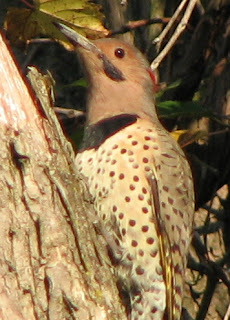
Growing up we always had bird feeders in the backyard, and therefore the usual eastern backyard birds were always around. I don't remember anyone tracking the species other than periodically announcing, "woodpecker," "nuthatch," "finch," or other vague descriptors. Was it a Hairy or Downy, maybe Red-bellied Woodpecker? Red- or White-breasted Nuthatch? House, Purple, or one of the other winter finches?
 Birds at a feeder are one thing, but in your hand?
That's gotta spew sparks, doesn't it?
Mandatory weekend walks at local parks were often boring, except on Bird Song Trail where the Black-capped Chickadees would come to your hand for sunflower seeds. On two occasions, something out of the ordinary. Once from a Downy Woodpecker, once from a White-breasted Nuthatch, and on these instances they were identified to species.
 The ubiquitous, easy to see, and accommodating
"egret." Watching their antics could hook
someone into watching other species.
Annual summer trips to Chincoteague National Wildlife Refuge, VA were not about roasting on the beach and trying to look cool, though I made a valiant effort through my teenage years. Every day, on the drive back from the beach, my parents insisted on driving the three-mile wildlife loop to see the birds and other wildlife. Other than "heron," "egret," and "Black Skimmer" we didn't identify much. I didn't grow up listening to anyone debate whether the bird in question was a Long- or Short-billed Dowitcher. It was probably left at "sandpiper" as "shorebird" wasn't in our vocabulary yet. We just watched for the aesthetics.
 Great Blue Herons, always known by their
proper name, were always inspiring.
My first distinct memory of a spark came after college when I lived in Boulder, CO. One afternoon I watched a pair of Blue Jays make their way across our lawn. All afternoon. Very slowly, patiently, but also raucously and defensively, and when necessary, offensively - a cat stalked them for a while before giving up. It turned out they were escorting two fuzzy birds, not yet able to fly, to my makeshift pie-plate-nailed-to-a-fence platform feeder, where they set up camp for several days.
When I mentioned this to the owner of the local bird store he got wild eyed and asked if it was all right if people came to see the birds. I shrugged it off, a bit surprised. They were just Blue Jays. Apparently they were still somewhat uncommon in the Front Range of the Rockies.
"Duh" moment crystallized: back east, these birds were nuisance birds at feeders; where they're not expected, they're a target species!
 So many "good" birds in my past, from the eastern shore
to upland woodlands to the foothills of the Rockies, but
Blue Jays certainly sparked an interest in
distribution. This one looks guilty!
I started paying more attention, biking down to Pearl Street on Saturday mornings for bird walks. Through volunteering at the Denver Museum of Natural History I participated in a biological inventory of a site in the Sangro de Cristo mountains in southern Colorado, mostly banding birds we caught in mist nets. I have some checklists from that era, but nothing in the way of personal notes, nothing recording my excitement (or lack thereof) for any species. Just dates, locations, species. Somewhat useful for science and "big pictures," but not for my own growth.
Flash forward a few months later to the World Bird Sanctuary outside of St. Louis, MO, where I was an intern. One morning another intern casually pointed out, "Carolina Wren singing" as we delivered prepared mice to the raptors.
 Identifying birds like Carolina Wrens without
seeing them? That is pretty awesome.
"What?" I asked, not knowing a Carolina Wren, let alone it's song.
As if on cue, "Tea-kettle, tea-kettle, tea-kettle."
"There, again."
That morning he started teaching me all of the songs, a lesson that didn't end until I left in May. During that time I learned the owls during the owl prowls, I learned Snow vs. Canada Goose as they migrated overhead in the cover of darkness. This was cool!
That fall I arrived in Arkansas to pursue a Master's degree in biology, torn between community ecology or animal behavior. Birds would probably be my study species. What I didn't realize when I arrived was that I was joining a cohort of the most energetic, tenacious, contemplative, and patient birders I've ever encountered. We went birding constantly, including Big Days, chases to sites hours away, a spring break trip camping through Oklahoma. I tracked what species I observed (heard birds counted, too), dates, locations, and where my life, state, and year lists stood. I participated in my first Christmas Bird Counts, collected data for the first Great Backyard Bird Count, hung feeders up and counted for FeederWatch. I even presented programs about birds to elementary school kids. Humbling thought: maybe I passed along the spark to one of them.
Somewhere in that period between the backyard Blue Jays in Boulder and my chasing birds in Arkansas the earlier experiences sparked. I became a birder. Which bird did it? It seems unfair to credit one and ignore the rest.
I'll leave my answer as, "My spark bird? Well, you know. All of them."
 Shorebirds became fun to scrutinize and identify.
From "sandpiper" to "shorebird" to "yellowlegs" to "Greater
Yellowlegs" to "now, where's the Curlew Sandpiper?"
Transition complete.
- Information about all birds in this post can be found at All About Birds | Bird Guide
- Post title credit: Sparks (1969), The Who.
- All images © Mike Powers.