Monday, January 26, 2009

Owl Moon

Quick poll: if you're a birder (or bird watcher if you differentiate), do you get a lot of bird-oriented gifts? You know, Audubon wall clocks, Sibley calendars, Swarowski EL 8x42 binoculars? Yeah, me too. Well, the first two, anyway, but two out of three ain't bad. Here's another to consider, a gift rapidly climbing among my upper echelon of gifts-for-birders, which came to us at our baby shower about five years ago: a copy of Jane Yolen's Owl Moon.

I read it to my daughter now and again, something I started shortly after she was born in 2004, and most recently on New Year's Eve. Upon finishing the book she matter-of-factly asked, "Daddy, when is the next Owl Moon?" The story takes place during a full moon, so I checked her calendar.

"11 days from now," I replied.

"Can we go owling on the Owl Moon?"

That statement was pretty huge. A couple of years ago I was out back with Barron one evening and I persuaded a Northern Saw-whet Owl to respond to my tooting. I called the family to come hear the owl, hoping it might even come in. And it worked. The owl flew right towards us but stopped short when it realized we weren't fellow saw-whets, momentarily fluttering a few feet from us. It then high-tailed it back to the spruce it started from, probably because of the shriek the wife let out when it nearly landed on her. That seemed to have scarred Reina's psyche on owls: she hasn't been interested in going outside after dark since. Until now.

Northern Saw-whet OwlIt was a pint-sized cutie like this that put Reina off owls. For a while, anyway.

The post-dinner evening of January 11th had clear skies, Venus shone brightly in the west. The full "Owl Moon," aka the Old Moon (Algonquin), Wolf Moon (English Medieval), or Ice Moon (neo-Pagan), rose in the east, illuminating the snowy backyard. We bundled up and headed out back to stand in the center of the frozen over pond where I tooted for a saw-whet. After a few minutes we got a rather surprising response. Not from a saw-whet, but a Barred Owl.

If you've listened to a standard recording of a Barred Owls you know their classic, "Who cooks for you?" routine. If you've listened to Barred Owls in the wild you probably know their raucous back-and-forth hooting. This was neither. The latter part of what we heard was familiar raucacity, but "hoot" doesn't come close to describing the first part. Shriek, scream, those are close.

It started with a fairly high pitch and rose higher, a shrill call from the direction of our spruce grove, then rapidly descended. Overall, it sounded like a classic wolf whistle, except ear-piercing and we weren't anywhere near a construction site. The wife wondered if a neighbor was making fun of us, specifically me, for standing outside in near zero degree (F) temperatures calling owls, when the sound devolved into the typical Barred Owl caterwauling.

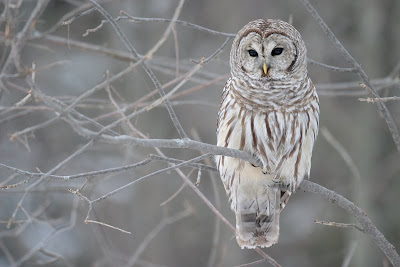
Barred Owl, from WikipediaLoud, raucous, and beautiful. Image courtesy Wikipedia.
To hear typical Barred Owl vocalizations visit All About Birds.

So, not the species we were trying for, but any owl during an Owl Moon is a welcome owl. I haven't yet figured out that shriek. There's nothing that explains it in the Barred Owl account on the BNA Online, though there is a similar-sounding, but not really close, Barred Owl recording on the "Voices of North American Owls" CD. It's listed as a "female solicitation" call. According to my source (Gerrit Vyn, the guy who actually recorded that track) the call could also be used as a contact call between a male and female.

But Gerrit also suggested it may have been a saw-whet as they do perform a wide variety of odd "whine" calls during the winter months. This didn't really fit, though, compared to their whine calls we've heard around our hill as well as on the aforementioned CD. And how could a Barred Owl immediately join in, unless it was right on top of the saw whet, a scenario that probably wouldn't end well for the smaller owl.

Comments appreciated, especially if you've encountered unexpected and never-before experienced sounds like this.

And for Reina it all ended happily: we're planning a trip to Amherst Island, Ontario in early February to see more owls!

-

Tuesday, January 20, 2009

What's It All Mean?

Like many, I spent part of today watching the swearing in of a new president. The peaceful transition of power is always an awesome spectacle, something that never fails to send chills through my nervous system. To paraphrase Sigmund Freud, "The first human who hurled an insult instead of a stone was the founder of civilization."

While watching the Inaugural Address a Sharp-shinned Hawk flew into our yard, choosing to perch in the tree closest to our windows. He patrols our yard frequently, usually landing across the yard watching for evidence of the scattered feeder birds, but today he was a mere 30 feet from where we sat.

Sharp-shinned HawkInaugural Sharpie

Of course, if you know me at all, my mind went right to wondering what the significance might be.

What did it mean that an accipiter hawk flew in and landed at the moment power shifted? Did it foretell something about the incoming president, or perhaps summarize the reign of the outgoing leader? Maybe something party-wide, or ideological? Or was it just a hungry bird trying to exploit my feeders?

I have my thoughts, what are yours? What could it all mean?

-

Wednesday, January 14, 2009

Time Lapse Artwork

Watching an artist work in their chosen medium is as inspiring, if not more so, than the final product. But who has the time? Well, with the use of time lapse photography and our friends at YouTube, we all do!

Carel Brest van Kempen of Rigor Vitae: Life Unyielding produces some beautiful likenesses of the natural world, and watching how they come alive is truly awesome. But don't listen to me, explore for yourself! See how this Golden Pheasant came into being in under two minutes.


You can watch this clip here or find it on YouTube, but either way you should also check out the artist's blog for additional works.

-

Tuesday, January 13, 2009

Birders Unite!

Do you know about BirdersUnited? As the front page states, BirdersUnited was originally started as "a Political Action Committee in 2004 to oppose the re-election of George W. Bush." Since it's inaugural mailing it has provided weekly (or thereabouts) summaries of events at the intersection of birding, birds, and politics, not only at the federal level, but often at the state and local levels. And because birds don't recognize our political borders, stories also may have an international scope.


Birders United
With a new administration taking control shortly, BirdersUnited states,

. . . birders must remain vigilant and politically active. Birders United vows to continue on as a watchdog to observe the policies and actions of the new administration and to recommend initiatives that will strengthen and enlarge the habitats of birds and increase protections for species that are most vulnerable.

Have a look at this week's issue, and please do let me, and others, know what you think.

-

Friday, January 9, 2009

Flashback Friday: Parrots of the Caribbean

In honor of, or maybe due to, "Parrot Month" over at 10000Birds I'm flashing back to a heart-palpitating experience I had in Puerto Rico. By now you may have put 2 + 1 together ("Puerto Rico" + "Parrot") and you'd be almost correct if you answered 3 ("Puerto Rican Parrot"). Almost right.

Dateline: Autumn 1997, El Yunque National Forest, Puerto Rico
In 1997 the mycologist (my then-girlfriend, now-wife) was working on her dissertation at the University of Arkansas. A great natural state, Arkansas, but when she was offered a chance to perform research in Puerto Rico for a semester she jumped at the chance. I also jumped and we were off for three months of working in the El Yunque National Forest (and don't tell anyone: also playing in El Yunque and the rest of the island).

I supported myself by working on two different research projects while there, and perhaps stating the obvious I was always on call to be a field assistant for the mycologist. Each project involved a fair amount of time hiking throughout the various forest types in El Yunque and I was giddy about this prospect of finding Puerto Rican Parrots. Scientifically known as Amazona vittata, they are the least-expected but most-desired birds to see on the island.

To really understand how adrenaline-surging this opportunity was you should take a few minutes to read a recent 10000Birds.com post about the history and status of the critically-endangered PR Parrot. Brief summary: population estimates from pre-Colombian times ranged between 100,000 to 1,000,000 individuals spread across Puerto Rico, Culebra, Vieques, and Mona, possibly across the northern Lesser Antilles. By the time we arrived in 1997 there were approximately 40 wild birds restricted to a single mountain range on Puerto Rico. Because my job(s), by definition, would require spending most of each day in areas favored by the parrots I would have an above-average chance to come across them in the wild. And I had three months to do so.

Amazona vittataMy quest: a pair of Puerto Rican Parrots. Actually, I was
hoping for a flock. Breeding wouldn't occur until February,
we were leaving in December. Image courtesy of Wikipedia.

For the more numerically-inclined among you, check out this recent paper if you're interested in some probability modeling. From the abstract, "We develop models to assess the probability of extinction and the search effort necessary to detect an individual in a small population." (Emphasis mine). That'll tell you exactly what my chances were.

One particularly sunny day, partway through our tenure in PR, we were hiking along a closed road in an area we hadn't visited before. To that point I hadn't seen nor heard PR Parrots. In fact, no parrots had been noted in the rainforest at all. Other parrot species, such as the introduced-and-established White-fronted Parrot (Amazona albifrons) and Red-crowned Parrot (Amazona viridigenalis), among others, prefer the lowlands along the coast. But if you saw/heard a parrot in the rainforest, I was told by other biologists, it was almost certainly a PR Parrot. Naturally, my ears remained tuned for any parrot-ish vocalizations, my eyes peeled for flying birds above the canopy. I wasn't able to convince myself that I'd find a flock foraging among the foliage, having watched Orange-winged Parrots (Amazona amizonica) completely disappear in plain sight into the trees in our yard.

El YunqueOne view of the El Yunque forest. There are several different
forest types in the forest. Image courtesy of Wikipedia.

I didn't know why, but as we walked the road I suddenly felt a tingling in my spine, goosebumps appeared on my arms. It slowly dawned on me: I could hear parrots. Not the classic squawking, no one begging for crackers, but something new. Something kind of like this (note: link will open/play an mp3 if you have Quicktime installed). The mycologist heard it, too. Our eyes met, she gave me a partly excited, partly resigned look that said, "Go for it." She knew I'd be useless if I didn't chase it.

I was off like a shot, bee-lining towards the sounds. Off the road, into the forest, slipping along a path, slipping off the path, crashing through undergrowth taller than me. I stopped and listened, they hadn't flown. Moving slower and more carefully I pushed on, sounds getting closer. I inched through the foliage, brushing leaves wider than me aside, and climbed a small rise. I threaded my way through a couple of plants and froze. About 30 feet in front of me was a parrot!

Classic cream-colored parrot bill, short, blunt tail characteristic of Amazona parrots, emerald-green body, wide white eye-rings, some blue evident in the folded wing - looked good! And I was up in the rainforest, away from the lowlands . . . I was staring at one of the rarest birds in world. Full of emotion, I stared. It calmly watched me, slightly moving its head, blinking. In the now-silent forest I tried to take in every detail, committing this bird to memory. It had that typical bemused parrot look, like there was something funny I wasn't quite getting. I shared a few minutes with this bird and began breathing again as the lister in me mentally ticked my life list up a notch.

I thought about this species' rough existence. Hunted as a food source by the Taínos, then the devastating loss of habitat starting post-European colonization that caused numbers to plummet. A species in peril, the dwindling population endured hurricanes, parasites, predators, and competitors. The numbers, which dropped to an all-time low of only 13 existing birds in 1975, has rebounded. In 1997, as I communed with this single bird, there were some 40 wild birds and about a hundred in captivity. The progress was heartening, but as I bonded with this individual I tried to convey that I knew the birds weren't out of the woods yet (actually, I should say they weren't into the woods yet, where they belonged). I whispered that I would do my part to help them get there.
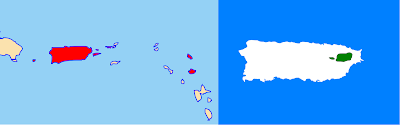
Amazona vittata distributionAmazona vittata range. Historical in red (left) and
current in green (right). Image courtesy Wikipedia.

My eyes wandered, searching for the others in the flock. That's when I noticed something weird. The bird was perched, but it didn't seem to be perched on anything. I mean, you'd expect it to be gripping a limb, a broad leaf, some oversize fruit, but there wasn't a tree nearby. It just improbably hung there. It impossibly hung in mid-air, continuing to watch, perhaps smirking. "C'mon, figure this one out, you can do it."

Careful scrutiny of the situation showed it was, in fact, perched on something. It was gripping the sides of a large enclosure. Thin, black, interlaced wire was near invisible within the forest foliage and dappled sunlight, but it was there. I knew there was a captive breeding facility within the park boundaries, and I suddenly realized that I had found it. I backed away slowly, not wanting to have to explain why I was sneaking up on the backside of a federal building to the authorities. I've never heard anything about Puerto Rican jails, but I can't imagine a scenario I would want to spend time in one.

Back on the road I recounted the story to the mycologist and removed that mental "tick" from my life list. In one sense it didn't matter that I stumbled across a captive parrot rather than a wild, free-flying bird. I still shared an encounter with one of the rarest species on the planet, something I had anticipated but never really expected. A beautiful moment, one I knew I'd be flashing back to for years to come.

Epilogue
That afternoon, back in the town of Sabana, we were putting away equipment in the research facility where the mycologist was based during our stay. If some of the wind was taken from my sails when I realized I was watching a captive parrot rather than a wild one, the rest was sucked away after I recounted my episode to Esteban, the field technician I periodically worked with.

Hispaniolan Parrots, look-alikes of, and surrogate parents
for, Puerto Rican Parrots. Image courtesy of Wikipedia.

"I hate to tell you this," he began. "They keep the Iguaca, the Puerto Rican Amazons, inside. The ones outdoors are Hispaniolan Parrots. You know, Amazona ventralis." He went on to say eggs laid by captive PR Parrots are moved to active nests of captive Hispaniolan Parrots, who seem to be better mothers. In the excitement and emotion of seeing this bird, and puzzling through the curious circumstance, I failed to take into account all of the field marks, never noticing that it had a prominent white forehead, not red. There's a lesson learned, hopefully I'll once again have an occasion to apply that reinforced knowledge.

Puerto Rican Parrot watercolorThis watercolor hangs in our house, given to me by
the mycologist for my birthday that year. I like how
the red is inescapable, a constant reminder of that day.

-

Wednesday, January 7, 2009

Ice and Quiet

The weather reports coming in last night were a bit ominous. They called for a "wintery mix," or some combination of snow, ice, and sleet to occur overnight and through the morning. Some places could expect power outages, and apparently others could expect the End Times. In a remarkable show of restraint the local school districts waited until the morning to cancel school, something quite uncommon. Usually they've canceled school here in NY as soon as a storm looks like it may hit the Pacific coast.

All of that doesn't mean I get off from work. I did leave a bit later than normal to give the road crews some time to clear up the slushy mess. Note to the village of Horseheads: take a lesson from the town of Veteran! Man, do they know how to maintain roads. Then again, they're a bit more liberal with the speeding tickets which probably pays for that increased work ethic.

Though the roads were expected to be icy and treacherous at higher elevations I decided to take my Blue Highway backroads to see what birds I might find. It wasn't precipitating, there was no wind, the temperature hovered just above freezing. All in all, not too shabby a morning, and maybe there'd be Horned Larks in the road, perhaps harriers, Rough-legged Hawks, and shrikes patrolling the open fields, and who knows what else. A Snowy Owl could turn up, or dare I hope for a Northern Hawk-owl? One was reported, but as of yet not relocated, just west of Binghamton, NY.


Male Ring-necked Pheasant walking through the corn.

All in all, I found exactly six species over seven miles of backroads. The best bird was a Ring-necked Pheasant, exactly where I started seeing them last fall. This time the corn field held his interest, he stuck around for several minutes pecking through the stubble.

My year list for 2009 is progressing slowly, a stop at Stewart Park, Ithaca may help it jump a bit. BTW, did you know I keep a running list of birds seen each year, along with life list additions, in the sidebar? Stay tuned as the numbers grow.

-

Sunday, January 4, 2009

A Meme! Six Random Things

Wren at Wrenaissance Reflections tagged me for the “Six Random Facts” meme. Having never been tagged directly for anything I'm a bit nervous: what should I wear? Should I bring a dish to pass, or a bottle of wine? I probably need a haircut.

Here are the rules for Six Random Things:

  1. Link to the person who tagged you.
  2. Post the rules on your blog.
  3. Write six random things about yourself.
  4. Tag six people at the end of your post and link to them.
  5. Let each person know they’ve been tagged and leave a comment on their blog.
  6. Let the tagger know when your entry is up.
Please hang in there while I think out loud: I linked back to Wren, I posted the rules. Two down, four to go, so now for the creative, openly-honest, soul-bearing part. Here goes:

1. "Isn't it ironic?"
I love people but hate gatherings. I'd rather hang out with one or two folks than attend a group function, though when forced to go to a gathering I always end up having a great time. (Quote from Randal in Clerks (bonus random thing: one of the funniest movies I've ever seen).)

2. "I'm late, I'm late!"
Given the natural order of things I would be late for everything. I conscientiously try very hard to be a bit early for events, both scheduled and unscheduled. I've (half-) jokingly referred to this as a genetic disorder as most everyone on my paternal side suffers from the same condition. Then again, it may be a learned behavior. Note to self, set up a longitudinal twin study for eventual publication. (Quote from the White Rabbit from Alice in Wonderland.)

3. "Welcome back my friends to the show that never ends . . . "
I spent a summer working at Busch Gardens in Williamsburg, VA as part of a show introducing audiences to various raptors and parrots. As the raptor guy I presented and handled various raptors such as American Kestrels, Barn Owls, Harris Hawks, Red-tailed Hawks, among others, culminating with Liberty, the Bald Eagle. (Quote from Emerson, Lake & Palmer, Karn Evil 9.)

4. "Pick up my guitar and play"
Much of my free time that isn't birding-oriented is spent playing guitar, almost exclusively acoustic these days. I'm not that bad when I play by myself, but put me with other musicians and you'll find out what musical arrhythmia means. What I prefer to play and what I can play are often two different sets, but their intersection keeps me happy. Most importantly, it entertains my 4-year-old daughter to no end and doesn't annoy my wife (at least, not enough that she tells me). (Quote from The Who, Won't Get Fooled Again)

5. "The elements in harmony"
Launching off of my late college career as a botanist, I started my post-college career as a botanist. Actually, as a molecular biologist. My desire was to work in a more general, ecologically broad field, but I spent my first year running gel electrophoresis on various cultivars of Brassica oleracea. I'll leave it to your Googling skills to figure out what important plant(s) I prepared for quantitative analysis. Boy, that sounds a lot more impressive than what it actually entailed! (Quote from Thomas Dolby, She Blinded Me With Science).

6. "I Want to be Like You"
One of my junior high teachers assigned an essay about who we most admired and why, and I was alone in choosing a relative rather than a celebrity. My uncle Ekkie not only has spellbinding stories from his past, such as escaping from eastern Germany as the wall was rapidly constructed, but his curiosity was insatiable, he possessed a seemingly photographic memory, a magnetic personality, and boundless energy. It's nearly three decades since I wrote that essay about him but he's still my top pick. (Quote from the King of Orangutans in the Jungle Book, here performed by Paulo Nutini.)

That said, I will tag six more people even though everyone and their dog probably already addressed this topic. To those listed below, I apologize if you've already participated and I missed it, but if you're up to it I look forward to your responses. My nominees:


Whew, I think I got through it all. In the immortal words of John Lennon, "I'd like to say thank you on behalf of the group and ourselves. I hope we passed the audition."

-
Locations of visitors to this page