Showing posts with label GBBC. Show all posts

Thursday, February 11, 2010

Counting Crows . . . and Jays and Chickadees [Fun & Games]

The annual Great Backyard Bird Count is on, let the games begin! Every day there are thousands of people watching birds across North America. Over the next four days (Friday, February 12th through 15th) there will be thousands of people watching and counting birds across North America, some for the first time, all to create a snapshot of where the birds are spending their winter. It's simple: observe birds; track a few necessary details (like when, where, and who); and upload your list on the easy-to-use web site.

Well, check out this video, it's worth a thousand-word blog post all on its own. You'll learn the whats, wherefores, and how tos. But also explore the web site to learn about birds, to see how your submissions are used by scientists, to see photos from past counts, and especially to get ideas on how to involve beginning birders and kids - from past experience I can tell you, it's great for kids!


The GBBC is a great excuse, if you need one,
to get your kids involved with nature.

Granted, watching birds is the best part. But it's a real trip to watch the map as it regularly updates throughout the weekend in near-real time with the most recent submissions, to track how many checklists come in from your town, and to see what birds are being seen where.

So, if nothing else, try and get out and collect a few checklists. Even better, attend a bird walk or workshop at a local nature center, or just get a few others out with you and introduce them to nature and citizen science. I'll be covering where I can in my county, will you do the same?

-

Tuesday, February 17, 2009

Great Backyard Bird Count

If you read more than two or three bird-related blogs you probably already know the data collection portion of the Great Backyard Bird Count took place last weekend between February 13 - 16. The data reporting portion continues until March 01, so if you collected any checklists be sure to submit your findings!

We were somewhat limited in our counting this year, compared to past years when we've submitted multiple checklists each day from our home, local nature centers, friend's homes, and wherever we happened to spend 15 minutes to count. This year we managed a few checklists from our home throughout the four-day count, not including four failed attempts at getting an owl (any owl!) to call.

But I find there are two equally exciting parts to the GBBC. First, getting outside and counting, and then exploring the results. We've been having fun checking out the maps as they're updated. One of the highlights of this year's count: Pine Siskin, this season a staple at not only in our yard, but apparently (almost) everyone's feeders. Small bird, big impact - you may have read about their presence on bird listserves or blogs, but check out what it looks like on a map.


BAM! Colorful and explosive! At the siskin page on the GBBC site you can generate the same map (which will be updated as new checklists are submitted) and go back in time to compare previous years. The differences are striking, and a great jumping off point to talk about bird distribution with young ones.

What interesting results have you found, either in your personal count(s) or the accumulated data?

-

Wednesday, February 20, 2008

GBBC: Wrap up

And here is the finally tally from my 2008 Great Backyard Bird Count. In total, I submitted six checklists over the four day period, two from our place outside of Horseheads, NY, one from Mendon Ponds Park in Mendon, NY, and three from my parents place outside of Rochester, NY. My grand total this year was 28 species, ten below what I recorded on the 2007 GBBC, even though last year's count included observations from our house, my folks place, and Mendon Ponds. Why such a big difference? A single 15 minute stop from Seneca Lake State Park, where I stopped en route to my folks place last year. This site on the northern end of Seneca Lake yielded waterfowl and gulls not found this year. If only I had timed my trip differently this year.

Anyway, here are the birds from this year's count.

Canada Goose - Branta canadensis
Red-tailed Hawk - Buteo jamaicensis
Mourning Dove - Zenaida macroura
Red-bellied Woodpecker - Melanerpes carolinus
Downy Woodpecker - Picoides pubescens
Hairy Woodpecker - Picoides villosus
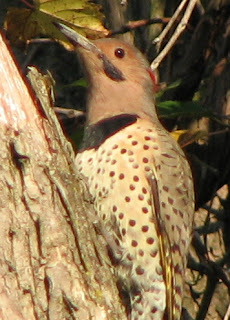
Northern Flicker - Colaptes auratus
Blue Jay - Cyanocitta cristata
American Crow - Corvus brachyrhynchos
Common Raven - Corvus corax
Black-capped Chickadee - Poecile atricapillus
Tufted Titmouse - Baeolophus bicolor
Red-breasted Nuthatch - Sitta canadensis
White-breasted Nuthatch - Sitta carolinensis
Eastern Bluebird - Sialia sialis
American Robin - Turdus migratorius
Northern Mockingbird - Mimus polyglottos
European Starling - Sturnus vulgaris
Cedar Waxwing - Bombycilla cedrorum
American Tree Sparrow - Spizella arborea
White-crowned Sparrow - Zonotrichia leucophrys
Dark-eyed Junco - Junco hyemalis
Northern Cardinal - Cardinalis cardinalis
Brown-headed Cowbird - Molothrus ater
House Finch - Carpodacus mexicanus
Common Redpoll - Carduelis flammea
American Goldfinch - Carduelis tristis
House Sparrow - Passer domesticus

Monday, February 18, 2008

GBBC: Days Two - Four

I could have just as easily called this "GBBC Wrap-up" as the Great Backyard Bird Count officially ends today and I just submitted my last checklist. Hmmmm, unless I go out for a bout of owling. Nah, I'm feeling pretty beat. Well, it is just 15 minutes, I could be back before anyone really misses me . . . all right, I'll go. Hang on.

Will I be able to add Eastern Screech Owl to my GBBC
lists this year? Stay tuned to find out!


OK, I'm back. Beautiful night, with the bright moon occasionally obscured by clouds, giving a lights-on, lights-off effect. I walked our quarter-mile loop, listening for any spontaneous owl calls, then tried tooting for a Northern Saw-whet, whinnying for an Eastern Screech-owl, and hooting for a Great Horned. No response, except a dog in the distance. At least my other counts were more successful. That is, I at least found some birds, though diversity and numbers were fairly low relative to previous years (I think). I suspect weather conditions played a big role as several took place in some form of precipitation, from light snow to rain.

Photography-wise, this weekend was a bust. I hoped
for a bright, clear shot of a White-crowned Sparrow,
but I got a cluttered American Tree Sparrow.


My GBBC weekend was bracketed by recording the birds in our yard, the middle counts took place near Rochester, NY. We visited my parents for the weekend where we counted their yard birds. I did find a few new year birds, like Red-bellied Woodpecker, Brown-headed Cowbird, and White-crowned Sparrow.

Isn't it funny how first-of-the-year birds instill excitement? Later
this spring I probably won't give a Brown-headed Cowbird a
second glance, but on this trip I made an effort to find them.


The highlight was a trip to Mendon Ponds Park where we walked part of the Bird Song Trail, a short loop on which you are trailed by tenacious birds that presume you are a walking feeder. I used to love this trail as a kid because the chickadees would come to your seed-filled hand, and on rare occasions a White- or Red-breasted Nuthatch, Tufted Titmouse, or possibly a Downy Woodpecker would visit. In fact, this trail may have sparked my interest in birds. I'm trying to make it a tradition that we walk this trail when we visit my folks, hoping to provide a similar spark for Reina, who is almost four. This year she was enthralled with the birds coming to my hand, and she wanted to try. What success! She was visited by chickadees, titmice, and both species of nuthatch. The descendants of the birds that visited my hand decades ago are much bolder than their ancestors!


Watch a short video (8 seconds) chickadee
accept a sunflower seed from Reina.


We'll keep our GBBC enthusiasm going through eBird, I hope you all enjoyed your weekend whether you counted for GBBC or just enjoyed some time appreciating the outdoors.

Friday, February 15, 2008

GBBC: Day One

I make it a point to collect and submit at least one checklist per day during the Great Backyard Bird Count, and usually I can squeeze in a couple. One from the yard, one from work, one from a stop on the way home, anywhere I've got 15 minutes and some daylight.

Not today, I spared the minimum 15 minutes to count birds in our yard after dropping Reina off at school. Nothing for the record books, a modest 17 species including a couple not-typical-for-our-yard species, like Red-tailed Hawk, Eastern Bluebird, Cedar Waxwing, and European Starling. The full list is below.

One of dozens of Cedar Waxwings counted on my GBBC list.

Can't wait for tomorrow, I plan a couple of counts with a bit more effort.

Locality: Horseheads, Chemung County, NY
Observation Date: FEB 15, 2008
Start Time: 8:30 AM
Checklist:

Red-tailed Hawk - 2
Mourning Dove - 6
Downy Woodpecker - 2
Blue Jay - 7
American Crow - 6
Black-capped Chickadee - 27
Tufted Titmouse - 8
Red-breasted Nuthatch - 1
White-breasted Nuthatch - 4
Eastern Bluebird - 2
American Robin - 18
European Starling - 11
Cedar Waxwing - 45
Dark-eyed Junco - 8
Northern Cardinal - 3
Common Redpoll - 4
American Goldfinch - 5

Sunday, February 10, 2008

Great Backyard Bird Count

It's that time of year again: the Great Backyard Bird Count is just around the corner. It seems obvious as to what it is, counting birds you see in your backyard. When deconstructing the name we find that's almost what it's all about.
  • It is "Great," especially talking about the fun you'll have, the importance of the data you're collecting, and the effort that comprises the count (81,003 checklists submitted last year).
  • It does not have to be your "Backyard." Count wherever you happen to be: I've submitted checklists from our yard, my parent's yard, local parks, work, and overnight trips to birding hotspots.
  • It is all about the "Birds," which you're almost guaranteed to see anywhere you go.
  • You do have to "Count" what you identify, and hopefully that will keep you counting on future checklists you keep, improving the value of your observations for science. For your observations to "count" towards the greater good, though, you do have to make sure you follow the protocol and are submitted to the analysts at the Cornell Lab and Audubon.
It really is simple. To get started, check out the GBBC website, where you can learn how to participate, get ideas on involving kids, view previous years' stats and maps and what scientific stories they tell, find participant photos, read this years' behind-the-scenes blog, and more.

And while you're at it, chime in on 10,000Birds.com's new promotion: vote on your favorite backyard bird and be eligible to win a copy of Audubon's Backyard Birdwatch by Steve Kress. In a nutshell, this is the must-have guide for the common backyard birds you're likely to encounter - why leaf through all 900+ species that occur in North America when Steve can focus your attention to the most likely candidates? Not sure you want this book? Read more here, at 10,000Birds.com's review of Audubon's Backyard Birdwatch.

The promotion entails, and I quote, "naming the bird that you most enjoy seeing in your backyard. Feel free to briefly state why you favor that bird over all others."

I'm sometimes accused of being too literal, alternately a smart-ass, but here's my answer:

Our favorite backyard bird: this specific
Black-capped Chickadee, named PBlu--RX

Yes, this individual, whom we know as Pink-Blue-Red-Silver, was banded in our yard three years ago and is a regular visitor to our feeders. In addition to being taxonomically assigned to our favorite species (Black-capped Chickadee), we are happy this specific one continues to grace our yard with his (or her) presence. Like all chickadees, not only does he (or she) come across as friendly and happy-go-lucky, their antics are bound to brighten the darkest winter day, their happy "dee-dee-dee"-ing a welcome upbeat chorus in the silence of winter. And, truth be told, in fall and spring they can lead you to amazing mixed species flocks of migrating passerines. And all they want in return: some sunflower seed and maybe a nest box. What more can you ask for?

Finally, keep up with the Birdchaser. He's a coordinator of the event and has lots of great info, reports, and updates on his personal blog. I'll leave you with a few images from a couple of our past Great Backyard Birds Counts. Happy counting to you and yours!

Reina's first GBBC, 2005. I helped count the Wild Turkeys
at our feeder. Come to think of it, I helped identify them, too.


GBBC 2006. Purple Finches are present in our area throughout
the winter, though hit-or-miss on any particular day. That's why
the count lasts for four consecutive days: to get an accurate
representation by counting several times over the count period.


GBBC 2007. If you're having trouble counting
distant birds, bring them closer! Look carefully,
there are two chickadees in this photo.

Locations of visitors to this page