Showing posts with label Winter finches. Show all posts

Saturday, September 20, 2008

Winter Finch Forecast, 2008-09

Approximately one year ago I wrote the following:

Below is one of the most forwarded emails in cyberspace, at least in the birding world. Each fall Ron Pittaway, from the Ontario Field Ornithologists, puts together a forecast of the distribution and abundance of winter finches in Ontario.

You can read the rest of my introduction from last year's post, all the information and background still holds true.

Here's Ron's general forecast for the upcoming 2008-09 winter season:

This winter's theme is where will crossbills go and will they irrupt south? Both species wandered widely this summer. Cone crops are poor in the Atlantic Provinces and fair to moderate in Western Canada. In Ontario, spruce crops are fair to good west and east of Lake Superior and in central Ontario such as Algonquin Park, but cone abundance diminishes rapidly northwards into the boreal forest. White pine (Ontario's provincial tree) has heavy cone crops in most areas. The hemlock crop is poor in central Ontario. The white birch crop is fair to good west and east of Lake Superior to Lake Ontario, but poor in the boreal forest. The mountain-ash (rowan berry) crop is excellent in Ontario and Western Canada, but poor in the Atlantic Provinces. Individual finch forecasts below apply mainly to Ontario, but adjacent provinces and states may find the forecast of interest. I also comment on three irruptive passerines and two boreal forest raptors.

This year, instead of posting the entire forecast here, I'll refer you to the eBird website where they've already uploaded it -- with images and proper web formatting, tasks I'm happy to turn over to someone else. I'll likely follow up in a couple of weeks when our own Matt Young posts his comments of how this will relate to central and western NY.

-

Sunday, December 30, 2007

Hanging Out

The end of the year is a natural time for retrospection, with introspection not too far behind, and an event that occurred this week has been occupying my thoughts on several different levels.

But first things first. This actually started with me saying something I've never said before: "I'm going to meet up with a couple folks I met on the Internet."

Of course, you hear that in all kinds of parents-worst-nightmare scenarios, but I never thought I'd play the naive teenager off to rendezvous with some creepy old guy. Then it gets better: instead of meeting up in some well-attended public place, I gave out directions to my front door. And when they showed up, off we drove to rural, state-owned land where we only ran into one other person all morning.

One of the species that influenced my decision to "connect"
via the Internet. And well worth it, in many ways.


Creepy? Not at all. The folks I met up with were Mike from 10,000 Birds and Seth from Cup O' Books, the goal was to chase some winter finches near Ithaca. The very active Cayuga Lake Basin birding community has been scouring Summerhill for weeks, as it sports wonderful habitat to attract some of the most desirable winter birds: Pine and Evening Grosbeaks, Red and White-winged Crossbills, Common Redpolls, Northern Shrikes, Rough-legged Hawks, and, although relatively common, Red-breasted Nuthatches and Purple Finches.

Redpolls on a wire: if only all the sought-after species were so easy!

We had a mixed day, much like the weather. We arrived with the clouds in a quandary about whether to release snow or rain on us, which was resolved by dumping both at a fairly even rate. Immediately after stepping out of the car we heard chickadees and a single RB Nuthatch calling, and that would be it for our entire (very slippery) hike. Happily, a bird feeder just up the road came through with dozens of Evening Grosbeaks, all easily viewable and photographable from inside the car.

Only a few of the flock of Evening Grosbeaks frequenting
the feeders (alliteration unintended, but worth saving).


Farther along the redpolls made their appearance, and with the exception of three Ruffed Grouse that sprinted across the road ahead of our car, that'd be it for notable species.

Waiting for clearance to approach a feeding station,
Common Redpolls gather atop a cluster of spruces.

After not hearing any flyover finches and not seeing any perched shrikes or Rough-leggeds, we made our way back to Ithaca, ate lunch while sitting in the staff lounge at the Cornell Lab of Ornithology, and walked a quick loop around Sapsucker Woods Pond (wishing for the local shrike to make a quick appearance).

So, at the end of the day, the birds were mixed, but the trip was awesome: I rediscovered the beauty of connecting with like-minded people again. This is what I've been dwelling on, what's been the impetus for some reminiscing, some longing, and some catharsis: the social aspect of birding. This is a hobby (obsession?) that works perfectly on the solitary end of the spectrum, but just as well on the other end, and it's that side I've been missing.

Once upon a time, I was young, unattached birder with a great group of birding buddies. We birded a lot, chasing vagrants, plotting big days, scouring hot spots near and far. Naturally, we interacted, communicated, shared, and learned.

Jay Withgott, perhaps the most influential person in my
birding career. We've now birded in at least four states
together, though we keep missing each other when scouting
New Jersey for the World Series of Birding. One day . . . .


But I'm not there, at that point of life, anymore, and most of my birding these days is solo. I work with some of the most amazing birders in the country, but I live far enough out of "the Basin" that I'm not regularly available to bird with them.

Most of my birding is around the house, for a simple reason: my love of spending time with my 3.75-year-old outweighs the attraction of vagrants, lists, and even the just-a-bit-too-far hotspots in our area. Though my daughter is almost ready to make some birding trips, she's not quite there.

So, a gratifying shout out to Mike and Seth for instigating the trip, and thanking them for bringing back some wonderful memories of birding trips past, and hopefully, future. Presently, however, I'm happy with what I get.

For another review of the trip, please read Mike's excellent account of our exploration here.

Thursday, November 29, 2007

Here, There, and Everywhere

In my last post I hinted, probably too covertly, how irruptions of different species affect observers. Irruptions set off "mad-keen" birders in a tingling frenzy: "What denizens of the north can I get on my state/county/yard/year/office list?" An irruption year may very well cause the casual bird watcher to stare a little longer at the birds visiting their feeder and wonder, "What is that species? I'm pretty sure I've never seen it before."

A Purple Finch visits our feeder in the Southern Tier of NY. They're
predicted to irrupt this year, so where else are they being reported?


But, more subtly, and arguably more interesting, instead of a more diverse crowd, the same observers might notice more individuals of a certain species around the feeder, or count more individuals than usual on their standard birding trips. If nothing else, the local listserve is inundated with reports, "I've got a Red-breasted Nuthatch (or Evening Grosbeak, or Pine Siskin, or Pine Grosbeak or . . . )!", which is met with a slew of replies, "Me too!"

A Red-breasted Nuthatch picks at a pine cone on
Chincoteague Island during Thanksgiving week, 2007. Were
they really more numerous this fall than in other years?


This experience was re-affirmed for me last week. I've spent a fair number of Thanksgivings in Chincoteague, VA, over the past 15 years. In addition to the normal Thanksgiving benefits (spending time with family, good food), these trips have the added incentive: coastal and southeastern birds! As a result, I have pretty good records of the species I've observed on those vacations (though we do quite a bit of birding, like most birders, I'm aware of and mentally recording what's around even when not formally birding).

There were several noteworthy events on this trip, and the first one I noticed: Red-breasted Nuthatches. They were everywhere, and they were there in numbers. You couldn't step outside without hearing one, usually several. In an unprecedented move, I've entered all of my checklists into eBird already, and nearly all of them included "RBNU" (bander shorthand for Red-breasted Nuthatch).

Red-breasted Nuthatches really were everywhere, even
scouring fallen pine needles on the road. Admittedly a crappy
photo, but it might be the fastest photo I've ever taken.


That begs the question, "are there really more this year than in others? Or am I not remembering things accurately?" Based on a few eBird queries, there were more. In some years I didn't record them at all, in others I recorded one, maybe two. This year, I recorded at least three on each checklist, my high count was 15. And I consider myself conservative when recording numbers.

I decided to look at the bigger picture: where are they being reported, and where were they reported during the same time frame last year? Below are a few eBird maps showing the comparative distributions. To interpret them you need to know that green areas are positive reports, the darker the green the higher the number of reports that include the species (in this case, RBNU). Light gray are checklists without any RBNU reported, the ligther areas (off-white?) are areas with no checklists reported at all. That said, check this out:


This map shows where RBNU were recorded a year ago, between October and December, 2006. Note the concentrations along the northern border of the US (or the southern border of Canada, for any Canadians reading), with some scattered reports in the southeast (south of PA), some birds in the highlands of NM and southeastern AZ.

Now check out where RBNU are being reported this year, same time frame (Oct - Dec, and we're not even into December yet!).


At the very least, notice how widespread the green areas are and how much darker they are. Clearly, many more reports from across the southeast, more birds reported in these areas, including NM and AZ. Hardly any were reported across VA, NC, SC and GA in 2006; this year, lots, especially in the higher elevations in the Appalachians. In 2006, none reported south of AR; this year, down to the gulf coast. Jeez, there's even a report halfway down the Baja peninsula in Mexico!

So, increased numbers at Chincoteague was definitely not my imagination. But this irruption would be lost on me here in NY: we still have a few coming to our feeders, just like last year, and the year before, and the year before that.

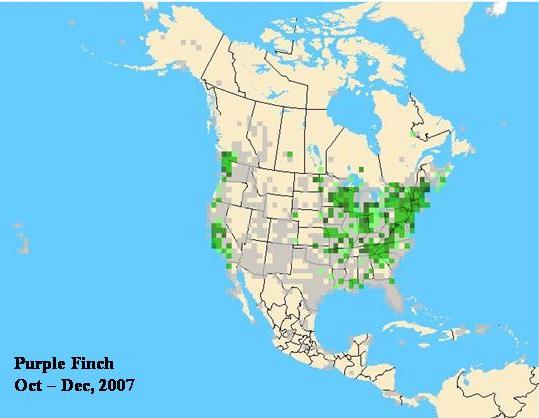
Same with Purple Finch, or "PUFI" to the bird banders. We still have a couple, but they were predicted to irrupt this year, too. They're not absent from our place, so to see what's going on in near-real time I compared reports of Purple Finches from late fall last year with what's being reported to eBird this year.

2006 saw PUFIs stretching down into FL and the gulf states, highest concentrations in the northeast, the Great Lakes region, and along the west coast. Again, note the relative scarcity of reports (lots of gray between individual green blocks), and the lightness of much of the green.

And this year?

It appears there are more green-shaded areas from the central states to the east coast, and much of the green is darker than last year. The west coast may be bucking that trend: hard to tell, but perhaps there are less reports and fewer birds than last year. It'll take more data mining to really get a handle on what's going on.

Obviously, this is only a thumbnail sketch, and very preliminary, as to what's going on, but it's exciting these kinds of movements can be explored so quickly. There's clearly a trend, it'll be a bit longer to properly examine the data and make more scientifically-appropriate comparisons, but for general interest (and/or birding) purposes, this is a very cool first glance at this season's excitement.

Now, I wonder what redpolls, shrikes, grosbeaks and other species are showing? Back to eBirding! (Well, first some birding, then some eBirding when it's too dark to see . . . .)

Post title credit: Here, There, and Everywhere (1966), The Beatles.

Monday, November 26, 2007

One and One and One is Three

Got to be good lookin' 'cause he's so hard to see.

OK, OK, I'm no John Lennon. Maybe a Julian, or Sean? Not a Yoko! C'mon! I get the message: less singing, more birdwatching.

Redpolls certainly are nice looking birds, a splashy combination of red, black, white, and yellow. And once they find your feeders, they're not hard to see. To me, they mean winter has arrived (in years when they aren't irrupting, well, it's just never really winter).

We were away for a few days over Thanksgiving, so we stocked the feeders and hoped any "new" birds would stick around to be appropriately recorded once we returned. And it actually worked: among the first birds seen following our return were Common Redpolls!

The first redpoll perches near the tube feeders, apparently
deciding whether to approach and find out what's inside.


A second redpoll eyes the suet, but eventually
opts out, favoring the thistle feeder.

A third redpoll is attracted to the seeds underneath the tube feeders.


Ultimately, they found their way to the source, with some
additional individuals: our high count was seven.


Not only did one and one and one eventually make seven, not three, Common Redpoll is the third winter finch species that found our feeders this season. First, the female Evening Grosbeak that showed up, then the Pine Siskins that settled down for a few days, and now this small group of Common Redpolls.

We have hosted a few other winter species of interest, the most atypical was the Northern Shrike that appeared the same day as the first (non-feeder) siskin. We also have Purple Finches continuing at our feeder, but these aren't as noteworthy as they are typically around. Ditto for the Red-breasted Nuthatches.

That's not to say the Purple Finches and Red-breasteds aren't interesting, they are making their own waves this season. During Thanksgiving in Chincoteague, VA, I found more Red-breasteds this year than any other my near-annual visits there. Even to the most casual observer there are clearly more around this year than in other years. And though I didn't find any in Virginia, Purple Finches are being reported in larger numbers and more frequently in southern areas than usual. More on these two birds in an upcoming post.

All in all, it's already been a very fun year for feederwatching, and we've only had the feeders up for a month! Can't wait to see how the rest of the season plays out; dare I wish for either species of crossbill in our grove of conifers? A visit from a Bohemian Waxwing on the berry bushes or Pine Grosbeaks on the crab apples? A Hoary Redpoll blending in with the Common Redpolls feeding on the birches, or under the feeder? Or some as-of-yet-unnamed rarity?

Or just "the usual suspects"?

The suspense is killing me!

Post title credit: Come Together (1969), The Beatles.

Friday, November 9, 2007

I've Been Waiting So Long

We've been waiting for the winter finches to find our feeders, and only a few have made it so far. To date, the Evening Grosbeak was certainly a fall highlight. And today, our patient waiting paid off and we added one more to the fall yard list: Pine Siskin. Others have been reporting them in large flocks in our area, and they've been reported wide and far.

House Finches take over the sunflower feeder,
a lone goldfinch sits on the thistle feeder.


Back to our siskin. It wasn't at the feeder with the more-prevalent House and goldfinches. But because the feeders were covered I decided to walk the loop around the yard to see what else might be around. In addition to the stationary feeder finches, there were dozens flying overhead, not quite circling, but not quite leaving the area.

Goldfinches take over both the thistle and sunflower feeders.

The larches, or tamarack, are turning a beautiful golden yellow, which really stands out against the green spruces and firs. I have been carefully watching the conifers for crossbills, but today only a half dozen Black-capped Chickadees were foraging on the cones. I tried shooting one as it bounced around in a colorful larch. Shooting with a camera, that is, although there were plenty of deer hunters blasting away across our hill.


Birding by ear, for me, is always challenging. Because I rarely make frequent and/or lengthy birding trips anymore I guess I lack confidence in remembering all of the sounds emitted by all of the birds of North America. As a result I'm always wondering if I would identify an unseen-but-vocal bird as it flew briskly overhead. These days it's even more intimidating: over the past few weeks the local listserve is replete with definitive statements like, "I also heard three crossbills, but never saw them," or, "I heard an Evening Grosbeak somewhere in the evergreens," and, "I heard the upslurred ziiiiiip of a redpoll, it wasn't as emphatic as a siskin, and was shorter in duration." Yikes, it's been so long since I've heard redpolls, siskins, crossbills and the like with any frequency in the field, I'm not sure I'd recognize one if it shouted at me.

But then I heard a squeaky whistle, higher pitched than the dozens of goldfinches "po-tay-to" chipping overhead. And my first thought wasn't even, "Huh, that was different." I went straight to, "That was a frickin' siskin!" Sure enough, it was; not only did it sound like one, it looked like one, too.

A Pine Siskin (middle bird with the streaky sides)
perches with two goldfinches.


But that wasn't the best sighting of the morning. When we (Barron, our dog, and I) got back near the house I saw some two dozen birds perched towards the top of a leafless maple. It was easy to pick out the goldfinches and House Finches, a few American Robins, two starlings, and a lone Cedar Waxwing. And one bird I couldn't quite figure . . . clearly bigger than the finches and the waxwing, not as chunky as the robins and the starlings. Through binoculars it was still fairly nondescript, grayish but tawny coloring, hint of a black mask covering the eye, a straight, slender bill with a hook at the tip . . . a hook? That means one thing: shrike!

Immature Northern Shrike bringing our yard list to 138 species.

The field marks add up to one species: an immature Northern Shrike. Not unexpected, but certainly not common, either. Unfortunately for me, I'm not a great photographer, so this was the best I did with a backlit bird on a gray day. Better shots of a similar bird can be seen on Bill Schmoker's website.

All in all, a great, but too short, walk around the yard. Now, about those redpolls people are reporting. . . .

Post title credit: Sunshine for Your Love (1967), Cream
Locations of visitors to this page