In
my last post I hinted, probably too covertly, how irruptions of different species affect observers. Irruptions set off "mad-keen" birders in a tingling frenzy: "What denizens of the north can I get on my state/county/yard/year/office list?" An irruption year may very well cause the casual bird watcher to stare a little longer at the birds visiting their feeder and wonder, "What is that species? I'm pretty sure I've never seen it before."
 A Purple Finch visits our feeder in the Southern Tier of NY. They're
predicted to irrupt this year, so where else are they being reported?But, more subtly, and arguably more interesting, instead of a more diverse crowd, the same observers might notice more individuals of a certain species around the feeder, or count more individuals than usual on their standard birding trips. If nothing else, the local listserve is inundated with reports, "I've got a Red-breasted Nuthatch (or Evening Grosbeak, or Pine Siskin, or Pine Grosbeak or . . . )!", which is met with a slew of replies, "Me too!"
 A Red-breasted Nuthatch picks at a pine cone on
Chincoteague Island during Thanksgiving week, 2007. Were
they really more numerous this fall than in other years?This experience was re-affirmed for me last week. I've spent a fair number of Thanksgivings in Chincoteague, VA, over the past 15 years. In addition to the normal Thanksgiving benefits (spending time with family, good food), these trips have the added incentive: coastal and southeastern birds! As a result, I have pretty good records of the species I've observed on those vacations (though we do quite a bit of birding, like most birders, I'm aware of and mentally recording what's around even when not formally birding).
There were several noteworthy events on this trip, and the first one I noticed: Red-breasted Nuthatches. They were everywhere, and they were there in numbers. You couldn't step outside without hearing one, usually several. In an unprecedented move, I've entered all of my checklists into eBird already, and nearly all of them included "RBNU" (bander shorthand for Red-breasted Nuthatch).
 Red-breasted Nuthatches really were everywhere, even
scouring fallen pine needles on the road. Admittedly a crappy
photo, but it might be the fastest photo I've ever taken.That begs the question, "are there really more this year than in others? Or am I not remembering things accurately?" Based on a few
eBird queries, there were more. In some years I didn't record them at all, in others I recorded one, maybe two. This year, I recorded at least three on each checklist, my high count was 15. And I consider myself conservative when recording numbers.
I decided to look at the bigger picture: where are they being reported, and where were they reported during the same time frame last year? Below are a few
eBird maps showing the comparative distributions. To interpret them you need to know that
green areas are positive reports, the
darker the green the higher the number of reports that include the species (in this case, RBNU).
Light gray are checklists without any RBNU reported, the ligther areas (off-white?) are areas with no checklists reported at all. That said, check this out:

This map shows where RBNU were recorded a year ago, between October and December, 2006. Note the concentrations along the northern border of the US (or the southern border of Canada, for any Canadians reading), with some scattered reports in the southeast (south of PA), some birds in the highlands of NM and southeastern AZ.
Now check out where RBNU are being reported this year, same time frame (Oct - Dec, and we're not even into December yet!).

At the very least, notice how widespread the green areas are and how much darker they are. Clearly, many more reports from across the southeast, more birds reported in these areas, including NM and AZ. Hardly any were reported across VA, NC, SC and GA in 2006; this year, lots, especially in the higher elevations in the Appalachians. In 2006, none reported south of AR; this year, down to the gulf coast. Jeez, there's even a report halfway down the Baja peninsula in Mexico!
So, increased numbers at Chincoteague was definitely not my imagination. But this irruption would be lost on me here in NY: we still have a few coming to our feeders, just like last year, and the year before, and the year before that.
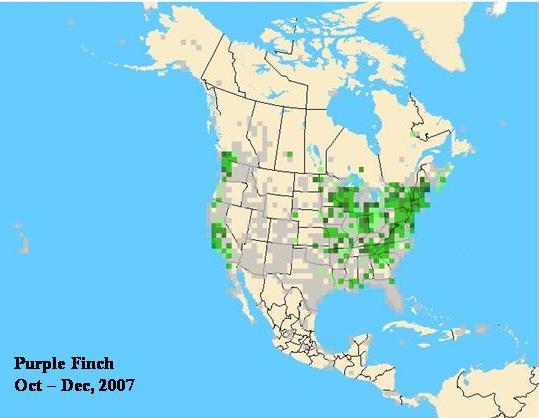
Same with Purple Finch, or "PUFI" to the bird banders. We still have a couple, but they were predicted to irrupt this year, too. They're not absent from our place, so to see what's going on in near-real time I compared reports of Purple Finches from late fall last year with what's being reported to eBird this year.

2006 saw PUFIs stretching down into FL and the gulf states, highest concentrations in the northeast, the Great Lakes region, and along the west coast. Again, note the relative scarcity of reports (lots of gray between individual green blocks), and the lightness of much of the green.
And this year?

It appears there are more green-shaded areas from the central states to the east coast, and much of the green is darker than last year. The west coast may be bucking that trend: hard to tell, but perhaps there are less reports and fewer birds than last year. It'll take more data mining to really get a handle on what's going on.
Obviously, this is only a thumbnail sketch, and very preliminary, as to what's going on, but it's exciting these kinds of movements can be explored so quickly. There's clearly a trend, it'll be a bit longer to properly examine the data and make more scientifically-appropriate comparisons, but for general interest (and/or birding) purposes, this is a very cool first glance at this season's excitement.
Now, I wonder what redpolls, shrikes, grosbeaks and other species are showing? Back to eBirding! (Well, first some birding, then some eBirding when it's too dark to see . . . .)
Post title credit: Here, There, and Everywhere (1966), The Beatles.
 Milestone alert: in December eBird, the online checklist program run by the Cornell Lab of Ornithology, received its one millionth checklist. As this press release notes, it wasn't that long ago when the project was receiving 5,000 checklists per month; now it's up to 50,000 per month.