Friday, February 22, 2008

I and the Bird #69

When people ask me why I like birds I used to be at a loss. Not of what to say, but where to start. And when I understood that, I had a revelation. Now the first thing I highlight about why I watch, observe, list, experience, and try to "grok" birds is that there are so many ways to experience them, and no two experiences are alike.

That's a rich topic, and more than I want to get into here. What I want to do is announce the new I and the Bird is available at Living the Scientific Life (Scientist, Interrupted). Grrlscientist has grouped the contributed essays into various headings, from "Ornithology" to "Bird Watching Trip Reports" with a few stops along the spectrum, you can witness first hand how various bird aficionados are affected by birds.

And, if that alone doesn't get you to check out her presentation, there's a quiz . . . with prizes! Enjoy, and good luck.

Wednesday, February 20, 2008

GBBC: Wrap up

And here is the finally tally from my 2008 Great Backyard Bird Count. In total, I submitted six checklists over the four day period, two from our place outside of Horseheads, NY, one from Mendon Ponds Park in Mendon, NY, and three from my parents place outside of Rochester, NY. My grand total this year was 28 species, ten below what I recorded on the 2007 GBBC, even though last year's count included observations from our house, my folks place, and Mendon Ponds. Why such a big difference? A single 15 minute stop from Seneca Lake State Park, where I stopped en route to my folks place last year. This site on the northern end of Seneca Lake yielded waterfowl and gulls not found this year. If only I had timed my trip differently this year.

Anyway, here are the birds from this year's count.

Canada Goose - Branta canadensis
Red-tailed Hawk - Buteo jamaicensis
Mourning Dove - Zenaida macroura
Red-bellied Woodpecker - Melanerpes carolinus
Downy Woodpecker - Picoides pubescens
Hairy Woodpecker - Picoides villosus
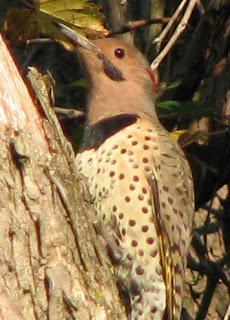
Northern Flicker - Colaptes auratus
Blue Jay - Cyanocitta cristata
American Crow - Corvus brachyrhynchos
Common Raven - Corvus corax
Black-capped Chickadee - Poecile atricapillus
Tufted Titmouse - Baeolophus bicolor
Red-breasted Nuthatch - Sitta canadensis
White-breasted Nuthatch - Sitta carolinensis
Eastern Bluebird - Sialia sialis
American Robin - Turdus migratorius
Northern Mockingbird - Mimus polyglottos
European Starling - Sturnus vulgaris
Cedar Waxwing - Bombycilla cedrorum
American Tree Sparrow - Spizella arborea
White-crowned Sparrow - Zonotrichia leucophrys
Dark-eyed Junco - Junco hyemalis
Northern Cardinal - Cardinalis cardinalis
Brown-headed Cowbird - Molothrus ater
House Finch - Carpodacus mexicanus
Common Redpoll - Carduelis flammea
American Goldfinch - Carduelis tristis
House Sparrow - Passer domesticus

Monday, February 18, 2008

GBBC: Days Two - Four

I could have just as easily called this "GBBC Wrap-up" as the Great Backyard Bird Count officially ends today and I just submitted my last checklist. Hmmmm, unless I go out for a bout of owling. Nah, I'm feeling pretty beat. Well, it is just 15 minutes, I could be back before anyone really misses me . . . all right, I'll go. Hang on.

Will I be able to add Eastern Screech Owl to my GBBC
lists this year? Stay tuned to find out!


OK, I'm back. Beautiful night, with the bright moon occasionally obscured by clouds, giving a lights-on, lights-off effect. I walked our quarter-mile loop, listening for any spontaneous owl calls, then tried tooting for a Northern Saw-whet, whinnying for an Eastern Screech-owl, and hooting for a Great Horned. No response, except a dog in the distance. At least my other counts were more successful. That is, I at least found some birds, though diversity and numbers were fairly low relative to previous years (I think). I suspect weather conditions played a big role as several took place in some form of precipitation, from light snow to rain.

Photography-wise, this weekend was a bust. I hoped
for a bright, clear shot of a White-crowned Sparrow,
but I got a cluttered American Tree Sparrow.


My GBBC weekend was bracketed by recording the birds in our yard, the middle counts took place near Rochester, NY. We visited my parents for the weekend where we counted their yard birds. I did find a few new year birds, like Red-bellied Woodpecker, Brown-headed Cowbird, and White-crowned Sparrow.

Isn't it funny how first-of-the-year birds instill excitement? Later
this spring I probably won't give a Brown-headed Cowbird a
second glance, but on this trip I made an effort to find them.


The highlight was a trip to Mendon Ponds Park where we walked part of the Bird Song Trail, a short loop on which you are trailed by tenacious birds that presume you are a walking feeder. I used to love this trail as a kid because the chickadees would come to your seed-filled hand, and on rare occasions a White- or Red-breasted Nuthatch, Tufted Titmouse, or possibly a Downy Woodpecker would visit. In fact, this trail may have sparked my interest in birds. I'm trying to make it a tradition that we walk this trail when we visit my folks, hoping to provide a similar spark for Reina, who is almost four. This year she was enthralled with the birds coming to my hand, and she wanted to try. What success! She was visited by chickadees, titmice, and both species of nuthatch. The descendants of the birds that visited my hand decades ago are much bolder than their ancestors!


Watch a short video (8 seconds) chickadee
accept a sunflower seed from Reina.


We'll keep our GBBC enthusiasm going through eBird, I hope you all enjoyed your weekend whether you counted for GBBC or just enjoyed some time appreciating the outdoors.

Friday, February 15, 2008

GBBC: Day One

I make it a point to collect and submit at least one checklist per day during the Great Backyard Bird Count, and usually I can squeeze in a couple. One from the yard, one from work, one from a stop on the way home, anywhere I've got 15 minutes and some daylight.

Not today, I spared the minimum 15 minutes to count birds in our yard after dropping Reina off at school. Nothing for the record books, a modest 17 species including a couple not-typical-for-our-yard species, like Red-tailed Hawk, Eastern Bluebird, Cedar Waxwing, and European Starling. The full list is below.

One of dozens of Cedar Waxwings counted on my GBBC list.

Can't wait for tomorrow, I plan a couple of counts with a bit more effort.

Locality: Horseheads, Chemung County, NY
Observation Date: FEB 15, 2008
Start Time: 8:30 AM
Checklist:

Red-tailed Hawk - 2
Mourning Dove - 6
Downy Woodpecker - 2
Blue Jay - 7
American Crow - 6
Black-capped Chickadee - 27
Tufted Titmouse - 8
Red-breasted Nuthatch - 1
White-breasted Nuthatch - 4
Eastern Bluebird - 2
American Robin - 18
European Starling - 11
Cedar Waxwing - 45
Dark-eyed Junco - 8
Northern Cardinal - 3
Common Redpoll - 4
American Goldfinch - 5

Flashback Friday: Another Time, Same Place

Given the ice, cold, and dropping temperatures of late my mind has been wandering back in time, but not wandering far in place. To be sure, I like seasons. I like the contrasts of summer against winter, shorts and lemonade against long underwear and hot chocolate, singing breeding birds and blooming native plants against chipping boreal visitors and standing dead seed heads. Last July we ventured out to a local nature center before it got too hot. As evidenced by my posting lately, even though I'm loving the winter finch irruption and the plethora of wintering gulls, I'm starting to long for the neotropical migrants to come back north!

Dateline: 08 July 2007, Elmira, NY.
Typical July morning: clear, warm, slated to turn hot in the afternoon. Looking to get outside while it was still tolerable, we decided to head up to Tanglewood Nature Center in Elmira. It's not too far from us, boasts a great visitor center, and offers lots of trails and habitats. We haven't explored it as much as we'd like because they don't allow dogs on the trails. Our dog, Barron, has been a constant on all of our trips, large and small, for the past 12 years. Because he gets around so much slower now we decided to let him have a break.

Tanglewood Nature Center's visitor center -
unfortunately, I cut off the Northern Mockingbird
welcoming us from his perch atop the flag pole.


The visitor center was open but we skipped going inside, preferring to check out the trails. We don't really get very far now that our three-year-old prefers to do her own hiking, but we experience more in those short-distance, long-duration explorations than we imagined we could. I wasn't expecting much bird-wise given the time of year and time of day, but some birds were still singing. For the most part it was fairly quiet. That sticky, oppressively heavy-air kind of quiet.

Brown Thrashers can be found in shrubby
areas, this one was posing rather boldly
alongside the trail as we approached.


We chose a short trial, a loop roughly a quarter of a mile long that wound through shrubby fields on a hillside, then back down through shady woods. Flowers were in full bloom, most notably the Asclepias (milkweeds). Butterfly wings, in near constant motion, provided the only semblance of a breeze.

A Great Spangled Fritillary probes the inflorescence of a
bright Butterfly Weed plant, not quite blending in
(gotta keep still if you're going to go unnoticed!).


An unidentified skipper on Common Milkweed.
I'd love to know who this guy is! I'll get better
at close-up photography this year, I hope.


A Baltimore Checkerspot perching in
the middle of an open lawn.


Reina kept us on our toes, either with deep questions we tried to postpone ("Why is that bird standing on top of the other one?") or wandering off to explore whatever caught her eye. She did follow me while I stalked a pair of Eastern Bluebirds, trying for an intimate close-up.

An Eastern Bluebird keeps one eye on the lawn
below for insects, the other on Reina and me.


We loved watching the Eastern Towhee singing non-stop,
although he never did the classic, "Drink yer teeeeeeee".


Have you ever told someone what a bird is "supposed" to say? Works great when the bird cooperates. "Oh, now I totally hear, 'Old Sam Peabody, Peabody, Peabody'! It's so obvious!"

But what happens when that bird doesn't say it? In polite company no one points it out, they just let it go. And when your company is an emperor-has-no-clothes toddler? Trust me, terms like individual variation and primary and secondary songs will not help. Enter the art of distraction: "Well, it's like this . . . hey! Is that a pond?"

A Bullfrog sits motionless among the
cattails, until too many eyes rest on it.


And were off to watch dragonflies and the fish slipping below the duckweed. The excellent view of a Bullfrog tabled the towhee song for a later discussion.

Bee Balm, a favorite of Ruby-throats.

The last stop was to watch a Ruby-throated Hummingbird patrolling a patch of Bee Balm. We didn't actually see any bees, but we did watch one male hummingbird protect his patch from a rival, chasing the intruder off every time he approached.

By now it was mid-morning, temperatures moving towards dog-days of summer. The birds that sang earlier were replaced by pure stillness, save the occasional buzzing wings of an insect rocketing by. At the time we were wishing for the more tolerable temperatures of winter - you can always put on more layers, but you can only strip down so far (we don't have air conditioning, so we're limited in our options). Right now we do have moments where we're eagerly anticipating those summer days, the grass being always greener. But I suspect that come July I'll be excited to sit in our stifling office and flashback to these gray, cold, winter-finch laden days.

Imagining that scenario lets me more deeply appreciate the conditions and birds we have now, which will be important standing outside in snow and cold while I count for the Great Backyard Bird Count for the next couple of days.

Wednesday, February 13, 2008

The Land of Ice and Snow

This week our region has certainly been the land of ice and snow - but no midnight sun, and no hot springs flowing. Just cold, steady below-freezing temperatures.

For several years I've followed a relatively mindless path as I commute back and forth to Ithaca on a near-daily basis. During that time I'm usually preoccupied with a combination of things: reflecting on the upcoming/just ended workday, listening to music and/or NPR (depends if we're in an election cycle), haphazardly noting the "road birds," and/or just zoning out (especially at the end of the day).

Scenic view from following the ridges, not the valleys.
Sometimes you just have to stop to take it all in.

Recently I've branched out, trying various back roads for at least part of the journey. I have a couple of goals, such as stay on roads where it's easier to pull over without getting hit, trying to stay higher on the ridges rather than follow the valley, partially for the view and partially to pass through more habitats where I can stop and maybe stumble across some birds I would ordinarily miss. Flocks of Horned Larks, Snow Buntings and perhaps a Lapland Longspur in a field come to mind, along with the possibility of winter finches (especially Red and White-winged Crossbills) in some conifer stands, or Evening Grosbeaks and redpolls coming to feeders. Northern Shrikes and raptors patrol the open areas along these roads.

Covered in glistening ice for now, I wonder what migrants will
be found at some of these road-side stops
when spring arrives.

The most beneficial aspect, though, is that this drive is so much more relaxing. I'm zoning out less, keeping in a more mindful state, more like focused meditation. The birding so far hasn't yielded anything of note, but the scenery more than makes up for it. I make regular stops to enjoy panoramic views of the rolling hills, to listen for birds singing from the wooded areas, to actually pay attention to the region where we live instead of focusing on the taillights in front of me. The roads, it turns out, are fairly easy to navigate in snow and slush, I'm more worried about "mud season" when these roads may be impassable.

This morning included heavy snowfall along
with the layered ice. This Red-shouldered Hawk,
regular at the Lab, didn't seem bothered.


Given the current conditions (the hawk photo was from this morning), it's hard to believe the first migrating Red-winged Blackbirds and Turkey Vultures are due back in another week or so. Spring, in one sense, is in the air!

Tuesday, February 12, 2008

New From The Cornell Lab


Two big events to pass along from the Cornell Lab of Ornithology. First, the Lab's quarterly magazine, Living Bird, is now available on-line at LivingBird.org.

Did I mention it's an award-winning magazine? It's no wonder, with regular columns by the likes of David Wilcove, Jack Conner, Mel White, and Pete Dunne - all four among my favorite writers, especially when it comes to all things birds. Feature articles that take you around the world, not just through the lyrical writing, but images that leave you speechless, placing you right in the action. All future issues will be archived for easy access, and all future issues will include web extras, additional images that wouldn't fit in the print version, and video (video!) from the Macaulay Library.

Second, a couple giant leaps forward from eBird: bulk uploading of past observations and the addition of checklists from the entire western hemisphere. Yep, you can submit your historical observations in a few relatively easy steps, increasing the usefulness of observations collected by birders from the past decades, not just the past few years. And they can be submitted from everywhere in the New World, everywhere between the Arctic and Antarctica.

Read more about the Data Import Tool and South America beta-testing, dig out those old notebooks and checklists from wherever you have been birding, "on the world's birdiest continent (South America) or its most birdless (Antarctica)," and let the fun begin!

Exciting times we live in, with these Internets. Enjoy!
Locations of visitors to this page