Friday, January 2, 2009

First of the Year

Like other birders I take special note of the first bird of the new year. I'm sure you know the feeling: the last few days of the year you start eying the birds around your home, or wherever you're waking up January first. What are the likely candidates you'll see when you first glance out a window? Around here it's the usual suspects, though I suppose that means something different wherever you are right now. Our typical yardlist on a winter day is topped by Black-capped Chickadee, Tufted Titmouse, Dark-eyed Junco, Mourning Dove, Red-breasted and White-breasted Nuthatches, Blue Jay, American Crow . . . you know, the usual.

I almost always try to get a more unusual bird as my first-of-the-year. Before I head off to bed I head outside with Barron and try calling up an owl. First saw-whet (no luck), then Eastern Screech-owl (still nothing), then Barred (silence), and finally Great-horned (nada). I'm not surprised nobody answered as I didn't give them much time. It was windy and cold shortly after midnight, and not the usual in the 20*s (F) cold. It was one. One degree above zero Fahrenheit degrees! Bed seemed like a better prospect, and the "usual suspects" are just as nice as an owl. Sorry Owlman, it's true!

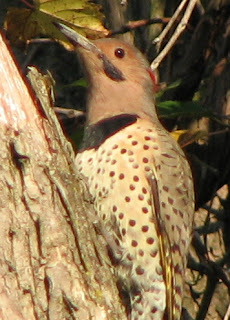
First bird of 2009: the Northern Cardinal.

Many birders probably then move on to their second, third, and other birds of the year, but I can't. I have a terrible tendency to look for the deeper meaning in things, which is helpful when scrutinizing data, educational when watching behaviors, futile when trying to connect two random events. But I can't help it, so my head is now churning through what seeing a cardinal as my first bird of the year has to do with what kind of year this will be.

Should I put money on the Arizona Cardinals to win the superbowl? Hard to believe since the Giants and Patriots are all I hear about. And what about all the folks whose first bird was a Falcon (Atlanta)? Or an Eagle (Philly)? Or a Raven (Baltimore)? Come to think of it, what about non-birders who saw Vikings, Dolphins, Colts, and so on?

The first thing I remembered about Northern Cardinals: they're my PowerBird, and have been since mid 2007. And (as I noted in that post), they are apparently my favorite species, at least according to my daughter. Since I've never found anything spelling out what a cardinal foretells for the future, here are some notable traits and notes about Cardinalis cardinals, the Northern Cardinal:

  • They are granivorous, primarily eating seeds, but sometimes prey on insects
  • They're socially monogamous
  • Their copulation is not commonly observed
  • They're named for the bright red robes worn by senior officials in the Catholic church; the name Cardinal comes from the Latin root cardo (hinge), and means chief, or principal.
  • In a Cherokee tale describing how the cardinal got its color the Cardinal is a helpful animal. An Ojibwa legend portrays the "red bird" as, shall we say, more retiring in the presence of danger (diving into cover when danger approaches), contrasting with the more confrontational black bird.

With that in mind, the cardinal seems like a good match for me. My diet is mostly vegetarian, though seafood is more likely to tempt me than insects. I tend towards monogamy and (as far as I know) I've never been watched copulating. I don't really wear red (I'm more of a "autumn"), but I like to think things hinge on me. I'll leave it to others to decide if I'm helpful and/or non-confrontational.

But what about the new year? Here's my first stab at producing a brand new, ancient fortune, dictating the year I want to have:

The sighting of a cardinal will bring a year of color, intensity, and joy. You will weather potential tough times without effect and your many friendships will strengthen. Lay low when danger is present and you will remain prosperous and well-liked. Be careful, as you are likely to attract Accipter hawks. And though you are non-migratory, you'll make an awesome trip to a far off place this year.

Yeah, that's not too shabby. I wonder what I would have written last year, when my first of the year was a crow?

-

Wednesday, December 31, 2008

Under the Wire

Well, it's getting down to the midnight hour. A new year just around the corner, the wife and I are having a quiet evening home, and I'm not ready to flip on Dick Clark or Carson-whoever just yet. That usually happens 15 seconds to midnight so we can watch ball drop and celebrate at the same time as everyone else.

When I said a quiet evening home I meant really quiet. Reina was tucked into bed around 9:00, the wife fell asleep on the couch so I'm taking advantage to squeeze in one last post for 2008. I expect it will be different than my past posts, no images, no recounting of a specific birding trip.

Nah, since I've got some unexpected free time and I'm not sure where my head's at right now I'm not sure exactly what'll come out, but I am looking for some closure on 2008. And to upload my 100th post for 2008, I just can't leave it at 99! (Note to Mike at 10000Birds.com: I feel for you with your year list halting one shy of 400, I hope you can retrofit one more bird!)

I don't really feel like clicking through the through the 99 posts I published in 2008 (though you are more than welcome to, they're all over there in the right-hand column in the archives), but I'll offer a few highlights from the year. In complete candor, I'm not sorry to see this year end, it was pretty much a downer on several fronts. But there were highlights:
  • I became an uncle back in April when Maddie Rose was born. That's my sister's first, so it's my first time being genetically uncled. I have many other nieces and nephews (and grand-nieces and grand-nephews!) on my wife's side so I've had some practice at playing the cool older relative.
  • Trips to Delaware/Virginia, Washington state, and Arkansas were the chances to see something new and different from our homestead. There were a lot of local trips through the western side of NY, meaning more time than usual to delve into our local flora and fauna.
  • I scored two "life birds," both within our region, a Slaty-backed Gull in Ithaca and a Curlew Sandpiper near Niagara Falls. There is a definite satisfaction in seeing new things where you are, but I am overtly jonesing for a trip somewhere exciting in 2009. I'm thinking South America -- Peru, Brasil, and Ecuador are jumbling in my brain, but for no real reason - if you have suggestions, please leave them in the comments. Requirements are lots of amazing birds to be found without hiring a tour guide or armed sentries, relatively cheap travel, lodging, and food, and reasonable entertainment for a bird-friendly wife and daughter.
  • Gardening and landscaping hit new highs and lows: we pushed hard to convert as much lawn as possible to gardens and native plants. We did well, but got burned out by mid-summer. Just as well, really, other things occupied us for the latter half of the year, from work (finishing up one grant and applying for others) and persronal (I won't go into those details, this isn't that kind of blog).
  • Oh, and there was that political election. Remember when Barack was elected? That was pretty cool.
There's more, to be sure, but those are the activities that stick out in these waning minutes of 2008. One applicable regret: the state of this blog. If I was the type to make resolutions I'd resolve to get on a specific schedule instead of the when-I-fit-it-in updates I tend to do. I suspect I should work on my time management for that, we'll see how that plays out (if the upcoming funding doesn't pan out I may be posting a lot more than I want).

Also, why am I here? Not in the metaphysical sense, which I've already figured out*, but here in the blogosphere? My intial impetus for starting a blog was an outlet, somewhere I could write (hopefully) creatively, have some fun, document some of the activities and experiences that occupy my time. Since not a lot of interesting things happen to me these days, at least compared to the young-birder-will-travel adventures I started highlighting in my "Flashback Friday" series, I've started to wonder, what is my point here, anyway? It's not a secret, but probably something I haven't openly shared with the general public, I always wanted to be a science writer. I'm not exactly sure how I wound up in pure research, but at least the blogosphere provides a (nonprofit) outlet.

Given the majority of topics are more "what my 4-year-old and I did outdoors," maybe that's the tack I should focus on. Maybe highlighting things going on at the workplace (lots of new initiatives at the Lab of Ornithology going on) and presenting natural history, distribution/abundance, and so on about local and exotic species and our natural world? Providing a window in the world of ornithological research, specifically remote monitoring of birds and migration? Regular pictures and stories of my dog, family, and our four acres?

Here's what I know: I will keep blogging until I figure out a direction (hold the phone, Chuck, maybe my direction is to be directionless?). I plan to post more regularly, especially to resurrect the Flashback Fridays and show more images from here, there (provided travel comes through), and everywhere. The Nature Blog Network blog stole a couple of my ideas (thankfully, as I never did anything with them), specifically introducing folks to blogs they may not be familiar with (and why I like them) and interviewing interesting bloggers, allowing folks to get to know them outside of their blog personalities. I may still run with that, I have different questions in mind, those that enquiring minds (at least mine) want to know.

Huh, so that's where my head is at this evening. That and wondering if Facebook is really worth the time and effort (if you're already there and we're not "friends" yet, hollar at me!).

OK, off to pour a drink, turn on some music (Dylan, Beatles, and old school classics? The Killers, Kings of Leon, and other new sounds?), and say farewell 2008, hello 2009.

A heartfelt thanks to you for reading, whether you're here by accident or you're a regular. Oh, and if you're wondering, what's the most fulfilling side of maintaining this blog? The friendship I've encountered, a totally unexpected side effect. I hope to meet many of you, face to face, in the near future. I'll even buy the first round.

May you all have a wonderful 2009!

* No I haven't.


-

Monday, December 29, 2008

Home Again, Home Again

We're just back from yet another inadvertent vacation from the blogosphere. Just as well, I'd rather be spending time with family, friends, and birds than the computer (though I did spend more time than I planned on a final report for work).

More to come shortly, in the meantime here's a typical scene of eastern Arkansas birding. What waterfowl can you identify?

Waterfowl flight in eastern ArkansasEastern Arkansas in flight. What are they?


-

Thursday, December 11, 2008

Seattle Dawn

23 November 2008 - Daybreak over Seattle

Waning CrescentA waning crescent moon in the cloudless, pre-dawn Seattle sky.
Where were the expected fog, rain, and clouds?

The downside of flying from the east to the west coast: morning comes a lot quicker than you're used to. We were up late the night before, the equivalent of 3:00 AM for us easterners. Reina, unfortunately, had slept quite a bit on the plane, and her four-year-old body was up and ready to go by 8:00 AM. But that's Eastern Standard Time, it was only 5:00 AM locally.

My wife entertained her for an hour, then it was my turn. We put on jackets and headed outside for a walk. The upside of flying from the east to the west coast: morning comes a lot quicker than you're used to. The sky was clear, the temperature crisp, and we watched the neighborhood come alive.

Cascade SunriseReady to start the day.

On our way back to the house we looked over our shoulders and caught the sun's glow over the Cascades and light fog rolling in from the north. In addition to the crow we found House Finches, Black-capped Chickadees, and Bushtits working over the neighborhood trees. The start of a beautiful day!


SkyWatchFriday Logo


-

Wednesday, December 10, 2008

Pacific Northwest Thanksgiving

We spent Thanksgiving week in the Pacific Northwest with friends and family. Birding, as others have noted, takes a backseat on these visits since many involved haven't transformed from "bird-friendly" to "birder" (yet). But for some of us the birding never really stops, especially when you're 3,000 miles from the typical birds of your own backyard. Instead, the birding is whatever you can squeeze in during or surrounding the family time.

Spotted TowheeThe neighborhood Spotted Towhee.

Happily, there is a lot surrounding my sister's place in Gig Harbor, just north of Tacoma. Their neighborhood is hilly and covered in conifers. The highlights of the neighborhood walks, for an easterner, were Chestnut-backed Chickadees, Varied Thrushes, Spotted Towhees, "Oregon" Dark-eyed Juncos, and more Ruby-crowned and Golden-crowned Kinglets than I've stumbled across back east.

Pelagic CormorantsPelagic Cormorants resting on a buoy above two
lolling pinnepeds (California Sea Lions, maybe?).

Nearby parks allowed views of Puget Sound so scoping for waterfowl didn't disappoint. Pacific Loons and Surf Scoters floated with Red-necked Grebes, Pelagic and Double-crested Cormorants raced across the water. Marbled Murrelets and Pigeon Guillemots added to the excitement of seabirding. I didn't have many views of sheltered coves so ducks weren't easy to come by; those I did see included Barrow's and Common Goldeneye, Red-breasted Merganser, Bufflehead, and the ubiquitous Mallard.

Tufted PuffinThe only puffins seen were at the Point Defiance Zoo and Aquarium.

The weather was great, with only a couple of the days flouting stereotypical clouds, rain, and fog. It's no wonder local birders spend much of their time scoping open water. It's tough to see the canopy of those tall conifers, especially on mornings with fog. Birding by ear must have developed in this area.

The most surprising bird was the first bird encountered on the trip. We landed at night so we didn't see any city-dwelling Rock Pigeons, House Sparrows, or European Starlings on the drive to my friend's place in the University District. Near midnight, local time (3 AM for us) I stepped on to his balcony so I wouldn't wake his daughter with my sneezing fit. The backyard slopes away so during the day you have an amazing view of a fairly large park and, in the distance, the Cascades. As the distant lights played across the waters of Lake Washington a medium-sized bird made its way through the darkness, first moving north over the neighbor's yards, then circling a large tree, finally heading south on completely silent wingbeats, almost lazy flight, head swiveling right, then left, repeatedly back and forth.

I've only seen the graceful hunting of a Barn Owl twice in my life, and it was possibly the same individual bird. My sister and I happened upon a single bird patrolling the park below my friend's house in the fading light back in August of 2007.

Cascades ViewThe view from the balcony during daylight.

Ironically the birds I spent the most time watching were ones I'm not comfortable identifying. The first group: gulls. I'm happy to watch gulls, I like sort through huge congregations trying to pick out the oddball and examining the various cycles (plumages) to identify what I can, but around Puget Sound? Forget it. The field guides will show you Glaucous-winged and Western Gulls are both present and relatively common, but a third type may be the most encountered: when those two hybridize you wind up with intermediate forms that have their own name, the "Olympic Gull." Here are a couple of the individuals I saw, please feel free to leave your identifications in the comments, preferably with some reasoning how you got there, and don't forget about Glaucous-winged x Herring Gull or any of the other possible gulls.

Gull speciesGot a guess? Click for larger image.


Gull speciesGuesses? Click for a larger image.


Finally, the crows. Are Northwestern Crows a "real" species or merely a race of small American Crows? More on these two dilemmas at another time, they both deserve more space and thought than I can provide tonight.

Crow speciesCrow species at the Point Defiance Zoo and Aquarium. This
one was wild, no convenient sign to help with identification.

-

Monday, December 8, 2008

Imagine

Briefly off topic, but I want to share my annual December 8th tradition of remembering John Lennon. His assassination in 1980 left me shaken. I was 12 when it happened, at the height of my "Beatlemania." In reality, that "height" has been more of a permanent plateau than a temporary spike, The Beatles remain among my all-time favorites (later joined by Bob Dylan, Simon and Garfunkel, and a couple of others).

The real impact came from the fact it happened on my birthday, obviously inflicting a measure of sadness during what is a time to celebrate. Over the years I've come to think of the anniversary of John's assassination less as a morbid and sad occurrence, though it clearly is, but a heartening one in that his ideals and causes live on. That can't be said about everyone. John joined a prominent group that includes naturalists and conservationists like John James Audubon, Roger Tory Peterson and Aldo Leopold (among many others). Sure, different causes and ideals, but alike in that they've left a legacy to inspire and build upon.


Strawberry Fields, December 2001.

I finally made it to Strawberry Fields, a memorial to John in Central Park, in December 2001. Coincidentally it was shortly after George Harrison died (I must be cursed). To include some semblance of birding here I will admit to paying attention to the birds, hoping for some sign or totem. We found the usual Central Park chickadees, White-breasted Nuthatch, Downy Woodpecker, Rock Pigeon, starlings, crows, jays, Canada Geese, and Mallards, as well as a Red-tailed Hawk (not Pale Male, maybe a mate or descendant?) and Hermit Thrush. Maybe there's meaning in there. Or maybe it just is.

So, if you hear radio and television take a moment to remember John today I hope you'll join them.

-

Friday, December 5, 2008

Honduran Emerald Rediscovered In Western Honduras

I just got this in my inbox.


PRESS RELEASE

December 2008

HONDURAN EMERALD (AMAZILIA LUCIAE) REDISCOVERED
IN WESTERN HONDURAS

Last month a team of American and Honduran researchers and conservationists traveled to western Honduras to search for the Critically Endangered Honduran Emerald Hummingbird in the Department of Santa Barbara. The Honduran Emerald (Amazilia luciae) is a critically endangered bird species restricted solely to the country of Honduras. The principal cause of its decline is habitat destruction, with approximately 90% of its original habitat lost, and the remaining habitat occurring in isolated patches of arid thorn-forest and scrub of the interior valleys of northern Honduras. Based on specimen data, the species was originally known to occur in four Honduran departments, Cortés and Santa Barbara in western Honduras, and Yoro and Olancho in northeastern Honduras. Despite efforts to find the species in western Honduras, it has not been detected there since 1935 (Underwood). Because of its status as critically endangered and “Red Listed” by The International Union for Conservation of Nature (IUCN) and the fragmented nature of its habitat, finding any additional populations is of major conservation importance.

The team’s searches were directed by over-flights and brief visits of the same area in February of 2007 and a report from a contractor working on an environmental mitigation plan that an Emerald was seen. In November of 2008 the expedition team conducted searches in Santa Barbara and Cortés and were able to find six sites inhabited by the Emerald, all in the department of Santa Barbara. They found the Emerald in patches of forest measuring 5 to 60 hectares along a 33-km long transect. As in northeastern Honduras, its remaining habitat is highly fragmented. Finding the species in western Honduras gives hope for the conservation of the species, because the rediscovery increases both the known distributional range and population size of the species. However, due to the highly fragmented nature of its habitat, the species definitely warrants its status as critically endangered.

The team included ornithologist David L. Anderson of Louisiana State University, Honduran biologists Mario Espinal & Leonel Marineros, hummingbird specialist H. Ross Hawkins, Ph.D. and conservationists Deborah M. Atwood, Fito Steiner and Robert E. Hyman of The Explorers Club.

For more information please contact Robert E. Hyman (robertehyman AT gmail DOT com)

Image from Wikipedia
Read more about this species at BirdLife International

-
Locations of visitors to this page