Wednesday, April 29, 2009

Where In the World? We're Headed to . . .

. . . the Republic of Trinidad and Tobago, "Together we aspire, together we achieve."

That's right, we'll be enjoying a yet to be determined number of days and nights at the very bottom of the Lesser Antilles. Or off the coast of Venezuela, depending on how you look at it. My glass is double-full, I see both!
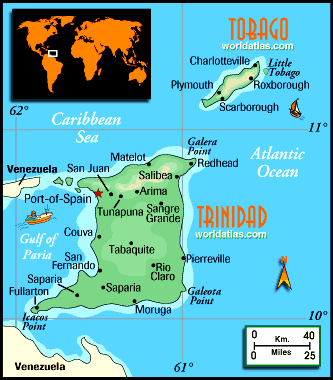
Map courtesy WorldAtlas.com

The quiz questions were designed to slowly help you narrow in on the single location that matched the suite of clues. OK, "designed" is a bit strong, let's just say it "worked out." Let's check out where I was hoping the questions would guide you. Each one should have cut out several possibilities, but I won't list all of them here.

First, remember I was planning to go somewhere "exotic." That should have pointed you away from the U.S., though you never really know: Big Bend in Texas, the Sonoran Desert . . . we live in a richly diverse country, with amazing habitats and exotic species, at least to this New Yorker. But here are the boundaries:

1. Climate
The average temperature in October is reported to be between 76* - 80*F, average rainfall in October is approximately 6.7 inches.

Hopefully this made you think sultry temperatures and fairly frequent rainfall. Probably somewhere tropical or subtropical.

2. Topography
The land is primarily mountains and plains. Naturally occurring wetlands include freshwater marshes, mangrove swamps, lagoons, and marine ecosystems.

Well, that seems to describe most tropical countries, but now we know there's a coast. Mangrove swamps? Clearly somewhere tropical or subtropical.

3. Geographic Location
We will not cross the equator.

That lops out a whole lot of locations, we can focus on tropical locations north of the equator. But I never did limit our destination to the western hemisphere, but that seemed to distract nobody.

4. Culture
The official language is English. We will need passports and to figure out the currency.

Cuts out many more countries, but there are several that require passports and have English as their official language - Jamaica and Belize are excellent deductions! As was T&T.

5. Economy
The infrastructure is excellent, including an international airport, an extensive network of paved roads, modern hospitals, and reliable utilities. At least in the cities.

I'm not sure that disqualifies anywhere at this point, does it? But at this point we know we're looking for an English-speaking, non-American location with a tropical/subtropical climate that boasts a coastline and mangroves lying north of the equator. A few Central American and Caribbean countries certainly qualify. There are probably some African or far eastern countries that fit (but I'm not sure which, and you all seemed to have figured out we're staying in the western hemisphere).

6. Climate
October is both in the wet season and the hurricane season, though we're not really worried about the latter. If we're lucky we won't worry much about the former, either.

In addition to being smack dab in the "Hurricane Belt," Puerto Rico is a US territory: no passport or currency exchange required. The Hurricane Belt factor also eliminates Jamaica, Belize, the U.S. Virgin Islands . . . well, everything except a small handful of islands in the very southern portion of the Caribbean. So, we're left with those choices and perhaps a few islands in the Pacific (that likely don't fit all of the previous criteria). By now you can safely surmise Trinidad and Tobago. All of the other Caribbean, Central American, or northern South American possibilities don't meet all the criteria.

7. Geology and Heritage
Geologically this country belongs to one region, but geographically it's considered part of a different region.

Trinidad and Tobago fits here: geologically part of the South American plate, but culturally considered part of the Caribbean Islands.

8. Flora and Fauna
There are over 400 bird species on the official checklist (466 to be precise). Only one is endemic.

There are a few other islands that have a single endemic, but not over 400 birds on their checklist. Not to mention they don't meet the other criteria.

A hearty congratulations to Nate of The Drinking Bird, not only for correctly pegging the location by the fourth clue, but naming the sole endemic I'll be targeting on our trip (among the other 465 birds, of course), the Trinidad Piping Guan. I hope to be posting about an encounter sometime in late October.

I didn't offer a prize at the outset - I'm not a big proponent of extrinsic motivation, so kudos and thanks to all who participated. But I feel I should offer something to the winner.

So, Nate, if you email me your mailing address I will happily send you one (1) postcard from the islands, replete with a personalized message written by me,* postmarked from T&T.

* Disclaimer: I may pawn off the actual writing of the message to my daughter. She may also choose the postcard. I will pay for the card and the postage.

-

Tuesday, April 28, 2009

Where in the World? Is That Your Final Answer?

Earlier I mentioned we've chosen an exotic location to visit this fall, but instead of blatantly disclosing it I turned it into a guessing game.

We're five clues into the hunt and there have been some excellent deductions. For this last round of the contest I've added three more clues which may help identify the mystery location. Have a read through and either try a guess (if you haven't already), confirm what you wrote before, or make a last minute switch, as you see fit.

1. Climate
The average temperature in October is reported to be between 76* - 80*F, average rainfall in October is approximately 6.7 inches.

2. Topography
The land is primarily mountains and plains. Naturally occurring wetlands include freshwater marshes, mangrove swamps, lagoons, and marine ecosystems.

3. Geographic Location
We will not cross the equator.

4. Culture
The official language is English. We will need passports and to figure out the currency.

5. Economy
The infrastructure is excellent, including an international airport, an extensive network of paved roads, modern hospitals, and reliable utilities. At least in the cities.

6. Climate
October is both in the wet season and the hurricane season, though we're not really worried about the latter. If we're lucky we won't worry much about the former, either.

7. Geology and Heritage
Geologically this country belongs to one region, but geographically it's considered part of a different region.

8. Flora and Fauna
There are over 400 bird species on the official checklist (466 to be precise). Only one is endemic.

There it is. Call your lifeline, spin the wheel, and lock in your answer in the comments! Answer comes tomorrow.

-

Monday, April 27, 2009

Earth Day Wrap-up

Earth Day 2009 turned out to be beautiful in the Southern Tier, at least how I remember it. Yes, I usually record the weather conditions when I am out birding. But on that particular morning I must have been in a more experiential and less data-driven mindset because I have no details. And too much has happened in between, too many other bird lists with weather conditions, so I can't remember a thing about that morning, other than I didn't get wet. It must not have rained.

I grabbed my coffee and headed outside for a few minutes of listening. I didn't expect it to be quiet, I expected birds, frogs, toads, dogs. Closing my eyes to deeply listen showed how much man-made machinery my brain tunes out. The steady hum of traffic from I-86, sirens and car horns from the town, someone running a generator nearby, neighbors heading off to work.

Northern CardinalNorthern Cardinals may duck out of sight, but
their calls are an unmistakable part of our yard.


The birds, thankfully, were at the forefront. Cardinals, titmice, chickadees, nuthatches - the usual suspects in full song. Recent arrivals augmenting the soundscape, Tree Swallows, Chipping Sparrows, phoebes, and blackbirds. Siskins still buzzing, there must be nests around. I'll be watching for fledglings in the weeks to come.

Pine SiskinPine Siskins are sticking around later than usual this
year, and in high numbers throughout the region.


And with promising migration weather rolling in for the weekend, the day list is sure to explode soon (hint: because I'm writing this after the weekend, it did! Shhh, more on that to come.).

Location: Prospect Hill - Home
Observation date: 4/22/09
Notes: Conditions: not recorded.
Number of species: 18

Mourning Dove 2
Northern Flicker 1
Eastern Phoebe 2
Blue Jay 3
American Crow 3
Tree Swallow 4
Black-capped Chickadee 7
Tufted Titmouse 2
Red-breasted Nuthatch 1
American Robin 8
Chipping Sparrow 5
Song Sparrow 4
Dark-eyed Junco (Slate-colored) 11
Northern Cardinal 2
Red-winged Blackbird 3
Common Grackle 1
Pine Siskin 1
American Goldfinch 6

This report was generated automatically by eBird v2(http://ebird.org)

-

Where in the World? Day Five

Earlier I mentioned we've chosen an exotic location to visit this fall, but instead of blatantly disclosing it I turned it into a quiz. Yes, I'm one of those annoying parents, one that rarely answers a question directly when I can get the kids (mine and others) to figure it out themselves.

Previous clues are listed below along with today's additional hint. I'll keep going for at least five clues even if someone guesses correctly, then as long as it takes for someone to figure it out. Each day (or so) I'll post the full set of clues for your convenience - the suite of characteristics should eventually lead you to the right place.

1. Climate
The average temperature in October is reported to be between 76* - 80*F, average rainfall in October is approximately 6.7 inches.

2. Topography
The land is primarily mountains and plains. Naturally occurring wetlands include freshwater marshes, mangrove swamps, lagoons, and marine ecosystems.

3. Geographic Location
We will not cross the equator.

4. Culture
The official language is English. We will need passports and to figure out the currency.

5. Economy
The infrastructure is excellent, including an international airport, an extensive network of paved roads, modern hospitals, and reliable utilities. At least in the cities.

If you've got a guess, or want to provide interpretations, post in the comments!

-

Sunday, April 26, 2009

Where in the World? Day Four

Earlier I mentioned we've chosen an exotic location to visit this fall, but instead of blatantly disclosing it I turned it into a quiz. Yes, I'm one of those annoying parents, one that rarely answers a question directly when I can get the kids (mine and others) to figure it out themselves.

Previous clues are listed below along with today's additional hint. I'll keep going for at least five clues even if someone guesses correctly, then as long as it takes for someone to figure it out. Each day (or so) I'll post the full set of clues for your convenience - the suite of characteristics should eventually lead you to the right place.

1. Climate
The average temperature in October is reported to be between 76* - 80*F, average rainfall in October is approximately 6.7 inches.

2. Topography
The land is primarily mountains and plains. Naturally occurring wetlands include freshwater marshes, mangrove swamps, lagoons, and marine ecosystems.

3. Geographic Location
We will not cross the equator.

Culture
4. The official language is English. We will need passports and to figure out the currency.

If you've got a guess, or want to provide interpretations, post in the comments!

-

Saturday, April 25, 2009

Where in the World? Day Three

Earlier I mentioned we've chosen an exotic location to visit this fall, but instead of blatantly disclosing it I turned it into a quiz. Yes, I'm one of those annoying parents, one that rarely answers a question directly when I can get the kids (mine and others) to figure it out themselves.

Previous clues are listed below along with today's additional hint. I'll keep going for at least five clues even if someone guesses correctly, then as long as it takes for someone to figure it out. Each day (or so) I'll post the full set of clues for your convenience - the suite of characteristics should eventually lead you to the right place.

1. Climate
The average temperature in October is reported to be between 76* - 80*F, average rainfall in October is approximately 6.7 inches.

2. Topography
The land is primarily mountains and plains. Naturally occurring wetlands include freshwater marshes, mangrove swamps, lagoons, and marine ecosystems.

3. Geographic Location
We will not cross the equator.

If you've got a guess, or want to provide interpretations, post in the comments!

-

Friday, April 24, 2009

Radar Ornithology

Regular readers may have noticed my somewhat-regular postings of continent-wide radar images over the past of couple of weeks. These images provide a visual aspect for many birds on migration: since many move at night this is a great way to "see" them. At least indirectly.

"Radar ornithology" is the practice of using Doppler radar to track migrating birds (and, in truth, other airborne objects like bats, insects, and even pollen). There is an excellent tutorial available at Clemson University Radar Ornithology Laboratory, but here's the bottom line: radar shows where birds are moving, in what direction, and estimates of how many are aloft. If you combine those features from the radar with the the weather forecast you can make reasonable predictions about what a morning of birding will produce: does it look like new birds will be arriving overnight? Will they fly right past your area, leaving a paucity of birds in your local habitats? Will a weather system drop the majority in your region (the fabled "fall out")?

Yes, with some meteorological acumen you can determine whether you should call in before the work day begins or if you should save your sick days for another time.

There are several blogs that use radar to comment on migration, some provide interpretation and predict what your morning should look like. I'm not skilled enough to predict fall-outs or where the best locations for your morning birding might be, but I enjoy commenting on what's going on at the moment.

And here's another excellent resource I hope to use more often: friend and science-blogger Paul Hurtado recently reminded our local listserve that he archives radar each night. I find the still images I've posted are an interesting snapshot of that moment in time, but Paul's dynamic loops make migration come alive. Instead of seeing birds aloft, you can watch them explode into the air at sunset, then descend in the morning hours.

Here's a 24-hour loop, starting at 3:00 PM, 23 April through 3:00 PM today (24 April 2009).


If the presentation looks goofy it's because I messed with the aspect ratio.

The blue, circular blobs that appear a few seconds into the loop are the beginning of nocturnal migration. If you look in the map's header there is a clock divided into "night" and "day" to orient you temporally. Because last night was so active it's easier to peg when evening begins by the explosion of blue on the map rather than looking at the clock.

There are a few storms in there, look at the greenish-yellow lines over Lake Michigan and another across Illinois-Kentucky-Tennessee. These dissipate over Pennsylvania and New York by the end of the loop, but as the evening progress you'll see some green mix in with those blue blobs of migration (look specifically across the gulf coast, northeastern Florida and coastal South Carolina, in eastern Kansas and western Missouri): those aren't rain, they represent a huge concentration of birds!

You can find these archives at Paul's radar site, an amazing resource to explore. Hopefully much of May will look like this, but selfishly with more activity over the northeast.

-
Locations of visitors to this page