Showing posts with label Birding. Show all posts

Sunday, May 9, 2010

Biggest Week in American Birding [Alternatives]

It's almost here, the biggest week in American birding! Migrant songbirds have been flooding into the region, birders will be descending into the state to find them, and I will be spending a week searching out the most reliable places to locate dozens of different species. It's going to be awesome!

Yes, this afternoon I'll be heading east on I-86 to . . . what's that? Ohio is west of New York? Right, I'm not that geographically challenged.

Anyway, I'll be heading east . . . what? No, I don't mean west, that'd take me out on to Pennsyltucky. I'm heading to northern New Jersey.

Oh, I know there's a festival where everyone-who-is-anyone will be migrant watching, but I'll be at the original biggest week, that granddaddy of competitive birding: that week-long run up to the World Series of Birding in New Jersey.

I won't be blogging, possibly I'll throw a tweet out now and again, or maybe a facebook update. I will be out at all hours noting any newly-arrived songbirds, pinpointing territories of breeders, staking out any lingering winter birds, searching for raptor nests, listening for what may be lurking in various wetlands, chasing a vagrant or two . . . a little bit of everything.

I've done this before, but this year already feels like a whole new ball game. The "Big Day" is late (mid-May!) and spring came early this year (not astronomically, but ornithologically). Usually we're scrambling to find the newly-arrived warblers, hoping the Canada Warbler is back on its territory before Saturday, hoping the Tennessee, Bay-breasted, and Blackpoll Warblers (the harbingers of "the end of spring migration") will have reached this far north. This year, they're already there! Leaves are out, Blue-headed Vireos have already quieted down, replaced by their ubiquitous Red-eyed brethren.

It's not all fun-and-games, sleep-deprivation, and supplementing our year lists. You can read how we use the competition to fund conservation work (and meet the team, hear additional stories, and more) at the Lab's web site.

Finally, you can follow my tweets (no promises, I may need those precious seconds for quick cat-like naps), as well as those from the Sapsuckers through the week and especially on the Big Day, which runs on Saturday, 15 May this year.

Wish us luck!

-

Thursday, February 11, 2010

Counting Crows . . . and Jays and Chickadees [Fun & Games]

The annual Great Backyard Bird Count is on, let the games begin! Every day there are thousands of people watching birds across North America. Over the next four days (Friday, February 12th through 15th) there will be thousands of people watching and counting birds across North America, some for the first time, all to create a snapshot of where the birds are spending their winter. It's simple: observe birds; track a few necessary details (like when, where, and who); and upload your list on the easy-to-use web site.

Well, check out this video, it's worth a thousand-word blog post all on its own. You'll learn the whats, wherefores, and how tos. But also explore the web site to learn about birds, to see how your submissions are used by scientists, to see photos from past counts, and especially to get ideas on how to involve beginning birders and kids - from past experience I can tell you, it's great for kids!


The GBBC is a great excuse, if you need one,
to get your kids involved with nature.

Granted, watching birds is the best part. But it's a real trip to watch the map as it regularly updates throughout the weekend in near-real time with the most recent submissions, to track how many checklists come in from your town, and to see what birds are being seen where.

So, if nothing else, try and get out and collect a few checklists. Even better, attend a bird walk or workshop at a local nature center, or just get a few others out with you and introduce them to nature and citizen science. I'll be covering where I can in my county, will you do the same?

-

Monday, October 19, 2009

Change of Plans [Turn and Face the Strange]

My 40th birthday trip was coming together. We picked a destination and our itinerary was taking shape. The twin themes of this trip, Balance and Change, were emerging quickly, with a third soon to appear.

The Balance challenge was clear: how to spend as much time as possible seeing new birds while keeping a 5-year-old entertained? Reina is perfectly happy on nature walks and birding stops, but up to a point. Anyone with kids, or socially maladaptive non-birding partners, knows how unpleasant it is for everyone involved (or just nearby) when disinterest sets in. My hardest challenge was scheduling our trips with Reina's threshold in mind.

Change, of course, is inevitable, the best laid schemes and all that. Almost immediately we found our plans had to change: Asa Wright Nature Center, heralded as Nirvana on earth by every birder that sets foot on Trinidad, wasn't available as our primary lodging. The vast majority of trip reports and trip itineraries always stayed at AWNC, but when we found out kids under eight weren't welcome for overnight stays we had to regroup.

I couldn't think of any alternative mentioned in those reports. Images of settling for a Trinidadian Holiday Inn or Super8 in the bowels of Port of Spain, far from any birding site we'd want to visit, crossed my mind with pangs of nausea. This trip wasn't shaping up the way I expected.

I freely admit to quoting wisdom from wherever I find it, including old Monty Python skits. "Adapt, adopt, and improve" became my mantra as I searched for alternate accommodations, and a wonderful things started to happen. Maybe deviating from the standard T&T birding trips that every other birder experiences was a good thing.

Yes, I'm talking additional blog fodder! Clearly, the birds were going to be front and center, but now, instead of copying the same "rum punch on AWNC's verandah" theme as everyone else, I could offer potential T&T visitors insights to other options. I could compare my bird lists and experiences from locations I ferreted out to the standard package they signed on to. Perhaps I could score some free lodging or excursions in exchange for publicity!

That's my lemonade making attempt. Yes, I can offer a differing view to the standard AWNC package, but I didn't score anything free. (Note to self, work on the marketing power of this blog.)

So, here is an overview of the secondary itinerary we created. I will be writing in more detail about each stop, including informal reviews of the lodging, the birding; the whole roti (we didn't see enchiladas anywhere, but rotis are a reasonable substitute).

  • Day 1: Arrive late, stay at Pax Guest House, Tunapuna, Trinidad
  • Day 2: Bird Mt. St. Benedict, coasts and wetlands, and Caroni Swamp.
  • Day 3: Bird savanna and grassland sites, stay at Laguna Mar, Blanchisseuse, Trinidad.
  • Day 4: Bird in the forests of the Northern Range.
  • Day 5: Fly to Tobago, stay Naturalist Beach Resort, Castara, Tobago.
  • Day 6: Bird Tobago: Main Ridge Forest Reserve and Little Tobago Island.
  • Day 7: Tobago birding in the morning, then fly to Trinidad, returning to Pax Guest House.
  • Day 8: Early flight back to U.S.
Up next, the trip! And photos, I swear. Oh, and I'll get to that third theme I hinted at but didn't identify. Maybe you can guess?

-

Friday, October 16, 2009

More Vacation Planning [What We Gonna Did]

Now that the hard part of picking a country to visit was out of the way (by a process delineated earlier) I could get down to the serious business: the itinerary. That may sound somewhat benign, but only until you realize that beneath my mellow and laid-back exterior lies the intensely anal-retentive persona of recidivist OCD patient. I would now need to chart out every minute of every day, knowing where we'd be, give or take a square meter or two. Maybe two. And layered on top of those parameters, what birds would be there? What birds would be likely, what would be within the realm of possibility but in the don't-hold-your-breath category?

Time to dig out the books and scour the Internet reports.

First task, figure out what birding areas Trinidad has to offer. Not unexpectedly, rainforests. But also dry forests and savannas. Obviously wetlands and coasts. Plus a whole sister island called Tobago.

To check off as many species as possible we'd have to spend time underneath the multiple-canopied habitat to find forest birds, in grasslands for birds adapted to open habitats, on rocky coasts scoping for pelagic species, beaches and mudflats for shorebirds, inland wetlands and/or rice fields for rails, crakes, blackbirds, and others, and we'd have to pull the car over to examine any raptor we came across, perched, soaring, or otherwise . . . man, this could be dizzying.

But Trinidad birding is weighted towards the central and northern regions, likely due to the industrial presence south side of the island. I can't say first hand, but it sounds as though it's pocked with oil wells and refineries. In fact, every gringo we met on Trinidad was affiliated with the oil industry, the exceptions were those that were tourists or owned a guest house.

Either way, given our time frame we opted not to route in the south side of the island. Given more time we would have explored the southern sites outlined in Murphy's Birdwatchers' Guide to Trinidad & Tobago and what turned up in Internet searches, but for this trip our choice was clear: stick to areas on the northern side of the island. Options we focused on included:
  • cruising Blanchisseuse Road for forest birds at a variety of elevations,
  • joining an evening trip to Caroni Swamp to see the Scarlet Ibises come in to roost and, hopefully, find a few specialty mangrove-affiliated species,
  • scoping Waterloo for shorebirds, gulls, and terns
  • surveying the Caroni Rice Fields for rails and other freshwater wetland species,
  • visiting Waller Field, Aripo Savanna, Aripo Livestock Station, and the Arena Forest for low-elevation and grassland birds,
  • exploring Nariva Swamp on the east coast for a different suite of coastal wetland birds,
  • and, naturally, staying at Asa Wright Nature Center - its reputation alone made that decision a no brainer.
Oh, and Tobago. Not a twin sister of Trinidad, but completely unique avifauna. Reading through the distributions in the field guide I was surprised at how many species are on one "T" or the other, but not both. The phrases, "Absent from Tobago" and "No records for Trinidad" showed up more frequently than I expected. Clearly we'd have to get over to Tobago for a couple of days, but should we take the cheaper, but 5 and a half hour, ferry? Or splurge on the 20 minute plane ride? We'd deal with that later.

Our Trinidad plans changed almost immediately. It turns out that staying at Asa Wright would be prohibitively expensive on our budget, even in the "off" season (aka, the low-, rainy-, or the more euphemistic-sounding "green"-season). But more to the point they have a policy that disallows children under eight staying at the center, so it wasn't really an option anyway. After flirting with the idea of letting five-year-old Reina get her own lodging somewhere else we thought about staying at Simla, aka the William Beebe Tropical Research Station,, the neighboring facility that houses researchers. I had been considering doing some sound recording anyway, and Donna is collecting slime mold samples this semester while on sabbatical. Sampling a few sites in the mountains of Trinidad would surely be novel for slime mold research.

We ultimately decided this was vacation, we didn't want to be tied to anything, so Simla was out. We started to re-evaluate our options, where could we set up base camp where we'd be lulled to sleep by Tropical Screech-owls, Little Tinamous, Ferruginous Pygmy-owls, hopefully a nightjar or two, and still make all of the relevant day trips we had planned?

Hmmm, maybe this wasn't going to be as straight-forward as I originally thought.

What's next? Find out here!

-

Thursday, October 15, 2009

Vacation Planning [Where the Birds Always Sing]

For those with short memories (like me), or those that don't read everything I post here (also like me), I offer this background to our recent trip to Trinidad and Tobago. You can also read about our then-far-off trip in a post from last April. - Mike

It's not often you find yourself on a tropical island after making an offhand comment. Well, unless you live on a tropical island, then you can't really help it. But my point is I've never found myself on a tropical island because of something I tossed out without really thinking.

Last autumn, long before I thought about staring my 40th birthday squarely in the eye, my wife asked, "So, what do you want this year? I mean, 40. It's a big one. Maybe a new guitar?"

I'm satisfied with my current stringed instrument status and there wasn't anything else really on my wish-list horizon. It wasn't until December, probably while enviously reading about someone else's exotic birding trip, I mused, "You know what? I want to travel. Somewhere new. Where there are lots of new birds to see. Lots of birds. I want to be overwhelmed, reduced to weeping and cowering at the sheer volume of new species. New genera . . . no, new families of birds."

I guess I said it out loud, and within earshot of Donna's bat-like hearing, so we discussed the options. After a few days of financial analysis, some debate, a touch of arguing followed by copious amounts of begging and pleading, my logic finally prevailed. "All right, we can make that happen," spoken with just the right amount of resignation. This would be a birthday to remember.

Now, where to go? Initial thought: Peru. I'd been talking with colleagues at the Cornell Lab (including Tom Schulenberg, author of The Birds of Peru) and Peru kept coming up, usually instilling a faraway, dreamy look in everyone's eyes. But that's just one possibility. What about Ecuador? Chile? Brazil? Panama? Belize? Mexico?

I had already ruled out trips to Africa, southeast Asia, Australia, New Zealand, and others, I felt those are more in line with the half-century mark. Staying within my home hemisphere was more of a 40-ish celebration.

But in there lay a rub: I didn't want a trip just for me, I wanted to go with my wife and daughter. I love birding pre-dawn to after-dark and racking up lifers as much as the next lister, but I wasn't anxious to spend 3,000-plus (after travel) of our well-saved US dollars so I could be led around a new country, bird by bird. Well, I was anxious, but it wouldn't mean as much. Of course I wanted to see lots of birds, but I wanted my family to experience the vacation. I would have my cake and I would it eat it, too, dammit.

The question became whether my target countries offered enough to entertain a birding-friendly spouse and a five-year-old. She's great on hikes and experiencing nature, but to a point. What about a place that offers new birds, interesting hikes and critters, and beaches? What about the Caribbean?

I'll spare you the island-by-island evaluation, but by early spring we ultimately, and happily, settled on twin Caribbean islands that lie on the South American plate. Not a big endemic list (one: Trinidad Piping Guan), but a reasonable species list (467, according to a recent check on Avibase), lots of interesting families represented, easy to get to, and travel domestically once there. Perfect. And T&T is a well-established birding destination, meaning lots of information available about where to stay, when to go, what to do.

The "when" question was answered by the other obligations already on the calendar, which whittled away at dates until we were left with the beginning of October.

The next phase of research was set to begin. Where do those 467 birds spend their time when they're on T&T? And how do we route them into our vacation? That turned out to be a fairly easy question to answer.

At least in theory.

-

Monday, October 12, 2009

A Walk in the Woods [Put the Lime in the Coconut]

The woods in our region are bursting with color, an event that shouldn't come as a surprise to anyone who has spent an October in the northeastern US. The air is crisp and cool downright cold, the sky a swath of pale blue above that darkens towards the horizons, punctuated by dozens of airy, aimlessly wandering clouds.

I haven't posted about any bird sightings or movements from our area as I haven't paid attention to what's been going on in our yard, or our region, for the first 10 days of October. Yeah, it's kind of tough to do when you're offline and 2,300 miles away. Not that it's tough to find an Internet connection on Trinidad and Tobago, they're there if you really want one, it's tough to be distracted from what's all around you.


blanchisseuse-Arima Road, TrinidadThe view along Blanchisseuse-Arima Road, Trinidad.

The woods we've been walking through aren't the temperate maple-oak assemblages we call home, but tropical mash-ups that include teak and nutmeg covered with hundreds of epiphytes and wrist-thick vines. We hunted among the foliage for glimpses of trogons, bellbirds, and manakins in the rainforest. Tropical Kingbirds, Great Kiskadees, and Ruddy Ground-doves lined the streets while Magnificant Frigatebirds, Brown Pelicans, and Brown Boobies soared above rocky coves as well as those lined with sandy beaches and palm trees.

Castara Bay, TobagoCastara Bay, Tobago.

I'll be recounting our trip over the next few weeks, narrating our adventures, giving recommendations based on our experiences, and of course presenting as many sights and sounds as I can. Stay tuned, but please be patient: I have lots of pictures and eBird checklists to process!

-

Thursday, August 6, 2009

The Rising of the Moon

Two important things about tonight, as far as I'm concerned. First, it's late and I'm tired so this won't be as detailed as it deserves. Heck, it probably won't be as focused as it deserves. Second, tonight's moon is beautifully full and worth spending a few minutes gawking, or at least staring, at it.

Full moon by Luc Viatour, courtesy Wikipedia.com.

Take some time to watch the moon, preferably through a scope so you can watch for birds flying across its face, though let me say this up front: WARNING: a full moon is bright, especially through a scope! Don't damage your retinas!

Here in the northeast, it looks like a good night for migration and a good night for observing it. Under a full moon you can observe migrating birds not only by ear as many give a characteristic flight call, but by sight, too, as they pass in front of the full moon. I spent some twenty minutes outside photographing the moon (not my image above, though, they're still on the camera). To be perfectly honest, I didn't see anything cross the moon as I stared through the camera, which wasn't optimal but I was too lazy to swap the camera for the scope on the tripod.

I did hear several flight calls, and by mid-morning tomorrow I'll know what my roof-top microphone recorded. I've been testing a new recording unit since early June, and I've impressed myself by analyzing each and every recording within a day or three after it happened. Things I've learned:
  • I record a lot more cuckoos, both Black- and Yellow-billed, during the breeding season than I see.
  • The local Ovenbirds give a beautiful flight song pre-dawn on our hill.
  • A Dark-eyed Junco likes to perch on the microphone.
  • Northern Cardinals are the earliest songsters.
  • Migration has already started. So far I've recorded American Redstarts, Yellow, Canada, Black-throated Green and Magnolia Warblers, Northern Waterthrushes, Chipping and White-throated Sparrows, and several yet-to-be-identified species. That's off the top of my head, not a complete list.
  • My neighbor's dogs bark a lot.
  • The resident coyotes howl a lot.
  • We have several vocal amphibians in our pond, and they have the stamina of a Tour de France competitor.
  • My other neighbor likes to blast classic rock every Friday night and occaisionally Saturday.
More to come as the migration season continues.

-

Thursday, July 30, 2009

Sapsucker Woods Heron Nest Progress: They Fledged!

From the photo files of 28 July 2009 . . .
Hint: click images for larger versions.

Adult Great Blue HeronAn adult Great Blue stalking along the pond's edge.

We knew it would happen one way or another: eventually, the Great Blue Heron nest would empty out. We all hoped for a successful fledging, but as anyone who observes the natural world knows it doesn't always turn out the way you wished. This was the first nesting attempt by Great Blues in Sapsucker Woods, so it's understandable there was a bit of trepidation underlying our excitement. We tracked the progress ever since the first stick was laid back in April, and now I'm happy to report a successful fledging. As of 9:00 AM this morning the nest was empty after the fourth bird took flight, the other three left ten minutes earlier.

Juvenile Great Blue Herons in nestOn Tuesday all four, appearing fairly comfortable in their now-tight-fitting nest.

This was to be an update post with some photos I took two days ago, but instead of marking progress the images serve as a reminder. Ah, the memories. Remember when the young were still in the nest? That was cool.

Or is it too early?

Juvenile Great Blue Herons in branches of nest treeRecently the young ones have spent time spreading out among the snag's branches.


Juvenile Great Blue Herons in branches of nest treeMore and more they exercised their wings, readying for that first flight.


Juvenile Great Blue Heron exercising its wings
I suspect the new fledglings will stick around, if I find them on my walks I hope to capture instances of them learning to behave like adult herons. Remember that first meal you had to cook by yourself in your first apartment? They're going through the same thing, but likely without the visit from the fire department.

-

Wednesday, July 22, 2009

Elbow Room

More from the photo files of 17 July 2009 . . .

After taking some time to photograph a pair of fledgling sapsuckers and a fledgie Great Crested Flycatcher, displayed in yesterday's post, I finally made it to the shore of the pond, my initial goal. Now I could spend some time shooting images of the still-occupied heron nest. They're awfully big, you'd think too large to all fit into the nest.

Nestling Great Blue HeronsAll four juvenile herons are still living at home.

But they do still fit. I'm told that earlier in the week, when storms were passing through with some high winds, they hunkered down while one of the adults crouched on top of them, shielding them from the weather. I kept thinking of some old commercial where the mechanic, holding some monstrosity of a muffler, assures the unbelieving customer, "we'll make it fit."

Nestling Great Blue HeronsI get mixed messages from this pose. Some seem so bored they
just sit and stare at one another, others turn their back.
I assume because they're sick of each other.

Reina and I have been watching some Schoolhouse Rock videos on YouTube. If you remember them, they're some of the catchiest tunes around. As my mind is wont to do I started humming one as I watched them stretch and flap their wings, bobbling around one another:

One thing you will discover
When you get next to one another
Is everybody needs some elbow room, elbow room.

It's nice when you're kinda cozy, but
Not when you're tangled nose to nosey, oh,
Everybody needs some elbow, needs a little elbow room.


(Author's note: It's worth watching so it'll be stuck in your head, too. Damn you, catchy songwriters!)

Seems apropos, especially when they exercise their wings. There's not much room to really stretch without whacking a brother or sister, and they often seem to tangle their nosey-noseys.

Nestling Great Blue Herons
I'm hoping for a huge coincidence, that one of my irregular walks will coincide with one of the birds leaving the nest for the first time. Really leaving the nest, a full-blown launch off the platform to fly to parts unknown. Or at least to gracefully soar to the pond's edge. Or, more likely and more fun to photograph, clumsily bomb their way to the earth's surface.

Nestling Great Blue Herons
There was a false alarm on Monday, 13 July. I was catching up on my work email and I came across two posts announcing one bird had fledged. Turns out the bird had left the nest, fluttered to a different branch or two, but then return to the nest a little while later.

I know it's a tough economy, but c'mon, kids! At one point you gotta strike out on your own!

For more images, and more impressive images, check out Laura Erickson's Flickr site. Laura occasionally posts about the heron family, too.


-

Tuesday, July 21, 2009

The Young Ones, or A July Walk in the Woods

From the photo files from 17 July 2009 . . .

I complain, quite a bit, that I don't get out enough to look at birds, that all my birding is "yard watching." Which is ridiculous! I mean, I work at a world-class ornithological institution that sits in a 220+ acre wildlife sanctuary. You'd think it would be as easy as walking outside.

Well, it is. But I often get wrapped up enough, or fall far behind enough, in work-related "things" and the end of the day arrives before I've made it outside. So much for my time management skills, such that they exist.

Last Friday my camera and my binoculars found their way into my peripheral vision during my working lunch. I didn't hesitate. I grabbed my camera, left my binoculars, and embarked on a brief photo safari.

Juvenile male Yellow-bellied SapsuckerYellow-bellied Sapsucker, totem bird of Sapsucker Woods.

The first bird I stumbled across as I entered the woods was the sanctuary's namesake. In the most recent Living Bird John Fitzpatrick writes that exactly one hundred years ago, when Yellow-bellied Sapsuckers were "unheard of in the wide-open, glaciated farmlands around the Finger Lakes," Arthur Allen and Louis Agassiz Fuertes discovered a pair nesting in an isolated woodlot a few miles from Cornell University. Fitz continues, "this was a prize find, because this migratory woodpecker bred mainly in the aspen and birch forests of Canada. This was the first documented breeding in New York's southern tier."

Today, they are common. So common, in fact, the single bird was almost immediately joined by another.

Juvenile Yellow-bellied Sapsuckers
Not as cryptic as a Brown Creeper, but their mottled back
and barred tail camouflage them against the tree trunk.


OK, it's not like the woods are swarming with sapsuckers on every tree. I'd crossed paths with two juvenile birds, likely siblings from the same nest cavity. Though they showed the classic marks you'd expect from a YB Sapsucker -- the face pattern, the white wing patch, the overall mottling - these birds wore more subdued plumage. They were overall darker, brownish rather than black in the facial markings. Also missing were patches of red on the throat and cap, sported by adult males, or solely on the cap (at least to some extent) as an adult female would show. The first bird did have reddish tinging on both the cap and throat, indicating he was a juvenile male. I didn't note any such tinging on the second bird, perhaps a female.

They were moving quickly, the blurriness in my photos wasn't only from hand-shake, and soon left me far behind. I watched as they scrambled around one tree trunk, flew awkwardly to another, scrambled again, fluttered to yet another trunk, then another.

No time to dwell on them, I was already faced with my next bird, one perched not too far off the trail. It sat with its back to me but head craned to the side to watch what I was doing. It was agitated, turning right, then left, then right again, in rapid succession. It was so agitated it bounced, as though it was launching itself into flight but forgetting to release its grip on the branch.

Fledgling Great Crested Flycatcher
One of my favorites, a Great Crested Flycatcher, and this one appeared to also be a juvenile. I say that based on the broad edging to the primaries and the greater and median wing coverts (your thoughtful analysis welcomed!). What convinced me it was a recent fledgling, later when I blew up the images, was the gape, clearly visible at the back of the mouth, something that young birds show but isn't visible on adults.

Somewhere nearby was a parental flycatcher, which made its presence known through near-constant wheee-eep calls, a sign of excitement. I wondered if the fledgling in front of me was agitated because of me, or if it was feeding off the parent's intruder warning, the avian "Danger, Will Robinson, danger!"

The bird appeared torn between wanting to flee and wanting to stay its ground. Eventually it successfully launched itself deeper into the woods where I lost sight of it; abruptly the parent's panicked calls stopped.

Young ones. That's what July birding is all about here in the southern tier of NY. A brief period where we can watch fledglings explore their new world, with or without their care givers. I started humming the theme song of The Young Ones, a British comedy from the early '80's. While I doubt lyricist Cliff Richard was thinking of birds (but who knows, I'm starting to think everyone in England is a birder to some extent), his lyrics were appropros.

We're young ones,
Darling we're the young ones,
And young ones shouldnt be afraid.

Love, me,
Theres a song to be sung
And the best time is to sing while were young.

To live, love
While the flame is strong,
For we wont be the young ones very long.

Very birdy, yes? Enjoy your summer birding!

UPDATED to announce: if you're interested in nestlings, four to be exact, the trip continues here.

-

Tuesday, July 7, 2009

Bird Handling Changes a Life

From the photo files from 17 May 2009 . . .

Our daughter, Reina, is five, and if you ask her career aspirations and goals she'll tell you she's strongly drawn towards education and the service industry.

Not in those words, of course, she just blurts out, "I wanna be a teacher and a waitress." And yes, we know she'll need that second income if she's gonna be a teacher.

But that all changed on a cool and sunny morning this past May. We were headed for an overnight to Rochester, NY, partly to visit my folks, partly to visit the Braddock Bay Bird Observatory's Kaiser-Manitou Beach Banding Station. I've been anxious to introduce Reina to bird banding, to the idea of handling wild birds to learn about them. This spring seemed perfect. She's not old enough to process the birds, of course, but she is old enough to appreciate what was going on and why. And not yet old enough to be jaded and cynical about the experience.

We planned to meet Laura Kammermeier, friend, fellow blogger, and former colleague who conveniently now lives near my folks, at the observatory's headquarters along the shore of Lake Ontario (Laura recounted her take of that morning's events, along with fantastic photos, in Bird Banding @ Braddock Bay Bird Observatory.

We walked in the door of the small, rustic facility and found a dozen animated folks busily interacting around a tall table. It was like walking into a local bar, where everyone pauses, glances over at the newcomers to give the ol' once over, then went back to their business. We weren't sure what to do, or what not to do, so we walked over to see what everyone was doing.

As we sidled up a woman turned to Reina, who was sporting the remnants of a butterfly face-painting from the day before, and asked, "Have you ever heard a hummingbird's heart?" To my surprise and complete joy Reina did not grab my leg and hide behind me.

"Nooo . . ." she sounded intrigued but unsure of the whole idea. She knows humans have hearts from playing with the models in the anatomy lab at my wife's college, but I'm not sure she transposed that information to other animals.

The woman crouched next to Reina held a Ruby-throated Hummingbird to her ear. As much as I wanted to hear the beating heart I stayed back and took pictures of a watershed moment. Her expression is all you need to realize something pivotal just happened in her life.

A Hummingbird's Heart"I can hear its heart beating?
I can hear its heart beating!"

Reina watched her finish processing the bird, then got an offer I was hoping would come. "Would you like to release the hummingbird?" Again the expression of uncertainty, so I explained.

"They got all the information they need from measuring the bird in here, now they let it go back into the wild. Let's go outside, and you'll get to hold the hummingbird until he decides to leave. You know, if you want to. Otherwise I'll do it." I was only half-goading her, I really wanted to release a bird!

"No, daddy! I can do it!" Yeah, she wanted to.

Hummingbird ReleaseReina held the male Ruby-throated Hummingbird, waiting for him to
either realize he's free to go, or to decide he was ready to take his leave
of all of us. He stuck around for about 30 seconds before taking flight,
29 seconds longer than it took for Reina to contemplate a new career path.

Then it was back inside to watch more processing of birds. There was only one hummingbird banded while we were there, but plenty of other action. The banding crew was extremely generous about letting us watch up-close-and-personal, especially the students of the banding class that was underway. We didn't even realize, everyone was so professional!

Mourning WarblerA male Mourning Warbler: one of the most
beautiful birds we saw that morning, maybe because
they are so skulky and hard to observe in our region.


Northern WaterthrushI'm always amazed how different birds look in the bander's grip compared to seeing
one in the wild, like this
Northern Waterthrush. It appeared so different than a
Northern Waterthrush in the wild, where they're behaving waterthrushy.


Swamp SparrowAnother bird of subtle beauty like the waterthrush:
the warm tones of a
Swamp Sparrow.

Back to the flashy colors of the warblers. This is another of my favorite images I've captured this year, a college student processing a Magnolia Warbler. Though technically accurate, "processing" sounds too clinical here, there is much deeper going on in the relationship between researcher and specimen. (And my sincere apologies: I did not catch the student's name, though we talked quite a bit - turns out she attends my undergrad alma mater, Hobart and William Smith Colleges. This photo deserves a more personal attribute.)

Magnolia AppreciationOpen caption: how would you describe this moment?


Magnolia Warbler ReleaseAgain Reina does the honors, though the Maggie didn't stick around.
He merely bounced off of Reina's open palm, off to turn his fancy
to flights of love. Or something more avian, but along those lines.
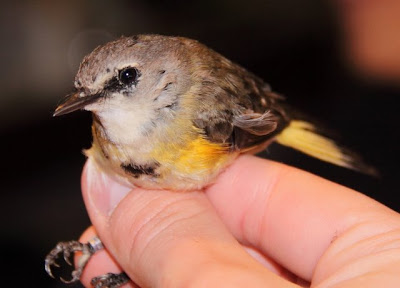

American Redstart, young maleSome birds don't look like what you're used to seeing flitting about in the trees,
like this young male American Redstart. Yellow where he will eventually be
orange (like a female), but the black lores (area between the eye and the bill) and
the black feathers coming in on his breast, face and cheek confirm he's a male.

Not all the captured species have been absent from our New York backyard since last fall, plenty of year-round residents are caught in the nets. Of course, they're processed, too: collecting data on our common birds is in lockstep with the goal of keeping them common.

Blue JayBlue Jays, though familiar in western New York year-
round, do migrate. This bird may be returning from a
mid-Atlantic state where the winters are more moderate.


Green DarnerNot all the captures are avian, either. Dragonflies, such as this common
Green Darner, are gently removed and released when caught.

In the 90 minutes or so we stayed we saw some two dozen birds pass through the capable hands of the BBBO staff, volunteers, and the students, each released adorned with a flashy silver band stamped with a unique identifying code by the Fish and Wildlife Service. If any of these birds are captured again they'll provide an important piece of information about that bird's travels and condition, shedding insight on the species as a whole and migration in general.

Through it all Reina helped release a few birds, as well as followed the banders as they checked the nets for newly caught birds (nets are checked every 30 minutes, at least). Actually, she only followed during the first net run. She lead the way on the subsequent trips.

Now ask her what she wants to be when she's grown and you'll hear, "I want to band birds, be a waitress, and teach." The requisite crack still applies, you're going to need the combined salaries to make ends meet. At least she'll be well rounded.

-

Friday, June 19, 2009

Great Blue Heron: Gone Fishin'

Yesterday I posted a teaser, for which I apologize. I'm no fan of cliff-hangers. I want resolution now, I don't want to carry it around for a week, something conditioned by those one-hour CSI, Law&Order, and Desperate Housewives shows. That said, I'm glad you're back to see how the Great Blue Heron went from "I'd like a fish" to "I got one!"

Heron sightings are abundant this spring in Sapsucker Woods, you only need to look at the nest they built to find one. During, or shortly after, their nest construction I found one perched on a downed log near the middle of the pond. Hoping to photograph the bird in flight, maybe delivering a stick back to the nest, I set up the camera and waited. I didn't catch a return to the nest sequence, but watch the embedded slideshow below (man, I hope this works) to watch what I captured. You can also visit the web album to view the (larger) still images.


If that worked, you will have witnessed a couple of events I found interesting. First, I won the staring contest. You can see in the first slide the intense glaring I received for about a half-minute, and then the moment of victory (second slide) when the bird was distracted by something in the water. But I had no time to savor the moment.

The second event relates to heron foraging behavior. As Great Blues are fairly common almost anywhere there's water, and they are such large, easily observable birds, I'm guessing most everyone has watched one snag a prey item at one point or another. If I'm right, you're familiar with the methodical stalking as they patiently step their way through the water or across a field, leaning forward as they sight a fish, amphibian, reptile, mammal, bird - they're really not that picky.

The actual capture takes but a second. A rapid thrust of the neck and head, and voila! Before you can blink they've got something tightly squeezed between their mandibles.

What I've never seen was a heron jump in the water from dry land, or floating log, after something, and almost fully submerge below the surface. But this one did, and, best of all, it came up with a snack. I particularly like the image of the bird returning its gaze towards me with the, "That's right, homeclown, I got the fish!"

It's always satisfying to witness a successful hunt, the food web in action, especially when it includes a new method of food capture. At least, this was a new method to me, perhaps you've seen this before?

-

Thursday, June 18, 2009

Photo Files: Great Blue Heron, With Snack

From the photo files of 12 May 2009 . . .

Great Blue Heron after capturing a snack.
Click on the photo for a larger image.

In early May, after/during the construction of the Great Blue Heron nest at Sapsucker Woods, I found one of the herons standing quietly, taking in its surroundings. As I sat and watched, also quietly, it captured a relatively small fish. I was lucky enough to capture the sequence, which ended with the bird flying off to the opposite shore where I lost track of it.

Next up: the full fishing sequence.

-

Wednesday, June 3, 2009

The WSB Scouting Chronicles, Day One

Someone recently lamented birding competitions like the World Series of Birding can be so impersonal: you hear about "the team," then you hear a final number, and if you search, a species list. What you don't hear are the details of the human experience, how those species were added, and how others were missed. Those stories are arguably the most interesting part of a Big Day. Though I can't offer all the details on what happened on the Big Day I can highlight some tales from the scouting trail.

06 May 2009, Milford, PA
I pulled into Milford right at 6:00 PM. After fitting a full work week into two-and-a-half days I could now shift my focus to helping the Sapsuckers scout the northern New Jersey counties for the Big Day competition, which kicked off in a mere 54 hours.

First problem: where was everyone?

The others arrived in Jersey between the Sunday and Tuesday before the Big Day. Priorities change minute by minute so the plan was for me to call the other northern scouts when I left Ithaca to find out the latest. As I headed south on I-81 former Sapsucker captain Ken Rosenberg (Director of Conservation Science), debuting in an advisory role, relayed the birds he was listening to in the Delaware Water Gap as we talked.

"When you arrive - Cerulean - at the motel, why don't you - Worm-eating - give a call - Blackburnian - and we'll figure - another Cerulean - out where to send you." Giddiness kicked in, I pressed the accelerator a bit harder. For someone who birds sporadically and briefly, immersing myself into solid birding for two days of spring migration was going to be heaven.

When I arrived at the Milford Motel the clerk had no idea who I was, and more importantly had no reservation for me. I started to wonder if I should be in Milford, NJ instead of Milford, PA, though the NJ one is a bit far south for where I'd be scouting. Eventually it all worked out, I was in the right place, now I just needed for someone to get back into cell phone range. Rather than wait in a lonely motel room I crossed the Delaware River into New Jersey to re-visit my old stomping grounds. I'd scouted Sussex county extensively between 2000 - 2004, and I was anxious to see what changed.

Not much, it turned out. Really, everything looked familiar. The soundscape was subdued, the evening chorus quiet compared to what the morning would bring. This evening held a Hermit Thrush's song here, a Blue-headed Vireo's there, but mostly quiet. I finally got word to meet the crew at the Sussex Queen Diner at 8:00 PM for the daily debriefing and to receive scouting assignments. Almost an afterthought, we could grab a bite, too.

Because of the way roads are laid out in this area it's a slow, winding meandering to get anywhere in Sussex county. I stopped at a small marsh in High Point State Park to listen for anything interesting. I verified a Yellow Warbler singing its secondary song, one that mimics a Chestnut-sided Warbler, while cars blew past the turn off. When one turned in I guessed it would be another WSB-affiliated birder. Birders from all teams are crawling all over the northern counties, concentrating on a target areas. Much like a fall out of songbirds in a patch of good habitat, you can get congregations of birders at these hotspots.

I was right. The car stopped, and there was Ken. Not just any WSB-affiliated birder, but the one I was looking for. We caught up for a few moments, then headed off independently for a couple last minute checks before meeting at the diner. Ken sent me to a small wetland to find out if any marsh birds were calling, he followed up on a report of needed birds at a different marsh. His site was a bust, I couldn't find my site at all. Using the New York DeLorme to get around northern NJ might not be a good idea.

Thirty minutes later I walked into the diner. Current Sapsuckers Marshall Iliff (eBird Project Leader) and Tim Lenz (eBird programmer) were poring over their NJ atlases, Ken highlighting historic territories of some much-needed species. Lewis Grove (fellow scout, flight-call researcher), was relaying his experiences from the day to Sapsucker Andrew Farnsworth (project leader on flight-call research and terrestrial acoustic monitoring). All looked somewhat frazzled, and it was only Wednesday.

Cloud-covered moon over New JerseyClouds rolled in covering a near, but not quite, full moon.
Unfortunately, they brought rain. A lot of rain.


Over dinner the Sapsuckers explained the strategy they were planning for this year and where some key birds were staked out. Around 9:30 I headed out for my evening assignment: visit three sites known to have Northern Saw-whet Owls, listening for any spontaneous calling. Saw-whets are certainly present in NJ in May, but whether they'll call during the time allotted for a stop is always questionable.

Given I just had to stand quietly and listen it was a relatively easy evening. The hard part was standing in a steady downpour, at times torrential, listening from the narrow shoulder of the road. Traffic was minimal, but each time a car approached my mind wandered to every horror story and urban legend I ever heard. I recalled a disproportionate number of them that take place on rainy nights on isolated roads.

The rain let up a bit at my second stop, where I parked and hiked in to the site. It was startlingly black, no town lights, street lights, headlights; no moon or stars. Half a mile later I didn't hear any owls, probably because no owls called, possibly due to a loss of hearing when I crossed a wetland full of Spring Peepers. The third stop was equally unproductive for owls, but helped me reorient myself to some sites I'd be visiting again in daylight hours for different birds.

When I returned to Milford (PA) it was nearly midnight. I reviewed my plan for the next morning, which would start by listening for Ruffed Grouse at 5:30, a perfectly reasonable time of the morning. Previous years started much earlier. The extra sleep would be welcome.

-

Tuesday, May 12, 2009

I Came, I Saw, I Scouted: Wrapping up the World Series

The World Series of Birding (WSB) is more than a birding competition. Well, at its basest level it is merely a contest to see which team can observe the most bird species in a single day within the state of New Jersey.

New Jersey, map courtesy of Nations Online ProjectIt's a small state, but I wouldn't want to paint it. Birding it is fine.
Map courtesy of Nations Online Project.

Dig deeper and it's a pretty daunting undertaking requiring stamina, knowledge, and more than a little strategery. Developing a strategy that allows you to find 220-plus species is mind bending, a task that employs all the little grey cells you possess. Managing your time diligently requires discipline envied by the most pious of Buddhist monks (if Buddhist monks were given to envy). The extended sleep deprivation and malnutrition would make David Blaine weep. And the skills to identify all of those birds, some by sounds less than a half-second long or by a profile on the edge of visibility, takes the eidetic memory of a Good Will Hunting. And in spite of, or because of, those factors, it really is fun.

I guess -- I didn't actually compete. When you work at the Cornell Lab of Ornithology, a place with dozens of world-class birders, you can bet only the best of the best are invited to join the Sapsuckers. But I can tell you this: it's flattering to be asked to give up a few days of computer work to travel to the wilds of Jersey to help the team scout.

Dawn in High Point State ParkI'm not being facetious when I say "the wilds." Northwestern New Jersey
contradicts the strip-mall-covered and urbanized stereotypes from movies.


Scouting is an essential part of the competition. It turns out you can't just show up and expect to make a 200 species-plus run through the state. I mean, you can have that expectation, but it's a bit naive. You'd be fooling yourself. There is a lot of preparation involved in tracking every bird in the state and determining how to visit them all, or at least one of each species. It means studying New Jersey, committing to memory the variety of habitats throughout the state, then coupling that knowledge with a thorough understanding of which birds use those habitats. Then, couple that with the phenology of bird movements -- when are those birds are actually in Jersey? When do the snowbirds head north, when do the neotrops return? Oh, and remember, you only have a single 24-hour period, so you need to know the best time of day to find them.

Black-throated Blue Warbler, maleMany Black-throated Blue Warblers pass through the state, but some breed.
You have to know where if you want to be sure to add them to your list.

That's why you scout. The mission, which I chose to accept: descend on New Jersey and stake out as many birds as you can.

So, what do you stake out? Ideally, everything. Some birds you simply shouldn't worry about. American Robin, drive by any lawn and there you go! American Crow? C'mon. They're everywhere. Northern Cardinal? Please, missing these guys is impossible, right?

Blue-headed Vireo nestFinding a Blue-headed Vireo nest may be the difference between
adding this species for the day or missing it altogether.


But there's a lesson many teams have learned over the years: take nothing for granted. What if it's pouring rain and no bird is calling? How do you efficiently find birds that were singing loudly a day or two before, but are hunkered down and silent? You don't have time to traipse through the woods looking for them, hoping to cross paths. You need to know precisely where to look. And even if it is amiable weather, you need to know what time to be at each location. Birds aren't signing all day; when does each species start? When do they quiet down? What locations are active early, which ones come alive late? It pays to know when the birds are most active, singing and calling without restraint.

Canada WarblerCanada Warblers often return to New Jersey shortly before the Big Day.
Visiting their territories lets you know exactly when they return.


I had some specific tasks, I had some general assignments. The weather was a mixed bag. I listened for saw-whet owls in the pouring rain, I watched migrant warblers in a sunny park. I spent hours by myself, not coming in contact with another person. I fought traffic on the Jersey Turnpike and sought much-needed birds in the middle of Newark. I had some successes and some complete failures. All of that information, merged with reports from other scouts, was fed to the Sapsuckers who incorporated it into their Big Day strategy.

More on the day-to-day activities of a scout to come, but how did it all work out for the Sapsuckers? The "tweet" came in on Sunday morning at 12:07 AM (you know I was still up, anxiously awaiting the results): their final tally was 221 species. I'd have to wait until late Sunday morning to hear how that stacked up against the other teams. Pretty well, it turned out, but not well enough to win.

More to come . . . .

-

Wednesday, April 22, 2009

The Broad-wings of Spencer Crest

Happy Earth Day! I can't think of a better day to post about a pivotal moment on my birding calendar that occurs each spring.

Spencer Crest Nature Center hosts a breeding pair of one of my favorite raptors, the Broad-winged Hawk. While many birders in the northeast count May as the prima donna of the birding calendar I side with April when Broad-wings, specifically that pair, return to Spencer Crest.

They were the birds I was most hoping to encounter during my visit last Saturday. Sometimes you see them on the drive in, perched on a large snag that stands on the west side of Amelia Pond. Sometimes you hear their high-pitched call as you step out of your car. Sometimes you watch one flush overhead as you walk the trails through the woods, and sometimes you miss them altogether.

About thirty-five minutes into my walk I was just entering the woods when I heard a single cry of a Broad-winged coming from a stand of White Pines. Scanning those tall trees didn't help, as I continued down the trail a bird suddenly flushed and disappeared. Not a great look, but at least one was back. That confirmation is what I was hoping for.

An hour later I finally saw one as I stood at the intersection of two trails, about quarter-mile from where I first heard the hawk. A largish bird, at least compared to the woodpeckers and creepers I'd been watching, landed on a large branch high above me, but in plain view.

Broad-winged Hawk
I moved quietly, stealthily shooting a series of pictures, at least in my mind. I was probably like a lumbering elephant in the bird's eyes, but it was kind enough to stay for a bit. I checked how much space remained on the card, discovering I only had space for eleven more images. Typical. If I tried to swap out the old card for the empty one in my pocket it would flush. So, with a handful of perched shots already completed I waited patiently for an action shot.

Broad-winged Hawk in flight
After several minutes it flew, but only a short distance to a neighboring tree. Just what I was hoping for - a chance at a flight shot. Unfortunately, only one of my shots came reasonably close to being in focus. No National Geographic cover, but the details allowing identification are there - the broad, alternating black-and-white banding on the tail, the dark trailing edge on the upper wings. Small consolation considering the head is completely absent.

It only stayed in the new spot for a minute, then bolted to parts unknown. One of the last images before the card filled shows the bird energetically launching from the branch in a crazy, sideways posture. Obviously one that it didn't hold for long.

Broad-winged Hawk in flight
It is something to see a kettle of these small buteos as they ride thermal to thermal on migration, and seeing a river of them moving over Corpus Christi or another fall hawkwatch must be an unparalleled event. But the two individuals who call Spencer Crest their home is my tipping point in my time line of spring migration - now the floodgates can open. I'm now primed for the vireos, warblers, thrushes, and others to make their appearance.

-

Monday, April 20, 2009

The Trickle Continues

Most of Spencer Crest Nature Center's property is wooded, but it's that time of year where sunscreen would have been appropriate for a walk in those woods. It got warm quick, enough so I had stripped down to short-sleeves for most of my walk. That may sound quaint to more-southerly readers but around here it's a "first of the year."

That said, back to my point. In my previous post I mentioned woodpeckers were hammering on nearly every tree, the most numerous was the Yellow-bellied Sapsucker. I readily and happily admit they are my favorite woodpecker - the one I'm most confident in identifying by their unique drumming pattern. They have that slow, uncertain tapping that peters out at the end, exactly like they've run out of energy. "Whew," I imagine they say, "I'm winded."

Yellow-bellied SapsuckerOne of many male Yellow-bellied Sapsucker hammering
on his tree. Each drum garnered a handful of responses -
either auditory or, in some cases, a physical encounter.


Sapsuckers, the only completely migratory woodpecker in the east, are back in force. They were drumming from every direction, vocalizing quite often, several times ending in chases involving both males and females. Exciting to watch, but I'm not sure the birds were enjoying themselves. While that bout of drumming clearly has a pay off, at this point in the season it seemed to attract the physical presence of another sapsucker that chased it away.

Tree trunks that weren't claimed by a woodpecker were used by other species. Can you find the bird in this photograph?

Camouflaged BirdI promise you there is a bird in this picture.
Click the image for a larger version.


If you're not seeing the bird against the tree trunk, here's a clue to give you a search image:

Brown CreeperA Brown Creeper, one of many encountered on my walk,
searches for insects while working its way up a trunk.


Brown Creepers called, they sang, from all corners of the forest. I spotted them over and over as they flew from the higher reaches of one tree to the base of the next, then probed for insects as they spiraled their way towards the uppermost branches. For the record, a flushed creeper has never nearly killed me, something I can't say for the equally cryptic woodcock, snipe, or grouse. I can handle a small bird flying a dozen feet (or more) away, a game bird flushing from underfoot is truly heart-stopping. On this trip I only heard Ruffed Grouse booming from a good distance away, and two of them at that. This was one of the very few times I've encountered them at Spencer Crest.

While I was photographing the sapsuckers and creepers I noticed there was only one other species in the immediate area, a pair of White-breasted Nuthatches. They repeatedly visited the backside of a thin tree, I assumed there was a cavity on the other side. I checked but didn't find anything obvious. They appeared agitated so I quietly moved away, shooting a few images as I left. It wasn't until I reviewed the photos I noticed the male was carrying a berry of some sort. Too early for chicks, but I do wonder what type of berry it is.

White-breasted NuthatchWhite-breasted Nuthatch carrying food . . . but to whom?

Here's the full list from my trip, my counts are very conservative. I'll post the results of next weekend's trip, who knows what new migrants will arrive between now and then.

Location: Spencer Crest
Observation date: 4/18/09
Notes: Surprised no Hermit Thrush, RC Kinglet, YR Warbler . . . conditions: 66*F, 40% cloud cover, light breeze, 0 precipitation.
Number of species: 33

Canada Goose 4
Mallard 2
Ruffed Grouse 2
Broad-winged Hawk 1
Mourning Dove 2
Red-bellied Woodpecker 1
Yellow-bellied Sapsucker 6
Downy Woodpecker 5
Northern Flicker 1
Pileated Woodpecker 2
Eastern Phoebe 4
Blue Jay 6
American Crow 1
Tree Swallow 11
Black-capped Chickadee 12
Tufted Titmouse 4
White-breasted Nuthatch 6
Brown Creeper 7
Eastern Bluebird 2
American Robin 8
European Starling 2
Cedar Waxwing 4
Eastern Towhee 3
Fox Sparrow 1
Song Sparrow 14
Dark-eyed Junco (Slate-colored) 8
Northern Cardinal 4
Red-winged Blackbird 14
Common Grackle 10
Brown-headed Cowbird 10
House Finch 2
Pine Siskin 1
American Goldfinch 4

This report was generated automatically by eBird v2 (http://ebird.org)

-

Sunday, April 19, 2009

They're Trickling In

I did a little research this weekend. Not of the professional type, the kind I spend my weekdays focused on. This research was for a bird walk I'm leading next weekend.

I was asked to lead the bird walk for the annual conference of biology professors from two-year colleges, hosted this year at nearby Corning Community College. Coincidentally, my wife is a biology professor there . . . nepotism at its best! That, and they know I work cheap.

As the radar indicated on Friday night, and as Kenn Kaufman predicted for his corner of Ohio, short-distance migrants that winter in the southern U.S. would continue to arrive, but don't expect an influx of neotropical birds just yet.

Song SparrowSong Sparrow numbers swelled, so much so
that they tied for most abundant species.


Right on target: there were some new arrivals to the party, and birds that showed up earlier in the week were more numerous. Obnoxiously numerous, in some cases. There were a couple of species that I heard no matter where I stood (yeah, I said it, Song Sparrow).

Red-winged Blackbird, maleMale Red-winged Blackbirds have been back for a
few weeks but they're still proclaiming territory.


Red-winged Blackbird, femaleFemale Red-winged Blackbirds are a new arrival. Now the males aren't
just staking their turf, they're interested in catching the eye of the fairer sex.


All told, I spent nearly two hours trolling around Spencer Crest Nature Center, my old stomping grounds. Barron and I used to spend many weekend hours, and the occasional weekday morning, peering into every corner of the 220-plus acre property. But when we moved 30 minutes away I adopted a closer location -- our yard - so I haven't been back for any serious birding in a while. It was like revisiting the neighborhood where you grew up, everything looks mostly the same. In those cases you don't recognize any of the people, but happily I recognized all of the residents and spring visitors.

Eastern TowheeMy first Eastern Towhee of the year, one of several that
shouted, "Drink Your Tea" as I passed through scrubby fields.


I tallied 33 species over my mile and half walk which, like any good birding trip, crossed a variety of habitats. I meandered through old fields, upland deciduous forests, wetlands, the open water of Amelia's Pond, my
expectations shifting as I crossed from one to the other. Common Yellowthroat and Field Sparrows not yet in the old field, but Song Sparrows everywhere. Woodpeckers seemed to drum from every tree in the woods, but no tanagers or warblers, not yet. I didn't find a Hairy Woodpecker, but found all other expected species: Red-bellied, Downy, Pileated, Northern Flicker, and Yellow-bellied Sapsucker.

Edges, as they always are, were productive. Between the old field and the woods I came across a song that rang familiar but unidentified. It sounded like a finch (House? Purple?) but not quite. Too sparrow like.

Eastern Fox Sparrow, Red formThe "red," or eastern, form of the Fox Sparrow. These birds
always come across as a thrush x sparrow hybrid to me.


A-ha! Fox Sparrows are passing through our region now, and one was singing up a storm.

Eastern Fox Sparrow, Red FormStrike a pose: Fox Sparrows are such cool looking birds, here's a second shot.

There were a couple additional interesting sightings, more from the trip tomorrow.

-
Locations of visitors to this page