Showing posts with label Birds. Show all posts

Tuesday, April 27, 2010

Blue Birds [Unexpectations]

George Carlin famously asked, "Where is the blue food?" something that has nagged at me for years. Blueberries? "Blue on the vine," he points out, "purple on the plate."

Blue birds, however, are easy to come by: here in the eastern U.S. we've got our Eastern Bluebirds, Indigo Buntings, Blue Grosbeaks, Cerulean Warblers, and Blue Jays to name a few. Other regions around the world have their share as well. You'll find Pinyon and Stellar's Jays in the western U.S., Red-legged Honeycreepers in the neotropics, House Martins in Europe and tropical Africa, the Common Peafowl from the Indian subcontinent and aviary collections everywhere; the point being blue isn't uncommon in the bird world.

But what you don't find are Blue Storks, because generally you don't find storks that are blue in the wild.

Until now.

The BBC reports here on an oddly colored stork that appeared in a small town in Germany, one that is attracting quite a bit of attention and, in turn, tourism. Not to mention speculation, what turned this bird blue?

Bonus link: watch Carlin's "Blue Food" routine on Youtube.

-

Thursday, March 11, 2010

2010 State of the Birds Report on Climate Change [Extra, Extra!]

Secretary of the Interior Ken Salazar today released the 2010 State of the Birds report, the first assessment of the vulnerability of our nation’s birds to climate change. The analysis of nearly 800 bird species shows that climate change is predicted to disrupt birds in every habitat, with seabirds and Hawaiian birds among the most vulnerable.

“Birds are excellent indicators of the health of our environment, and right now they are telling us an important story about climate change,” said Dr. Kenneth Rosenberg, director of Conservation Science at the Cornell Lab of Ornithology. “Many species of conservation concern will face heightened threats, giving us an increased sense of urgency to protect and conserve vital bird habitat.”

The report highlights conservation initiatives and partnerships needed to advance conservation efforts, and discusses how climate change affects birds in every habitat, based on an analysis by a team of scientists from the Cornell Lab of Ornithology, U.S. Fish and Wildlife Service, Audubon, The Nature Conservancy, American Bird Conservancy, and others.

Visit www.stateofthebirds.org for the full story, or jump right to the News Release for the key findings.

-

Friday, January 22, 2010

Introducing PicidPics [Awesomeness!]

I could spend hours listing all of the fantastic resources available on the Interwebs, but for the moment I want to introduce a new member that is sure to appeal to birders, photographers, and nature-lovers everywhere.

From Martjan Lammertink:

We like to point you to our newly launched website, PicidPics.

With PicidPics we aim to present quality photos of woodpeckers, wrynecks and piculets from around the world. Available photos include striking species as Wryneck, Greater Flameback, White-backed Woodpecker, Black Woodpecker, Helmeted Woodpecker, Magellanic Woodpecker, Cream-backed Woodpecker, Grey-and-Buff Woodpecker, and Great Slaty Woodpecker.

At PicidPics we also present pictures of woodpecker researchers in action in the field. This allows viewers to see researchers whose names may be familiar from publications, and to see the environments these researchers work in. Research pictures may also act as a resource of ideas for tree climbing techniques and woodpecker capturing techniques to other researchers.

Lastly, at PicidPics we present pictures of secondary users of woodpecker cavities, to illustrate the ecological role of woodpeckers as cavity providers.

Photos on PicidPics are available for use in presentations or conservation and education publications free of charge, and for magazines and books against a fee. Please ask for permission before any use.

Over time we will be adding more photos to PicidPics from our archives as well as fresh material, so please stop by regularly to look for updates.

Enjoy!

Martjan Lammertink & Julio Pérez Cañestro

-

Friday, January 15, 2010

Longest Living Birds Are . . . [Extra, Extra!]

A study just published in the Journal of Zoology finds that the longest lived birds are large, social, vegetarian, and live on islands.

Large, social, vegetarian, island-dwelling birds live longer than other birds, reports a new Cornell study that examined the relationships between evolution and life spans in birds.

Some of the longest-living birds include flamingos, parrots, petrels and shearwaters, all of which can live 30 years and more, while many perching birds, grebes and woodpeckers have the shortest life spans of under 10 years, the researchers found.

So, what is it about island dwelling, body size, diet, and behavior that allows a longer life span?

. . . bigger birds have fewer predators; herbivorous birds avoid risks that carnivorous birds may face, such as getting hurt or picking up parasites and pathogens when attacking prey, and compared to carnivores, may find food more readily available; social species can mob and warn of predators, and may find safety or may hide in numbers; and island breeders face fewer predators, pathogens and parasites.

For more: read the press release, or the abstract and full text (note: abstract free, full text requires a subscription).

Meanwhile, I'm going to contemplate a move to the Caribbean.

-

Thursday, October 29, 2009

Learn More About Birds [Double Your Pleasure]

Here's another FYI post to announce a new online course offered through the Cornell Lab, especially great for those who want to increase their knowledge about the birds they're watching.

Enhance Your Enjoyment of Birds with Our New Online Course

Why does a Red-winged Blackbird flare its colorful wing patches? What does it mean when ducks bob their heads? Explore the meaning behind fascinating bird behaviors with the Cornell Lab's newest course, "Investigating Behavior—Courtship and Rivalry in Birds."

"It's packed with multimedia and interactive activities that make this course unlike anything else available," says course instructor and author Colleen McLinn. "We wanted to create a learning environment that's friendly and accessible to everyone."

“You get the whole gamut—from birds you might see in your backyard to the most spectacular birds on the planet,” says course coauthor Kevin McGowan.

The five-week course begins on November 11 and will be offered again on January 6. The course is $255 for Cornell Lab members ($295 for nonmembers), plus a $30 registration fee. You can watch a 2.5-minute video about the course at http://www.ecornell.com/birds. To receive the member discount, sign up by phone at (866) 326-7635 and mention that you are a member. Enrollment is limited, so sign up soon!

-

Tuesday, October 20, 2009

Birding Tales [A Bird in the Hand]

I love reading birding email lists, and from time to time there are really great stories that come through. The following post, a rare bird report submitted to the New York State Avian Records Committee (NYSARC), came across Cayugabirds-L this weekend. It's a fascinating encounter with a bird seldom-seen anywhere, and just about never in New York. It's also a call to expect the unexpected.

It also serves up some food for thought that has been bandied about for a long time: how many birds go undetected by observers on migration? How many species go undetected?


17 October, 2009
From: John L. Confer
Biology Department
Ithaca College,
Ithaca, NY 14850

To: NYSARC

Yellow Rail (Coturnicops noveboracensis) report.

On the afternoon of 17 Oct, 2009 I was walking through a ~60 acre hay field that was mowed this past July. This site is adjacent to the Goetchius Preserve, owned by the Finger Lakes Land Trust, about one mile west of the eastern edge of Tompkins County, NY and bordered to the east by Flatiron Rd, in the Town of Caroline. The coordinates are N42o, 25’30”, W76o 17’42”.

The mixed vegetation averaged about a foot high with patches of taller goldenrod and some areas with shorter vegetation. My dog, Belle Flower, began pouncing in the grass with stiff front legs and then grabbed something in her mouth. I fully expected the creature to be a dead vole, as has happened in the past. I pried her mouth open and was shocked to find it was a bird. I opened my hand and rolled the bird over for a better look. I was actually flabbergasted when it started to move. I’ve banded thousands of birds, but having just gotten it from Bell’s mouth, I was certain this one was dead and left my hand open. In a few seconds, this creature, which I had thought was certainly dead, flew out of my hand.

Frankly, I could have gotten a much more detailed view of this hand-held bird if I had anticipated it was well enough to get up and fly a few seconds after I removed it from the jaws of death. In fact this observation might be the shortest view of a potential NYSAR bird on record. Nonetheless, some of the features were seen in hand with complete certainty, enough so that I offer this report. I am quite certain of the features I saw, which I think are sufficient to definitively identify the bird. However, I know that there are features that you might well expect, which I did not have the time to observe. Please don’t pillage me too harshly for not noting several other features.


***************
Note that this is only the description of the encounter, though the Cayugabirds-L post did include Dr. Confer's responses to the NYSARC's Rare Bird Report questions (such as description of the bird's appearance, flight pattern, and how it similar species were eliminated in the identification process).

So, have you had any crazy encounters like this? Or know of any great stories like this from your area?

-

Saturday, September 5, 2009

The Skies at Night

The skies at night certainly are big and bright on the radar screen, and not just in Texas. Last night's radar, Friday, September 04, was simply hopping here in NY.


Above is the radar from about 10:00 PM (EDT), which shows some intense dark blue across the north side of Lake Ontario and into the Adirondack mountains. The western sides of Massachusetts and Connecticut are also showing some serious airborne activity.

The time I spent outside, intermittent periods between 9:00 PM and midnight, were not throbbing with avian sound as I hoped. A few calls here and there, mostly warblers and sparrows but a couple of Swainson's Thrush mixed in, and they fought to be heard through the din of insects and my neighbor's affection for .38 Special.

Moon watching, on the other hand, was spectacular, at least in my limited experience. All told it averaged about a bird per minute, all small, all transiting the moon to the south. At least two bats danced independently in seemingly random directions. It's not like they were waltzing with one another, they'd appear from below, slow and graceful, and seem to hover. A few beats of the wings would take them higher, into the Sea of Tranquility, past the Sea of Crisis, and out past the edge of the moon. Or towards the crater Copernicus, through the Ocean of Storms and back into invisibility. By now you may be guessing I dug out my college astronomy text. Busted - you're right.

Near Full Moon
The cold front that prompted these birds to take flight will hopefully open another door of migration tonight. I'll be out again, listening and watching.

What are you seeing/hearing in your neck of the woods?

-

Friday, September 4, 2009

I Wear My Sunglasses At Night

Last night was slow for nocturnal migrant watching on our hill, I never did see anything fly past the face of the moon. Others reported seeing a few birds here and there from sites nearby and far away, but all I noted were the flight calls of a few warblers and sparrows, and they only came after midnight.

Maybe I missed the silhouettes while my rods and cones were recovering from the brightness of the moon. I wore sunglasses while staring through the scope which helped a lot, but not enough. After staring for a few minutes I would turn and look at a patch of wildflowers in our yard, illuminated by moonlight to show white flowers as white, purple and red flowers as black, and yellow flowers as pale yellow. I could actually make out the yellow flowers with my non-scope eye. But if I covered my left eye and stared at the flowers with my right eye? They disappeared. It was an blind spot in my vision, a scotoma.

Which can't be good. But I'm seeing fine again now, so I'll be trying again tonight. Maybe I need darker shades?

David La Puma of Woodcreeper fame, a site dedicated to tracking migrating birds with radar, uploaded digiscoped clips of birds flying by the moon:

http://www.youtube.com/watch?v=OOVXdVooAeQ&NR=1

http://www.youtube.com/watch?v=rQOGPtAfmr0&NR=1

http://www.youtube.com/watch?v=uASqg7OHBSw&NR=1

http://www.youtube.com/watch?v=gz6qyvsBnrI&NR=1

Don't blink while you watch!

-

Thursday, September 3, 2009

Watch the Moon, Count the Birds

Mike Lanzone, flight-call guru (among other things) from the Powdermill Avian Research Center, is loosely coordinating a moonwatch tonight. The moon will be nearly full tonight, and if the weather cooperates migrating birds should be visible as they wing their way south.

Mike recently posted to the new Nocturnal Flight Call listserve (NFC-L),

A number of you have indicated that you would like to participate so I am just sending some very brief instructions for anyone that wants to participate. I am thinking that if possible between 10-11 and 11-12 we could watch at least 2 times during the hour for 5 minutes. Only count birds that actually go through the lighted part of the moon, but you can note others that you see in your field of view. I will be doing this 4 times per hour 5 minutes each time, starting at 9:00 pm. If you can only do this once for 10 minutes that will be ok too. This is fairly informal now, hopefully in the future it can become more. You should record the time(s) you begin and end, your location- closest town or lat/long, # birds that pass the moon (and bats too if you see any), other observations, and optics used. Send me your results and I will post to the list once I compile. Possibly in October we can get more people to join in!

Original email here. And if your concerned about identification, don't be! No need to ID species down to . . . well, species.

Why wait for October? If you've got some time tonight, wander outside and have a look. Or use tonight as a practice run for a wider effort in October. Or just got out and enjoy the night sounds, and take in Jupiter - with decent optics you can see at least four moons!

Of further interest:
Subscribe to NFC-L
Info about NFC-L
NFC-L archives

-

Monday, August 31, 2009

Return To The Blogosphere

I'm back from vacation, where we were (happily) offline most of time. Not enough birding, but lots of photos taken and lots of blog fodder spinning in my head. I'm hoping to translate them into actual blog posts in the next week or two, once the pile on my work desk has cleared a bit. Wish me luck.

Tonight looks good for migration, especially in our area. I stepped outside during the last throes of the fading light and almost immediately heard flight calls from at least two Veeries. The skies are clear, the waxing gibbous moon on the rise, and the radar is popping.

Migration appears along the eastern seaboard, especially in eastern Virginia.
Radar image captured at 8:36 PM EDT from NCAR's RAP Real Time Weather Data.

Helpful hint to generate your own up-to-the-minute map: click on the link in the caption, then click on the words "Contiguous US" at the top of the map on the page that appears. If you're more daring, click on a specific radar site for a more detailed view of that area.

Alternately, if you get a chance, step outside (bundle up a bit if in the northeast!) and turn an ear skyward, and check out your favorite migrant patch tomorrow morning.

-

Friday, August 21, 2009

Have You Seen These Birds?

BirdLife International is launching a quest to find 47 "lost" bird species, some of which haven't been seen for 184 years. Marco Lambertini, BirdLife International's chief executive, says

History has shown us that we shouldn't give up on species that are feared to have gone to their graves because some, such as the Cebu flowerpecker, have been rediscovered long after they were feared extinct, providing hope for the continued survival of other ‘long-lost' species.

Who is on the list? Everything from a petrel (Jamaican) to a duck (Pink-headed), a woodpecker (Ivory-billed) to a quail (Himalayan), a seedeater (Hooded) to a curlew (Slender-billed).

Can you pick out which is the Slender-billed Curlew?
Image from Wikipedia.com.

See more of the species, and the Cebu Flowerpecker (emblem of the program), on the BBC's web site, and read the full story at BirdLife International. Then grab your camera and go birding!

-

Thursday, July 30, 2009

Sapsucker Woods Heron Nest Progress: They Fledged!

From the photo files of 28 July 2009 . . .
Hint: click images for larger versions.

Adult Great Blue HeronAn adult Great Blue stalking along the pond's edge.

We knew it would happen one way or another: eventually, the Great Blue Heron nest would empty out. We all hoped for a successful fledging, but as anyone who observes the natural world knows it doesn't always turn out the way you wished. This was the first nesting attempt by Great Blues in Sapsucker Woods, so it's understandable there was a bit of trepidation underlying our excitement. We tracked the progress ever since the first stick was laid back in April, and now I'm happy to report a successful fledging. As of 9:00 AM this morning the nest was empty after the fourth bird took flight, the other three left ten minutes earlier.

Juvenile Great Blue Herons in nestOn Tuesday all four, appearing fairly comfortable in their now-tight-fitting nest.

This was to be an update post with some photos I took two days ago, but instead of marking progress the images serve as a reminder. Ah, the memories. Remember when the young were still in the nest? That was cool.

Or is it too early?

Juvenile Great Blue Herons in branches of nest treeRecently the young ones have spent time spreading out among the snag's branches.


Juvenile Great Blue Herons in branches of nest treeMore and more they exercised their wings, readying for that first flight.


Juvenile Great Blue Heron exercising its wings
I suspect the new fledglings will stick around, if I find them on my walks I hope to capture instances of them learning to behave like adult herons. Remember that first meal you had to cook by yourself in your first apartment? They're going through the same thing, but likely without the visit from the fire department.

-

Wednesday, July 29, 2009

Almost Wordless Wednesday: American Kestrel

American Kestrel


American Kestrel


American Kestrel


Kestrel parent-offspring interaction
Click images for larger versions.

Meet the American Kestrel
  • Scientific name: Falco sparverius.
  • Formerly known as Sparrow Hawk.
  • The smallest, most numerous, and most widespread North American falcon.
  • The only kestrel species that occurs in the Western Hemisphere.
  • Contains seventeen recognized subspecies.
  • Sexually dichromatic, meaning males and females have different plumages. Males have blue-gray wings, females have rufous wings. Tails also differ, the male showing a rufous tail with a black subterminal band, females show a rufous tail with black bars across the length of the tail.
  • Often seen in open areas with short ground vegetation.
  • Hunts by perching on limbs, fences, or wires or hovering if perch sites are limited.
  • Captures arthropods and small mammals on the ground, insects and small birds in flight.
  • Nests in natural cavities or those made by woodpeckers. Availability of suitable cavities may limit numbers in certain areas of breeding range; they will readily take to nest boxes.
Source: The Birds of North America Online

-

Monday, July 27, 2009

New Study: Cerulean Warblers Return to Same Wintering Ground

One aspect of birds I find absolutely mesmerizing is migration. As I watch the birds that arrive during the spring and choose to summer in our yard I can't help but wonder if they're the same birds I watched last year and if I'll see them again next year. I wonder where they are the rest of the year, and I generate vague pictures of the habitat I understand they use as stopover sites and where they choose to winter.

One reason I'm interested, apart from idle curiosity, is the answers directly affect how we approach conservation. The more you know and all that, because knowing is half the battle (leave it to G.I. Joe to turn that into a military action). And now we know a bit more about one of the warbler jewels, one that sadly doesn't breed in my yard. According to recent findings it appears "some individual Cerulean Warblers return to the same wintering area in succeeding years — something we’ve always suspected, but have never proven."

Image courtesy wikipedia.com

This is hopefully an important step forward for this species, one that is of conservation concern throughout its range. From the All About Birds species account,

Cerulean Warbler is one of the species of highest concern in the eastern United States because of a small total population size and significant declines throughout its range. Under consideration for listing under the Endangered Species Act. Listed on the Audubon Watchlist.

Read the Nature Conservancy's account of the report here.

-

Wednesday, July 22, 2009

Elbow Room

More from the photo files of 17 July 2009 . . .

After taking some time to photograph a pair of fledgling sapsuckers and a fledgie Great Crested Flycatcher, displayed in yesterday's post, I finally made it to the shore of the pond, my initial goal. Now I could spend some time shooting images of the still-occupied heron nest. They're awfully big, you'd think too large to all fit into the nest.

Nestling Great Blue HeronsAll four juvenile herons are still living at home.

But they do still fit. I'm told that earlier in the week, when storms were passing through with some high winds, they hunkered down while one of the adults crouched on top of them, shielding them from the weather. I kept thinking of some old commercial where the mechanic, holding some monstrosity of a muffler, assures the unbelieving customer, "we'll make it fit."

Nestling Great Blue HeronsI get mixed messages from this pose. Some seem so bored they
just sit and stare at one another, others turn their back.
I assume because they're sick of each other.

Reina and I have been watching some Schoolhouse Rock videos on YouTube. If you remember them, they're some of the catchiest tunes around. As my mind is wont to do I started humming one as I watched them stretch and flap their wings, bobbling around one another:

One thing you will discover
When you get next to one another
Is everybody needs some elbow room, elbow room.

It's nice when you're kinda cozy, but
Not when you're tangled nose to nosey, oh,
Everybody needs some elbow, needs a little elbow room.


(Author's note: It's worth watching so it'll be stuck in your head, too. Damn you, catchy songwriters!)

Seems apropos, especially when they exercise their wings. There's not much room to really stretch without whacking a brother or sister, and they often seem to tangle their nosey-noseys.

Nestling Great Blue Herons
I'm hoping for a huge coincidence, that one of my irregular walks will coincide with one of the birds leaving the nest for the first time. Really leaving the nest, a full-blown launch off the platform to fly to parts unknown. Or at least to gracefully soar to the pond's edge. Or, more likely and more fun to photograph, clumsily bomb their way to the earth's surface.

Nestling Great Blue Herons
There was a false alarm on Monday, 13 July. I was catching up on my work email and I came across two posts announcing one bird had fledged. Turns out the bird had left the nest, fluttered to a different branch or two, but then return to the nest a little while later.

I know it's a tough economy, but c'mon, kids! At one point you gotta strike out on your own!

For more images, and more impressive images, check out Laura Erickson's Flickr site. Laura occasionally posts about the heron family, too.


-

Tuesday, July 21, 2009

The Young Ones, or A July Walk in the Woods

From the photo files from 17 July 2009 . . .

I complain, quite a bit, that I don't get out enough to look at birds, that all my birding is "yard watching." Which is ridiculous! I mean, I work at a world-class ornithological institution that sits in a 220+ acre wildlife sanctuary. You'd think it would be as easy as walking outside.

Well, it is. But I often get wrapped up enough, or fall far behind enough, in work-related "things" and the end of the day arrives before I've made it outside. So much for my time management skills, such that they exist.

Last Friday my camera and my binoculars found their way into my peripheral vision during my working lunch. I didn't hesitate. I grabbed my camera, left my binoculars, and embarked on a brief photo safari.

Juvenile male Yellow-bellied SapsuckerYellow-bellied Sapsucker, totem bird of Sapsucker Woods.

The first bird I stumbled across as I entered the woods was the sanctuary's namesake. In the most recent Living Bird John Fitzpatrick writes that exactly one hundred years ago, when Yellow-bellied Sapsuckers were "unheard of in the wide-open, glaciated farmlands around the Finger Lakes," Arthur Allen and Louis Agassiz Fuertes discovered a pair nesting in an isolated woodlot a few miles from Cornell University. Fitz continues, "this was a prize find, because this migratory woodpecker bred mainly in the aspen and birch forests of Canada. This was the first documented breeding in New York's southern tier."

Today, they are common. So common, in fact, the single bird was almost immediately joined by another.

Juvenile Yellow-bellied Sapsuckers
Not as cryptic as a Brown Creeper, but their mottled back
and barred tail camouflage them against the tree trunk.


OK, it's not like the woods are swarming with sapsuckers on every tree. I'd crossed paths with two juvenile birds, likely siblings from the same nest cavity. Though they showed the classic marks you'd expect from a YB Sapsucker -- the face pattern, the white wing patch, the overall mottling - these birds wore more subdued plumage. They were overall darker, brownish rather than black in the facial markings. Also missing were patches of red on the throat and cap, sported by adult males, or solely on the cap (at least to some extent) as an adult female would show. The first bird did have reddish tinging on both the cap and throat, indicating he was a juvenile male. I didn't note any such tinging on the second bird, perhaps a female.

They were moving quickly, the blurriness in my photos wasn't only from hand-shake, and soon left me far behind. I watched as they scrambled around one tree trunk, flew awkwardly to another, scrambled again, fluttered to yet another trunk, then another.

No time to dwell on them, I was already faced with my next bird, one perched not too far off the trail. It sat with its back to me but head craned to the side to watch what I was doing. It was agitated, turning right, then left, then right again, in rapid succession. It was so agitated it bounced, as though it was launching itself into flight but forgetting to release its grip on the branch.

Fledgling Great Crested Flycatcher
One of my favorites, a Great Crested Flycatcher, and this one appeared to also be a juvenile. I say that based on the broad edging to the primaries and the greater and median wing coverts (your thoughtful analysis welcomed!). What convinced me it was a recent fledgling, later when I blew up the images, was the gape, clearly visible at the back of the mouth, something that young birds show but isn't visible on adults.

Somewhere nearby was a parental flycatcher, which made its presence known through near-constant wheee-eep calls, a sign of excitement. I wondered if the fledgling in front of me was agitated because of me, or if it was feeding off the parent's intruder warning, the avian "Danger, Will Robinson, danger!"

The bird appeared torn between wanting to flee and wanting to stay its ground. Eventually it successfully launched itself deeper into the woods where I lost sight of it; abruptly the parent's panicked calls stopped.

Young ones. That's what July birding is all about here in the southern tier of NY. A brief period where we can watch fledglings explore their new world, with or without their care givers. I started humming the theme song of The Young Ones, a British comedy from the early '80's. While I doubt lyricist Cliff Richard was thinking of birds (but who knows, I'm starting to think everyone in England is a birder to some extent), his lyrics were appropros.

We're young ones,
Darling we're the young ones,
And young ones shouldnt be afraid.

Love, me,
Theres a song to be sung
And the best time is to sing while were young.

To live, love
While the flame is strong,
For we wont be the young ones very long.

Very birdy, yes? Enjoy your summer birding!

UPDATED to announce: if you're interested in nestlings, four to be exact, the trip continues here.

-

Monday, July 20, 2009

Good News From Project Puffin

Because puffins are such cool birds I'm compelled to pass along the latest "PuffinNews," from 20 July 2009. You can (and should!) check out their web site for the history of puffins along the Atlantic coast, their efforts to restore the birds, and more.

Enjoy!


Image by T.Müller, courtesy Wikipedia.

From Project Puffin:

Summary: The first weeks of July were wetter and cooler than most years—though not as wet as June. This was good news for terns, which suffered from the heavier-than-usual June rain. On the brighter side, most islands are reporting an exceptionally good summer for herring—an important component of puffin and tern diets. Atlantic herring are an excellent source of calories for rapidly growing chicks. These calories are helping counteract the weight loss caused by low temperatures and chilling rain. As a result, we are seeing surprisingly high success rates for Common and Roseate Terns at Stratton Island, Outer Green Island, Jenny Island, and Seal Island National Wildlife Refuge. However, the heavy rain at Eastern Egg Rock contributed to significant tern chick mortality, despite good food supplies. Puffin chicks have largely survived the weather, and some are now approaching six weeks. Very soon they will be fledging and leaving the islands. Then they will live at sea for the next two to three years. This appears to be another excellent year for puffins on Maine islands.

Island Updates (view clickable map):

Eastern Egg Rock
It has been a challenging breeding season for Egg Rock terns as the Laughing Gull colony has increased and the abundant rain has taken a toll. On the bright side, the first Common Tern chick successfully fledged on July 13th and some are now flying! So far, we have confirmed 80 puffin burrows—including one new burrow! Our researchers are now “grubbing” for puffin chicks to measure and band them, and trapping adult puffins that need new leg bands.

Seal Island National Wildlife Refuge
The seabirds of Seal Island have been enjoying plentiful food this year, with good supplies of highly desirable herring. Two new Razorbill burrows have been discovered, bringing the total to 13 Razorbill burrows, up from 11 last year. As of July 13th, some of the Common and Arctic Tern chicks had fledged. A count of over 600 puffins at once was recorded during this period- a new record one time count. Of the four puffins that received geolocators in 2008 to help discover the puffin’s mysterious winter home, one bird has not been seen this year and two of the remaining three have lost the devices. A fourth puffin is still incubating and researchers are waiting for it’s chick to hatch to see if the device is still present. The geolocators record the locations of puffins throughout the year, but must be taken off of the birds to download the data. We will be attaching eight new geolocators soon. The Red-billed Tropicbird that was present during most of June made a short reappearance in mid-July and recently a Black-browed Albatross was seen near the island.

Pond Island National Wildlife Refuge
The food supply on Pond Island this year includes abundant herring and sand lance, as well as butterfish being brought in by the terns. Our researchers have been diligently trying to chase off a Merlin and capture a second Great Horned Owl—both of which have been predating the tern adults and chicks. They are working night shifts in their efforts to trap the owl.

Stratton Island
Several large thunderstorms passed through on the July 4th weekend. These storms, combined with frequent raids by a Peregrine Falcon that chased parent birds off their eggs and chicks, resulted in exposure to the cold and chilling weather, killing 27 Least Tern chicks. Because of their smaller body mass, Least Terns may be especially susceptible to extreme weather and they are too small to eat the abundant herring that is helping the larger terns. A late second nesting of Least Terns may yet help to boost numbers here. Elsewhere on the island, Common and Roseate Terns are thriving. Many of the older Common Tern chicks are now flying around the island, and more Roseate Terns are hatching. And there is still more good news—on July 11th, a new American Oystercatcher nest was found- the third pair for this year!

Matinicus Rock
The puffin grubbing season has begun. In the coming weeks, about 100 puffin chicks will be carefully removed from their burrows to receive leg bands. Tern chicks are flying, and most of the young Razorbills have fledged. This year, predation by Herring and Great Black-backed Gulls has been heavy. Perhaps the poor weather and low price of lobsters has kept more lobster boats back in the harbor than usual. This makes the gulls hungrier than usual, as they typically feed on discarded lobster bait. In its absence, some gulls become chick predators, taking a heavy toll on young Razorbills. It was likely a Herring or Great Black-backed Gull that destroyed the Murre egg—the first seen on Matinicus Rock since 1883. Though that egg is gone, the Murre parents and others will likely return in 2010 to try again.

Outer Green Island
Early in the month, the tern chicks were fed largely on butterfish. By July 14th, the chicks were being fed mostly herring, as well as hake, and an occasional moth or butterfish. Many of the chicks are now large, and the first flying fledgling was seen on the 10th. A big re-nesting of Common Terns began on the 14th; this may help make up for the nests lost earlier this season from rain. The Black Guillemot chicks are getting large enough to receive leg bands. Exciting bird sightings included Eastern Kingbirds, Blackburnian Warblers, and Blackpoll Warblers, as well as an Atlantic Puffin and Razorbill which are rarely seen this far south.

Jenny Island
The last days of this short research season were eventful and productive. Two of the three Roseate Tern nests have hatched and the chicks are already developing flight feathers. They will likely be on their way to Brazil shortly. Most of the fish brought in during the feeding studies consisted of hake, herring, butterfish, and cunner. The 4th of July thunderstorms brought dime-sized hailstones to this small island. Without time to dry out, even an unopened box of spaghetti developed mold. As the last of the blinds were being taken down and the island readied for its early closing, the tern chicks began to fly—a perfect send-off for the island’s protectors!

-

Tuesday, July 7, 2009

Bird Handling Changes a Life

From the photo files from 17 May 2009 . . .

Our daughter, Reina, is five, and if you ask her career aspirations and goals she'll tell you she's strongly drawn towards education and the service industry.

Not in those words, of course, she just blurts out, "I wanna be a teacher and a waitress." And yes, we know she'll need that second income if she's gonna be a teacher.

But that all changed on a cool and sunny morning this past May. We were headed for an overnight to Rochester, NY, partly to visit my folks, partly to visit the Braddock Bay Bird Observatory's Kaiser-Manitou Beach Banding Station. I've been anxious to introduce Reina to bird banding, to the idea of handling wild birds to learn about them. This spring seemed perfect. She's not old enough to process the birds, of course, but she is old enough to appreciate what was going on and why. And not yet old enough to be jaded and cynical about the experience.

We planned to meet Laura Kammermeier, friend, fellow blogger, and former colleague who conveniently now lives near my folks, at the observatory's headquarters along the shore of Lake Ontario (Laura recounted her take of that morning's events, along with fantastic photos, in Bird Banding @ Braddock Bay Bird Observatory.

We walked in the door of the small, rustic facility and found a dozen animated folks busily interacting around a tall table. It was like walking into a local bar, where everyone pauses, glances over at the newcomers to give the ol' once over, then went back to their business. We weren't sure what to do, or what not to do, so we walked over to see what everyone was doing.

As we sidled up a woman turned to Reina, who was sporting the remnants of a butterfly face-painting from the day before, and asked, "Have you ever heard a hummingbird's heart?" To my surprise and complete joy Reina did not grab my leg and hide behind me.

"Nooo . . ." she sounded intrigued but unsure of the whole idea. She knows humans have hearts from playing with the models in the anatomy lab at my wife's college, but I'm not sure she transposed that information to other animals.

The woman crouched next to Reina held a Ruby-throated Hummingbird to her ear. As much as I wanted to hear the beating heart I stayed back and took pictures of a watershed moment. Her expression is all you need to realize something pivotal just happened in her life.

A Hummingbird's Heart"I can hear its heart beating?
I can hear its heart beating!"

Reina watched her finish processing the bird, then got an offer I was hoping would come. "Would you like to release the hummingbird?" Again the expression of uncertainty, so I explained.

"They got all the information they need from measuring the bird in here, now they let it go back into the wild. Let's go outside, and you'll get to hold the hummingbird until he decides to leave. You know, if you want to. Otherwise I'll do it." I was only half-goading her, I really wanted to release a bird!

"No, daddy! I can do it!" Yeah, she wanted to.

Hummingbird ReleaseReina held the male Ruby-throated Hummingbird, waiting for him to
either realize he's free to go, or to decide he was ready to take his leave
of all of us. He stuck around for about 30 seconds before taking flight,
29 seconds longer than it took for Reina to contemplate a new career path.

Then it was back inside to watch more processing of birds. There was only one hummingbird banded while we were there, but plenty of other action. The banding crew was extremely generous about letting us watch up-close-and-personal, especially the students of the banding class that was underway. We didn't even realize, everyone was so professional!

Mourning WarblerA male Mourning Warbler: one of the most
beautiful birds we saw that morning, maybe because
they are so skulky and hard to observe in our region.


Northern WaterthrushI'm always amazed how different birds look in the bander's grip compared to seeing
one in the wild, like this
Northern Waterthrush. It appeared so different than a
Northern Waterthrush in the wild, where they're behaving waterthrushy.


Swamp SparrowAnother bird of subtle beauty like the waterthrush:
the warm tones of a
Swamp Sparrow.

Back to the flashy colors of the warblers. This is another of my favorite images I've captured this year, a college student processing a Magnolia Warbler. Though technically accurate, "processing" sounds too clinical here, there is much deeper going on in the relationship between researcher and specimen. (And my sincere apologies: I did not catch the student's name, though we talked quite a bit - turns out she attends my undergrad alma mater, Hobart and William Smith Colleges. This photo deserves a more personal attribute.)

Magnolia AppreciationOpen caption: how would you describe this moment?


Magnolia Warbler ReleaseAgain Reina does the honors, though the Maggie didn't stick around.
He merely bounced off of Reina's open palm, off to turn his fancy
to flights of love. Or something more avian, but along those lines.
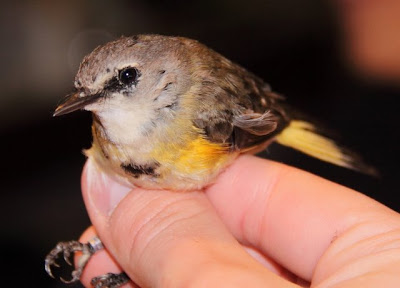

American Redstart, young maleSome birds don't look like what you're used to seeing flitting about in the trees,
like this young male American Redstart. Yellow where he will eventually be
orange (like a female), but the black lores (area between the eye and the bill) and
the black feathers coming in on his breast, face and cheek confirm he's a male.

Not all the captured species have been absent from our New York backyard since last fall, plenty of year-round residents are caught in the nets. Of course, they're processed, too: collecting data on our common birds is in lockstep with the goal of keeping them common.

Blue JayBlue Jays, though familiar in western New York year-
round, do migrate. This bird may be returning from a
mid-Atlantic state where the winters are more moderate.


Green DarnerNot all the captures are avian, either. Dragonflies, such as this common
Green Darner, are gently removed and released when caught.

In the 90 minutes or so we stayed we saw some two dozen birds pass through the capable hands of the BBBO staff, volunteers, and the students, each released adorned with a flashy silver band stamped with a unique identifying code by the Fish and Wildlife Service. If any of these birds are captured again they'll provide an important piece of information about that bird's travels and condition, shedding insight on the species as a whole and migration in general.

Through it all Reina helped release a few birds, as well as followed the banders as they checked the nets for newly caught birds (nets are checked every 30 minutes, at least). Actually, she only followed during the first net run. She lead the way on the subsequent trips.

Now ask her what she wants to be when she's grown and you'll hear, "I want to band birds, be a waitress, and teach." The requisite crack still applies, you're going to need the combined salaries to make ends meet. At least she'll be well rounded.

-

Monday, July 6, 2009

A Hummingbird's Heartbeat

Sometimes words aren't needed, they just distract.

Reina and Ruby-throated Hummingbird
Tune in tomorrow to get the backstory.

-

Sunday, July 5, 2009

Typical Songbird Photograph: Identity Revealed

The Hawthorn Orchard, where I took that poor-quality photograph in last week's teaser post, is a remarkable patch during spring migration. Hawthorn flowers bring in the insects, which bring in the migrating birds. And in mid-late May there are a lot of flowering Hawthorns, a lot of insects, and therefore a lot of songbirds. Most hawthorns in the orchard are less than 30 feet tall, many only 15 - 20 feet high. The best way to avoid "warbler neck"? Don't look up, look horizontal! This is where you go for paralyzing looks at warblers that are often difficult to lay glass on - Bay-breasted, Blackburnian, Wilson's, Tennessee, and many, many more.

Luckily, the photo I presented was the last in the series. While trolling through the shrubby Hawthorns I successfully tracked down a lively weeta-weeta-weetsee.


The singer was a very handsome male Magnolia Warbler, a species Alexander Wilson originally called "Black-and-Yellow Warbler" when he collected one from a Magnolia tree in 1810. That was unfortunate, and not just for the individual he shot: he selected "magnolia" as the scientific name, Dendroica magnolia. Unfortunately, magnolia trees are not a big part of this species life history. These birds like dense, young growth; nests are usually in a conifer.

No matter, a rose by any other name still looks stunning. I had a reasonable amount of time to witness him flitting among the branches of a Hawthorn, maybe 20 feet from me. Eventually I had the presence of mind to drop the binoculars and raise the camera, capturing some foraging behavior.

Classic Magnolia Warbler foraging, scanning and probing the
undersides of leaves from below. Note the undertail pattern, as the
white patch towards the body and wide, dark band across the tips
are a very useful diagnostic feature for identifying tail-only birds.


Magnolia Warblers, or "Maggies" if you're in the hip birding crowd (a group who must all have Rod Stewart's "Maggie May" running through their head whenever someone finds one), feed primarily on caterpillars and a variety of other tree-dwelling organisms: leaf beetles, weevils, leafhoppers, spiders. This one thoroughly scanned the leaves, striking at unseen (to me) items. While they typically focus on the undersides of leaves and conifer needles, this one was checking every surface. Sometimes twice.

Any morning where you stumble across a beauty like this is an unequivocal successful trip. Enjoy this sequence of Maggie foraging - he was trying every leaf, bud, nook, and cranny. As always, click on the images for larger versions.

"Hullo, what's this?"


"Ah, yes, this looks promising indeed."


Smacks mandibles, munch, munch


"Blechh! Oooh, what's up here?"

This went on for a few minutes, until I got the parting shot. Now do you see a Maggie?

There is a bird in there, promise.
Click on the image for a larger version.


-
Locations of visitors to this page