From the photo files from 17 July 2009 . . .
I complain, quite a bit, that I don't get out enough to look at birds, that all my birding is "yard watching." Which is ridiculous! I mean, I work at a
world-class ornithological institution that sits in a
220+ acre wildlife sanctuary. You'd think it would be as easy as walking outside.
Well, it is. But I often get wrapped up enough, or fall far behind enough, in work-related "things" and the end of the day arrives before I've made it outside. So much for my time management skills, such that they exist.
Last Friday my camera and my binoculars found their way into my peripheral vision during my working lunch. I didn't hesitate. I grabbed my camera, left my binoculars, and embarked on a brief photo safari.
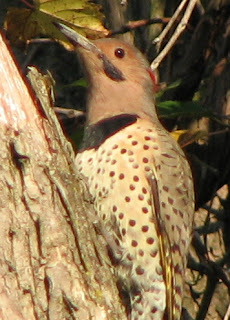
 Yellow-bellied Sapsucker, totem bird of Sapsucker Woods.
The first bird I stumbled across as I entered the woods was the sanctuary's namesake. In the most recent
Living Bird John Fitzpatrick writes that exactly one hundred years ago, when
Yellow-bellied Sapsuckers were "unheard of in the wide-open, glaciated farmlands around the Finger Lakes," Arthur Allen and Louis Agassiz Fuertes discovered a pair nesting in an isolated woodlot a few miles from Cornell University. Fitz continues, "this was a prize find, because this migratory woodpecker bred mainly in the aspen and birch forests of Canada. This was the first documented breeding in New York's southern tier."
Today, they are common. So common, in fact, the single bird was almost immediately joined by another.

Not as cryptic as a Brown Creeper, but their mottled back
and barred tail camouflage them against the tree trunk.
OK, it's not like the woods are swarming with sapsuckers on every tree. I'd crossed paths with two juvenile birds, likely siblings from the same nest cavity. Though they showed the classic marks you'd expect from a YB Sapsucker -- the face pattern, the white wing patch, the overall mottling - these birds wore more subdued plumage. They were overall darker, brownish rather than black in the facial markings. Also missing were patches of red on the throat and cap, sported by adult males, or solely on the cap (at least to some extent) as an adult female would show. The first bird did have reddish tinging on both the cap and throat, indicating he was a juvenile male. I didn't note any such tinging on the second bird, perhaps a female.
They were moving quickly, the blurriness in my photos wasn't only from hand-shake, and soon left me far behind. I watched as they scrambled around one tree trunk, flew awkwardly to another, scrambled again, fluttered to yet another trunk, then another.
No time to dwell on them, I was already faced with my next bird, one perched not too far off the trail. It sat with its back to me but head craned to the side to watch what I was doing. It was agitated, turning right, then left, then right again, in rapid succession. It was so agitated it bounced, as though it was launching itself into flight but forgetting to release its grip on the branch.
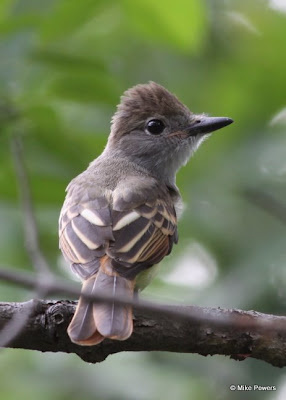
One of my favorites, a
Great Crested Flycatcher, and this one appeared to also be a juvenile. I say that based on the broad edging to the primaries and the greater and median wing coverts (your thoughtful analysis welcomed!). What convinced me it was a recent fledgling, later when I blew up the images, was the gape, clearly visible at the back of the mouth, something that young birds show but isn't visible on adults.
Somewhere nearby was a parental flycatcher, which made its presence known through near-constant
wheee-eep calls, a sign of excitement. I wondered if the fledgling in front of me was agitated because of me, or if it was feeding off the parent's intruder warning, the avian "Danger, Will Robinson, danger!"
The bird appeared torn between wanting to flee and wanting to stay its ground. Eventually it successfully launched itself deeper into the woods where I lost sight of it; abruptly the parent's panicked calls stopped.
Young ones. That's what July birding is all about here in the southern tier of NY. A brief period where we can watch fledglings explore their new world, with or without their care givers. I started humming the theme song of
The Young Ones, a British comedy from the early '80's. While I doubt lyricist Cliff Richard was thinking of birds (but who knows, I'm starting to think everyone in England is a birder to some extent), his lyrics were appropros.
We're young ones,
Darling we're the young ones,
And young ones shouldnt be afraid.
Love, me,
Theres a song to be sung
And the best time is to sing while were young.
To live, love
While the flame is strong,
For we wont be the young ones very long.
Very birdy, yes? Enjoy your summer birding!
UPDATED to announce: if you're interested in nestlings, four to be exact, the
trip continues here.
-
 An adult Great Blue stalking along the pond's edge.
 On Tuesday all four, appearing fairly comfortable in their now-tight-fitting nest.
 Recently the young ones have spent time spreading out among the snag's branches.
 More and more they exercised their wings, readying for that first flight.