Tuesday, April 21, 2009

Earth Day Activity: Get Out and Listen

A recent post title from Cool Green Science, the conservation blog from the Nature Conservancy, caught my eye: Earth Day Idea: Get Out and Listen!

Here's an excerpt:

Here’s my idea for how to celebrate Earth Day: get up (early if possible), grab your coffee or other beverage of choice, go outside, sit in your comfy outdoor chair, close your eyes and listen!

The idea is to listen to the sounds of the Earth. And, since I’m a bird guy, I recommend you listen to the voices of the birds wherever you are.

What a great idea, I love the simplicity. Step outside, settle down for a few minutes of deep listening, and tune in. For the majority of us it won't all be pristine. From our yard I'll certainly be hearing some early morning traffic, an airplane gunning its engines in a pre-flight check, and our obnoxiously loud aerated-septic system.

But through it all, or above it all, the American Robins will be cheery-uping from all directions, Eastern Phoebes will be calling back and forth, Pine Siskins, American Goldfinches, and Purple Finches will be clamoring from the evergreens. The sad cooing from the Mourning Doves, the punctuated calls from the American Crows and Blue Jays, the whistled "see-saws" from the Black-capped Chickadees, all of them will make up the natural symphony of our yard. And who knows which recently arrived migrants will be joining them.

I can't imagine a better way to start Earth Day, I know I'll be inspired to carry that vibe throughout the day, throughout the year.

Read Dave's full post here, and let me know: what will you be hearing from your yard?

-

Monday, April 20, 2009

Storms Trump Migration

Here in the northeastern U.S. we've had a dreary day. Gray skies, rain, wind, more rain. Unfortunately, that means less in the way of migration, probably both on the inbound and outbound migrants. The radar map at 10:30 PM EDT shows intermittent rain across our region, but to our south: whoa, look out! Lots of birds hitting the air from northern Florida across to Texas . . . and beyond.

Hopefully this gets the neotrops closer to our area, but it looks like it won't be tomorrow.

Which is fine, I still have a few birds that are around but I haven't found yet. You've been warned, Hermit Thrush, Ruby-crowned Kinglet, and Yellow-rumped Warbler. I'm after you . . . .

-

The Trickle Continues

Most of Spencer Crest Nature Center's property is wooded, but it's that time of year where sunscreen would have been appropriate for a walk in those woods. It got warm quick, enough so I had stripped down to short-sleeves for most of my walk. That may sound quaint to more-southerly readers but around here it's a "first of the year."

That said, back to my point. In my previous post I mentioned woodpeckers were hammering on nearly every tree, the most numerous was the Yellow-bellied Sapsucker. I readily and happily admit they are my favorite woodpecker - the one I'm most confident in identifying by their unique drumming pattern. They have that slow, uncertain tapping that peters out at the end, exactly like they've run out of energy. "Whew," I imagine they say, "I'm winded."

Yellow-bellied SapsuckerOne of many male Yellow-bellied Sapsucker hammering
on his tree. Each drum garnered a handful of responses -
either auditory or, in some cases, a physical encounter.


Sapsuckers, the only completely migratory woodpecker in the east, are back in force. They were drumming from every direction, vocalizing quite often, several times ending in chases involving both males and females. Exciting to watch, but I'm not sure the birds were enjoying themselves. While that bout of drumming clearly has a pay off, at this point in the season it seemed to attract the physical presence of another sapsucker that chased it away.

Tree trunks that weren't claimed by a woodpecker were used by other species. Can you find the bird in this photograph?
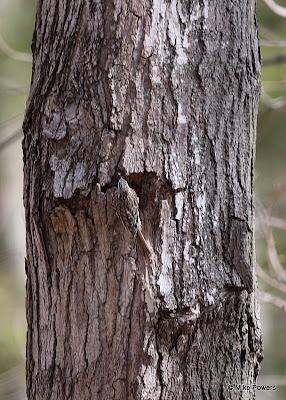
Camouflaged BirdI promise you there is a bird in this picture.
Click the image for a larger version.


If you're not seeing the bird against the tree trunk, here's a clue to give you a search image:

Brown CreeperA Brown Creeper, one of many encountered on my walk,
searches for insects while working its way up a trunk.


Brown Creepers called, they sang, from all corners of the forest. I spotted them over and over as they flew from the higher reaches of one tree to the base of the next, then probed for insects as they spiraled their way towards the uppermost branches. For the record, a flushed creeper has never nearly killed me, something I can't say for the equally cryptic woodcock, snipe, or grouse. I can handle a small bird flying a dozen feet (or more) away, a game bird flushing from underfoot is truly heart-stopping. On this trip I only heard Ruffed Grouse booming from a good distance away, and two of them at that. This was one of the very few times I've encountered them at Spencer Crest.

While I was photographing the sapsuckers and creepers I noticed there was only one other species in the immediate area, a pair of White-breasted Nuthatches. They repeatedly visited the backside of a thin tree, I assumed there was a cavity on the other side. I checked but didn't find anything obvious. They appeared agitated so I quietly moved away, shooting a few images as I left. It wasn't until I reviewed the photos I noticed the male was carrying a berry of some sort. Too early for chicks, but I do wonder what type of berry it is.

White-breasted NuthatchWhite-breasted Nuthatch carrying food . . . but to whom?

Here's the full list from my trip, my counts are very conservative. I'll post the results of next weekend's trip, who knows what new migrants will arrive between now and then.

Location: Spencer Crest
Observation date: 4/18/09
Notes: Surprised no Hermit Thrush, RC Kinglet, YR Warbler . . . conditions: 66*F, 40% cloud cover, light breeze, 0 precipitation.
Number of species: 33

Canada Goose 4
Mallard 2
Ruffed Grouse 2
Broad-winged Hawk 1
Mourning Dove 2
Red-bellied Woodpecker 1
Yellow-bellied Sapsucker 6
Downy Woodpecker 5
Northern Flicker 1
Pileated Woodpecker 2
Eastern Phoebe 4
Blue Jay 6
American Crow 1
Tree Swallow 11
Black-capped Chickadee 12
Tufted Titmouse 4
White-breasted Nuthatch 6
Brown Creeper 7
Eastern Bluebird 2
American Robin 8
European Starling 2
Cedar Waxwing 4
Eastern Towhee 3
Fox Sparrow 1
Song Sparrow 14
Dark-eyed Junco (Slate-colored) 8
Northern Cardinal 4
Red-winged Blackbird 14
Common Grackle 10
Brown-headed Cowbird 10
House Finch 2
Pine Siskin 1
American Goldfinch 4

This report was generated automatically by eBird v2 (http://ebird.org)

-

Sunday, April 19, 2009

They're Trickling In

I did a little research this weekend. Not of the professional type, the kind I spend my weekdays focused on. This research was for a bird walk I'm leading next weekend.

I was asked to lead the bird walk for the annual conference of biology professors from two-year colleges, hosted this year at nearby Corning Community College. Coincidentally, my wife is a biology professor there . . . nepotism at its best! That, and they know I work cheap.

As the radar indicated on Friday night, and as Kenn Kaufman predicted for his corner of Ohio, short-distance migrants that winter in the southern U.S. would continue to arrive, but don't expect an influx of neotropical birds just yet.

Song SparrowSong Sparrow numbers swelled, so much so
that they tied for most abundant species.


Right on target: there were some new arrivals to the party, and birds that showed up earlier in the week were more numerous. Obnoxiously numerous, in some cases. There were a couple of species that I heard no matter where I stood (yeah, I said it, Song Sparrow).

Red-winged Blackbird, maleMale Red-winged Blackbirds have been back for a
few weeks but they're still proclaiming territory.


Red-winged Blackbird, femaleFemale Red-winged Blackbirds are a new arrival. Now the males aren't
just staking their turf, they're interested in catching the eye of the fairer sex.


All told, I spent nearly two hours trolling around Spencer Crest Nature Center, my old stomping grounds. Barron and I used to spend many weekend hours, and the occasional weekday morning, peering into every corner of the 220-plus acre property. But when we moved 30 minutes away I adopted a closer location -- our yard - so I haven't been back for any serious birding in a while. It was like revisiting the neighborhood where you grew up, everything looks mostly the same. In those cases you don't recognize any of the people, but happily I recognized all of the residents and spring visitors.

Eastern TowheeMy first Eastern Towhee of the year, one of several that
shouted, "Drink Your Tea" as I passed through scrubby fields.


I tallied 33 species over my mile and half walk which, like any good birding trip, crossed a variety of habitats. I meandered through old fields, upland deciduous forests, wetlands, the open water of Amelia's Pond, my
expectations shifting as I crossed from one to the other. Common Yellowthroat and Field Sparrows not yet in the old field, but Song Sparrows everywhere. Woodpeckers seemed to drum from every tree in the woods, but no tanagers or warblers, not yet. I didn't find a Hairy Woodpecker, but found all other expected species: Red-bellied, Downy, Pileated, Northern Flicker, and Yellow-bellied Sapsucker.

Edges, as they always are, were productive. Between the old field and the woods I came across a song that rang familiar but unidentified. It sounded like a finch (House? Purple?) but not quite. Too sparrow like.

Eastern Fox Sparrow, Red formThe "red," or eastern, form of the Fox Sparrow. These birds
always come across as a thrush x sparrow hybrid to me.


A-ha! Fox Sparrows are passing through our region now, and one was singing up a storm.

Eastern Fox Sparrow, Red FormStrike a pose: Fox Sparrows are such cool looking birds, here's a second shot.

There were a couple additional interesting sightings, more from the trip tomorrow.

-

Friday, April 17, 2009

Migration: Yes and No

Radar is showing birds are moving across the eastern U.S. tonight, as of 11:45 EDT, but you wouldn't know it standing outside our place. All I hear is Tupac. Or Notorious B.I.G. Or Snoop Dog . . . ah, hell, I can't tell my west side from my east side.

We've got mild temperatures, no real breeze to speak of, clear skies, and not a prayer of hearing a flight call.

Continental base reflectivity shows a good movement
occurring from the Mississippi River east to the Atlantic coast.

Kenn Kaufman articulates what I think we'll wind up with here in the Southern Tier of NY this weekend: the departure of some of our wintering birds, such as Dark-eyed Juncos, and an influx of short-distance migrants. We're still a couple weeks from neotropical birds dripping from the trees, but hopefully this weekend we'll see newly-arrived sparrows, Hermit Thrushes, Yellow-rumped Warblers and the like.

I find this image interesting:

Base velocity from Binghamton, NY, 11:45 PM EDT.

This is base velocity, not reflectivity, meaning it shows movement rather than mass. The orange-red-yellows are moving away from the radar station, the blue-greens are moving towards it. The gray is essentially neutral, so if you follow the gray area you create a line perpendicular to the movement.

Another way of saying that: draw an arrow from the blue-greens pointing towards the red-oranges, that's the direction the birds are moving.

This image shows the movement primarily to the east, slightly northeast, not the due north you'd expect. They are called northbound migrants, not eastbound, after all. But take into account winds, which have been coming out of the west and northwest all day, likely affecting the direction the birds move.

Tomorrow should hold some new birds, assuming my neighbors crash sometime before dawn. Or at least turn off the stereo.

-

Young Birders Event at the Cornell Lab

This just in . . .

The Cornell Lab of Ornithology is excited to host The Cornell Lab Young Birders Event, which will be held August 6-9, 2009 in Ithaca, New York. The Young Birders Event aims to bring together teenagers with a passion for birds who are interested in pursing a career with birds. The young birders will meet people who have successful careers that involve birds in a variety of ways from ornithological researchers to tour leaders, to audio specialists and computer scientists. High school aged young birders are invited to fill out our application form and return it for review by May 10th 2009. Ten young birders will be selected and notified in mid-May. Please share this information with any young birders you know!

The Young Birder’s Event will feature:
  • two days of field trips
  • presentations by Cornell Lab of Ornithology staff including professors, researchers, and students who will share various ways to incorporate birds into a career
  • eBird and field notes workshop
  • specimen preparation workshop
  • sound recording workshop
  • tour of CLO including the Macaulay Library and Museum of Vertebrates
  • dinner with CLO Directors and Staff
Details are on the eBird News page. It's a great opportunity, if you're not a young birder, please pass it along to any you may know!

-

Thursday, April 16, 2009

Major Migration

Looks like there is a widespread movement of birds across the eastern US tonight, as of 9:50 EDT. The storm system stretching from the Texas panhandle to southwestern South Dakota appears to be suppressing movements in the midwestern corridor that has been so active the last few nights. The high pressure system centered over the Great Lakes should mean settled, calm weather in the northeast, in this case extending down to the Gulf coast.

Current winds in the Southern Tier of NY have been out of the north, but have been virtually non-existent over the past couple of hours. Current base velocity maps, which show direction of movement, from south of us (State College, PA) and east (Binghamton, NY) show birds are heading in a northeasterly direction.

All in all, in our region it's a good night to migrate, new birds should be ushered into our area tomorrow. I didn't make it out this morning (poor time management skills hindered that), but tomorrow is more likely.

What's going on in your area?

-
Locations of visitors to this page