Thursday, November 29, 2007

Here, There, and Everywhere

In my last post I hinted, probably too covertly, how irruptions of different species affect observers. Irruptions set off "mad-keen" birders in a tingling frenzy: "What denizens of the north can I get on my state/county/yard/year/office list?" An irruption year may very well cause the casual bird watcher to stare a little longer at the birds visiting their feeder and wonder, "What is that species? I'm pretty sure I've never seen it before."

A Purple Finch visits our feeder in the Southern Tier of NY. They're
predicted to irrupt this year, so where else are they being reported?


But, more subtly, and arguably more interesting, instead of a more diverse crowd, the same observers might notice more individuals of a certain species around the feeder, or count more individuals than usual on their standard birding trips. If nothing else, the local listserve is inundated with reports, "I've got a Red-breasted Nuthatch (or Evening Grosbeak, or Pine Siskin, or Pine Grosbeak or . . . )!", which is met with a slew of replies, "Me too!"

A Red-breasted Nuthatch picks at a pine cone on
Chincoteague Island during Thanksgiving week, 2007. Were
they really more numerous this fall than in other years?


This experience was re-affirmed for me last week. I've spent a fair number of Thanksgivings in Chincoteague, VA, over the past 15 years. In addition to the normal Thanksgiving benefits (spending time with family, good food), these trips have the added incentive: coastal and southeastern birds! As a result, I have pretty good records of the species I've observed on those vacations (though we do quite a bit of birding, like most birders, I'm aware of and mentally recording what's around even when not formally birding).

There were several noteworthy events on this trip, and the first one I noticed: Red-breasted Nuthatches. They were everywhere, and they were there in numbers. You couldn't step outside without hearing one, usually several. In an unprecedented move, I've entered all of my checklists into eBird already, and nearly all of them included "RBNU" (bander shorthand for Red-breasted Nuthatch).

Red-breasted Nuthatches really were everywhere, even
scouring fallen pine needles on the road. Admittedly a crappy
photo, but it might be the fastest photo I've ever taken.


That begs the question, "are there really more this year than in others? Or am I not remembering things accurately?" Based on a few eBird queries, there were more. In some years I didn't record them at all, in others I recorded one, maybe two. This year, I recorded at least three on each checklist, my high count was 15. And I consider myself conservative when recording numbers.

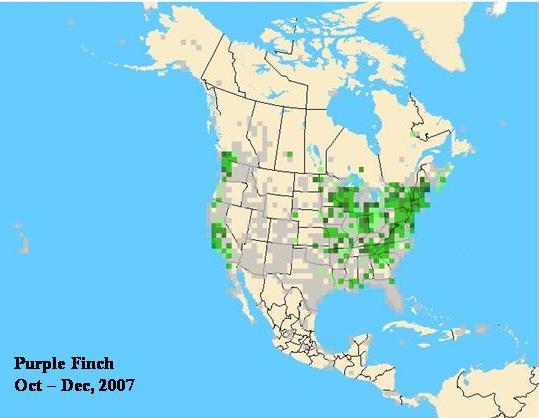
I decided to look at the bigger picture: where are they being reported, and where were they reported during the same time frame last year? Below are a few eBird maps showing the comparative distributions. To interpret them you need to know that green areas are positive reports, the darker the green the higher the number of reports that include the species (in this case, RBNU). Light gray are checklists without any RBNU reported, the ligther areas (off-white?) are areas with no checklists reported at all. That said, check this out:


This map shows where RBNU were recorded a year ago, between October and December, 2006. Note the concentrations along the northern border of the US (or the southern border of Canada, for any Canadians reading), with some scattered reports in the southeast (south of PA), some birds in the highlands of NM and southeastern AZ.

Now check out where RBNU are being reported this year, same time frame (Oct - Dec, and we're not even into December yet!).


At the very least, notice how widespread the green areas are and how much darker they are. Clearly, many more reports from across the southeast, more birds reported in these areas, including NM and AZ. Hardly any were reported across VA, NC, SC and GA in 2006; this year, lots, especially in the higher elevations in the Appalachians. In 2006, none reported south of AR; this year, down to the gulf coast. Jeez, there's even a report halfway down the Baja peninsula in Mexico!

So, increased numbers at Chincoteague was definitely not my imagination. But this irruption would be lost on me here in NY: we still have a few coming to our feeders, just like last year, and the year before, and the year before that.

Same with Purple Finch, or "PUFI" to the bird banders. We still have a couple, but they were predicted to irrupt this year, too. They're not absent from our place, so to see what's going on in near-real time I compared reports of Purple Finches from late fall last year with what's being reported to eBird this year.

2006 saw PUFIs stretching down into FL and the gulf states, highest concentrations in the northeast, the Great Lakes region, and along the west coast. Again, note the relative scarcity of reports (lots of gray between individual green blocks), and the lightness of much of the green.

And this year?

It appears there are more green-shaded areas from the central states to the east coast, and much of the green is darker than last year. The west coast may be bucking that trend: hard to tell, but perhaps there are less reports and fewer birds than last year. It'll take more data mining to really get a handle on what's going on.

Obviously, this is only a thumbnail sketch, and very preliminary, as to what's going on, but it's exciting these kinds of movements can be explored so quickly. There's clearly a trend, it'll be a bit longer to properly examine the data and make more scientifically-appropriate comparisons, but for general interest (and/or birding) purposes, this is a very cool first glance at this season's excitement.

Now, I wonder what redpolls, shrikes, grosbeaks and other species are showing? Back to eBirding! (Well, first some birding, then some eBirding when it's too dark to see . . . .)

Post title credit: Here, There, and Everywhere (1966), The Beatles.

Monday, November 26, 2007

One and One and One is Three

Got to be good lookin' 'cause he's so hard to see.

OK, OK, I'm no John Lennon. Maybe a Julian, or Sean? Not a Yoko! C'mon! I get the message: less singing, more birdwatching.

Redpolls certainly are nice looking birds, a splashy combination of red, black, white, and yellow. And once they find your feeders, they're not hard to see. To me, they mean winter has arrived (in years when they aren't irrupting, well, it's just never really winter).

We were away for a few days over Thanksgiving, so we stocked the feeders and hoped any "new" birds would stick around to be appropriately recorded once we returned. And it actually worked: among the first birds seen following our return were Common Redpolls!

The first redpoll perches near the tube feeders, apparently
deciding whether to approach and find out what's inside.


A second redpoll eyes the suet, but eventually
opts out, favoring the thistle feeder.

A third redpoll is attracted to the seeds underneath the tube feeders.


Ultimately, they found their way to the source, with some
additional individuals: our high count was seven.


Not only did one and one and one eventually make seven, not three, Common Redpoll is the third winter finch species that found our feeders this season. First, the female Evening Grosbeak that showed up, then the Pine Siskins that settled down for a few days, and now this small group of Common Redpolls.

We have hosted a few other winter species of interest, the most atypical was the Northern Shrike that appeared the same day as the first (non-feeder) siskin. We also have Purple Finches continuing at our feeder, but these aren't as noteworthy as they are typically around. Ditto for the Red-breasted Nuthatches.

That's not to say the Purple Finches and Red-breasteds aren't interesting, they are making their own waves this season. During Thanksgiving in Chincoteague, VA, I found more Red-breasteds this year than any other my near-annual visits there. Even to the most casual observer there are clearly more around this year than in other years. And though I didn't find any in Virginia, Purple Finches are being reported in larger numbers and more frequently in southern areas than usual. More on these two birds in an upcoming post.

All in all, it's already been a very fun year for feederwatching, and we've only had the feeders up for a month! Can't wait to see how the rest of the season plays out; dare I wish for either species of crossbill in our grove of conifers? A visit from a Bohemian Waxwing on the berry bushes or Pine Grosbeaks on the crab apples? A Hoary Redpoll blending in with the Common Redpolls feeding on the birches, or under the feeder? Or some as-of-yet-unnamed rarity?

Or just "the usual suspects"?

The suspense is killing me!

Post title credit: Come Together (1969), The Beatles.

Sunday, November 25, 2007

It's Good to be Back

Ah, the best laid plans. For Thanksgiving week I traveled to Chincoteague, VA (gateway to Chincoteague National Wildlife Refuge) with every intent of birding a lot and blogging about it each night. I prepared our lap top so I could download images daily and nightly, I remember being able to tap into a nearby wireless network, so what could go wrong?

A relatively small gathering of Snow Goose
pose in front of the Assateague Lighthouse.


Easy! Leave your damn external wireless card about 440 miles away so you can't access the aforementioned wireless network.


A typical sight for this part of the coast: pine and Sweetgum.

Nonetheless, I did bird a lot, I took lots of pictures. Chincoteague is one of my favorite birding destinations and I am stoked to finally write about it. So, after a couple of catch-up posts on what's been going around the homestead in New York (hint: winter finches keep on coming!), I'll recap the trip.

Northern Mockingbird guarding a winter food source. (Though the
mockingbird should be, they are not the state bird of Virginia!)


Hope you all (yeah, I said "all": I'm assuming someone other than my mom reads this . . . ) had a wonderful Thanksgiving!

Flowers blooming in late November? Well, it was on the beach.

Post title credit: Hello! Hello! I'm Back Again (1973), Gary Glitter.

Friday, November 16, 2007

(Don't) Come to My Window

As many homeowners know, especially those with bird feeders near a room with a view, birds colliding with windows is rarely a good thing. There are the lucky birds that are merely stunned and eventually recover, but a majority of birds don't survive the strike. A perpetual question in the bird feeding world is what we can do about it.

A mid-September victim of a window kill in Rochester, NY.
I'll leave it to the readers to provide the bird's identity.
A second image appears below.


Moving your feeders, if you feed, is a good start, but it's not uncommon for a bird that was just passing through to hit a window that was mistaken for open sky. And forget about a panicked bird trying to escape an Accipter. In the split second they have to decide, they'll blindly go wherever looks promising at first glance, whether it's truly what they perceive, or merely a reflection.

Netting pulled taught over a windows bounces the bird (relatively) harmlessly, the impact isn't fatal. Many homeowners, however, don't want this unsightly blemish on their house.

How is this for a blemish? Imagine this
as a daily scene under your windows!


David Sibley, author of one of the most popular field guides to birds, decided to try do something about the birds attracted to his feeders that were also attracted to his windows. And not only is it very clever (ingenious, we'll wait and see), but the great part is David is blogging about the experiment as it continues. Rather than wait for the peer-reviewed finished product, we can not only learn how well it's working for his family, but he invites you to try it, too, and share your results.

A July window strike at our place in the Southern Tier. We don't feed in
the summer, and this is not a feeder bird. Additionally, the window it hit
was on the opposite side of the house from the feeding station.


Another view - any guesses as to the identity?

Last year we added not-too-obvious (to us) stickers to the windows overlooking the feeders. They are designed to break up the reflection of field, forest, and sky, driving home the point that this is not safe passage. Since those additions we're happily not hearing the heart-dropping "thumps that used to be a regular part of winter. Maybe David's idea will be the easier, less visually intrusive, and best of all, the most successful method yet.

Post title apologies: Come to my Window (1994), Melissa Etheridge.

Monday, November 12, 2007

Come On A My House

Here is a draft of an ad I'm wondering where to post:

House for Rent
Available for immediate inhabitation: several residences in an up-and-coming, safe, and spacious neighborhood. Many amenities available nearby, including a variety of food and plentiful water sources. Residences are newly constructed and ideally situated for young couples interested in starting a family. Landlords will respect your right to privacy; infrequent but periodic visits will be clearly announced before peeking in to see how things are going. No mammals need apply.

The newest addition to our rental properties.
We're hoping for a Wood Duck or Hooded Merganser.


Where do you advertise to attract the avian community?

When we first moved in I put up one large box on an existing pole that held a Purple Martin house, knowing there was no chance martins would even look at our location (not near enough open space). I took down the house and swapped it for a box suitable for a Wood Duck (or screech-owl, maybe a saw-whet owl or Great Crested Flycatcher). It wasn't to be: a squirrel got there first, and I haven't been up there to clear them out yet.

We then put up a half-dozen bluebird-sized boxes. Early on I imagined we get Tree Swallows because of the pond, possibly bluebirds because they do nest on our hill, but the habitat just isn't right for either, apparently we have to many trees. Mice took the boxes in the woods (I was hoping for nuthatches or titmice), but chickadees and House Wrens use the boxes along the edges. Happily, I can report that the nest boxes we placed in earlier years have not been overtaken by exotic species: although we do see the occasional starling or House Sparrow, they don't really bother our feeder nor take up residence in our nest boxes.

This past weekend we took advantage of the warm weather (not to mention the low water level in the pond) and put up a similar box over the water - no squirrels this time! Here is the play-by-play:


I swear I'm not throwing the ladder in the pond!

Though why am I holding it over my head? If I suddenly plunge over my head, am I really scared the ladder might get wet?

Lining up the site with the ecliptic,
the outdoor equivalent to feng shui.


Actually, I have no idea what I'm doing. I'm starting to wonder if this was even me. And I think I voided the warranty on the ladder by setting it up in the pond.

Hammering the post, without falling in. That went well,
except when I dropped the hammer. The water is cold!

Don't let the fact that I'm hammering a post through water fool you: it took half a million strikes (at least, that's what my shoulder felt like) and three different locations. Rockiest damn water I've ever waded in!

Home sweet home.

Idyllic placement (we hope): a currently-shallow cove, protected from wind and predators, and us. We don't actually use the dock much, and we're hoping the pond starts to fill back in. Although, based on what's going on in the southeastern states, we're happy we still have something liquidy left in there.

Post title credit: Come On a My House (Live), Ayaka Hirahara.

Sunday, November 11, 2007

Watching and Waiting

Last week my 3-and-a-half-ish daughter blurted, out of the blue, "When do we count birds again?"

One of the first sightings of this season's Project FeederWatch count: a Purple Finch shares the (embarrassingly empty) hopper with a Black-capped Chickadee.

Because 3-and-a-half-ish-year-olds have no concept of time (when we tell her, "Wait three minutes" she counts to three and yells, "I'm ready!"), we were lucky that Project FeederWatch started this weekend. (For more eloquent thoughts on the merits of counting birds at your feeder, check out Born Again Bird Watcher - almost everything I read on his blog I want to post here with a simple, but forceful, "What he said!" endorsement).

A male Downy Woodpecker chooses his usual suet snack.

Our count was fairly uneventful, squeezed between some normal weekend activities (laundry, house cleaning) and some rushed, end-of-the-season activities (last lawn cutting, prepping the garden and other spots for next season, cleaning the shed, mounting a nest box, and so on). No winter finches, no outstanding sparrows, no lingering migrants. What was notable: no cardinals.

Mourning Doves were a bit shy about coming to
the feeder, one settled in the nearby oak.

We always have cardinals, but they've been sparse on my yard lists for the past month or more. I'm a little behind in entering my eBird data, but my overall impression is they're not frequenting our yard like they used to. Usually at least two birds are at the feeder at dawn and dusk, plus another pair or more elsewhere in the yard, but they're not around right now. Thanks to PFW and eBird I've been tracking, and will continue to track, their coming and going, or more precisely, their presence and absence, and look for a pattern.

A White-breasted Nuthatch classically poses, watching for an
opening at the feeder. His stash of sunflower seeds is a couple of feet
above him in this oak, where the squirrels usually find them.


Already my daughter can't wait to count again next weekend, she's also hoping for a cardinal (earlier this year she pointed out to me that cardinals are my favorite).

Post title credit: Watching and Waiting (1974), The Moody Blues

Friday, November 9, 2007

I've Been Waiting So Long

We've been waiting for the winter finches to find our feeders, and only a few have made it so far. To date, the Evening Grosbeak was certainly a fall highlight. And today, our patient waiting paid off and we added one more to the fall yard list: Pine Siskin. Others have been reporting them in large flocks in our area, and they've been reported wide and far.

House Finches take over the sunflower feeder,
a lone goldfinch sits on the thistle feeder.


Back to our siskin. It wasn't at the feeder with the more-prevalent House and goldfinches. But because the feeders were covered I decided to walk the loop around the yard to see what else might be around. In addition to the stationary feeder finches, there were dozens flying overhead, not quite circling, but not quite leaving the area.

Goldfinches take over both the thistle and sunflower feeders.

The larches, or tamarack, are turning a beautiful golden yellow, which really stands out against the green spruces and firs. I have been carefully watching the conifers for crossbills, but today only a half dozen Black-capped Chickadees were foraging on the cones. I tried shooting one as it bounced around in a colorful larch. Shooting with a camera, that is, although there were plenty of deer hunters blasting away across our hill.


Birding by ear, for me, is always challenging. Because I rarely make frequent and/or lengthy birding trips anymore I guess I lack confidence in remembering all of the sounds emitted by all of the birds of North America. As a result I'm always wondering if I would identify an unseen-but-vocal bird as it flew briskly overhead. These days it's even more intimidating: over the past few weeks the local listserve is replete with definitive statements like, "I also heard three crossbills, but never saw them," or, "I heard an Evening Grosbeak somewhere in the evergreens," and, "I heard the upslurred ziiiiiip of a redpoll, it wasn't as emphatic as a siskin, and was shorter in duration." Yikes, it's been so long since I've heard redpolls, siskins, crossbills and the like with any frequency in the field, I'm not sure I'd recognize one if it shouted at me.

But then I heard a squeaky whistle, higher pitched than the dozens of goldfinches "po-tay-to" chipping overhead. And my first thought wasn't even, "Huh, that was different." I went straight to, "That was a frickin' siskin!" Sure enough, it was; not only did it sound like one, it looked like one, too.

A Pine Siskin (middle bird with the streaky sides)
perches with two goldfinches.


But that wasn't the best sighting of the morning. When we (Barron, our dog, and I) got back near the house I saw some two dozen birds perched towards the top of a leafless maple. It was easy to pick out the goldfinches and House Finches, a few American Robins, two starlings, and a lone Cedar Waxwing. And one bird I couldn't quite figure . . . clearly bigger than the finches and the waxwing, not as chunky as the robins and the starlings. Through binoculars it was still fairly nondescript, grayish but tawny coloring, hint of a black mask covering the eye, a straight, slender bill with a hook at the tip . . . a hook? That means one thing: shrike!

Immature Northern Shrike bringing our yard list to 138 species.

The field marks add up to one species: an immature Northern Shrike. Not unexpected, but certainly not common, either. Unfortunately for me, I'm not a great photographer, so this was the best I did with a backlit bird on a gray day. Better shots of a similar bird can be seen on Bill Schmoker's website.

All in all, a great, but too short, walk around the yard. Now, about those redpolls people are reporting. . . .

Post title credit: Sunshine for Your Love (1967), Cream
Locations of visitors to this page